
Livraison le jour même ou le lendemain

Qualité garantie

Débloquez vos offres de bienvenue: Livraison GRATUITE | Jusqu'à -80 % | 30 jours d'essai gratuits à JoyPlus
Téléchargez l'application
By the Joybuy Team, your high-tech shopping guide – August 26, 2026
Your phone battery is at 5%, and you have to leave in ten minutes. It's a familiar situation that often ends in a day of anxiety, hunting for any available power outlet. The market promises a simple solution: the fast charger. Yet, the purchase often leads to disappointment. Between unfulfilled power promises and risks to your devices, it's hard to know what to choose.
Before rushing to buy the first model you see, let's break down the common pitfalls that cost you time and money.
Choosing the right charger isn't a lottery. You just need to know the few criteria that truly matter.
To make an informed choice, focus on the technical specifications that really count, beyond the marketing jargon.
Power, expressed in watts (W), determines charging speed. However, total wattage isn't everything. The crucial point is to check the maximum power delivered per port.
Make sure the advertised power for a single port matches the needs of your most demanding device.
You'll often see the term "GaN charger" on recent models. Gallium nitride is a semiconductor material that replaces traditional silicon. Its practical advantages are clear:
This technology truly shines in travel chargers or high-power, multi-port models.
The era of USB-A is coming to an end. The USB-C port has become the universal standard in Europe, and for good reason. It's reversible and, most importantly, it's the key to Power Delivery (PD) technology, the most widespread fast-charging protocol.
For maximum versatility, a wall adapter with a combination of USB-C and USB-A ports can be a good transitional option. However, for a future-proof investment, prioritize models with at least one powerful USB-C port. If you have many devices, a dedicated charging station can centralize and organize your space.
Rather than searching for a one-size-fits-all charger that doesn't exist, it's better to choose a model tailored to your daily life. Here is our selection for three typical profiles.
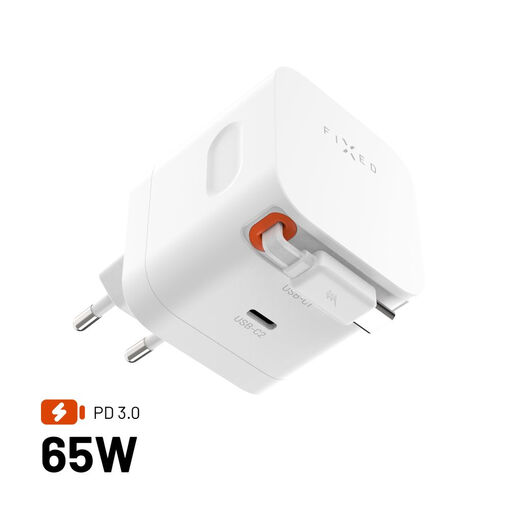
Why we chose it: Ideal for those who travel light. Its GaN technology makes it very compact, while its two USB-C ports and 65 W output allow you to charge a laptop and a smartphone simultaneously, all with a single block and no more tangled cables.
It sidesteps the shared power trap with smart distribution: it can allocate up to 65 W to one port for a computer, or split the power (e.g., 45 W + 20 W) to charge two devices efficiently. GaN technology prevents overheating, a critical feature for such a compact charger.
Its built-in retractable cable is a major asset: no more digging for a cable at the bottom of your bag, it's always ready to go.
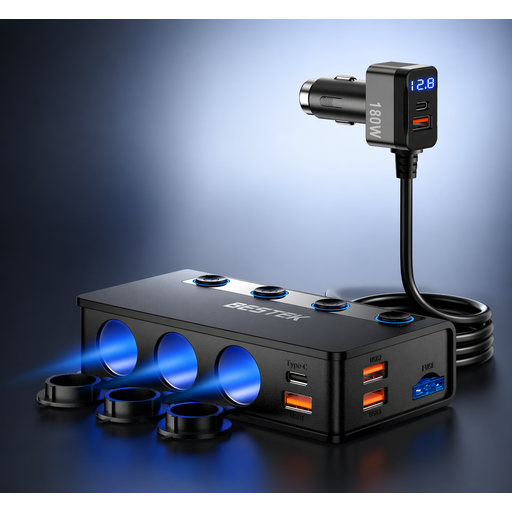
Why we chose it: For those whose car is an extension of their office or a home away from home. This distributor turns a single cigarette lighter socket into a true power hub, capable of simultaneously powering a GPS, dashcam, smartphones, and tablets for all passengers.
Unlike low-end cigarette lighter splitters, it doesn't just divide an anemic power supply. It delivers a massive total output of 180 W and includes dedicated fast-charging ports, including a 65 W USB-C PD port capable of powering a laptop at full speed.
It features 3 cigarette lighter car charger sockets and 6 USB charging ports, with independent switches for each socket to preserve the vehicle's battery.
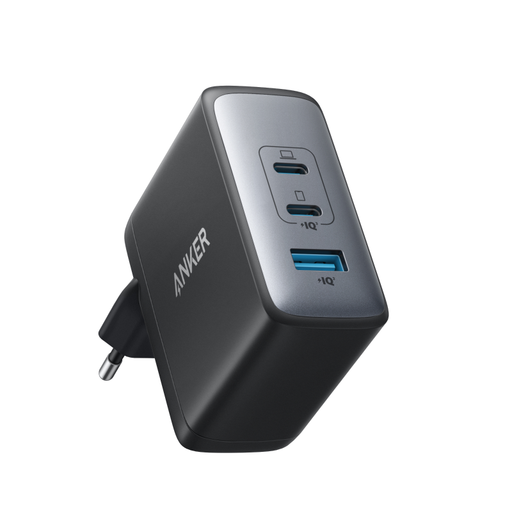
Why we chose it: Perfect for decluttering a desk or nightstand. Powerful enough to charge a demanding laptop, a tablet, and a phone at the same time, it replaces three bulky chargers with a single compact block thanks to GaN II technology.
It delivers a true 100 W on a single USB-C port, ensuring a fast charge even for the most power-hungry laptops. Smart power distribution ensures optimized charging when multiple devices are connected.
Thanks to its GaN II technology, Anker claims it's 34% smaller than an original Apple 96 W charger, while offering more power.
We've curated a complete selection of products that meet our quality criteria and European safety standards.
It's a valid concern, but the answer is no, provided you choose wisely. A quality, CE-certified fast charger is designed to be completely safe. Modern chargers and devices communicate with each other to adjust the charging speed. The charge slows down as the battery fills up to prevent overheating and preserve its longevity. The real danger comes from low-cost, uncertified chargers.
GaN technology allows for smaller, lighter chargers that generate less heat. If you're looking for a travel charger or a powerful model (65?W and up) for multiple devices, the benefits in terms of compactness and efficiency are undeniable. For a simple 20?W smartphone charger, it's not an essential criterion, but it is a mark of modern, efficient design.
Yes, absolutely. Your smartphone has a power management circuit that will only "draw" the maximum power it can safely handle. Using a 65?W laptop charger to charge an iPhone won't damage it; it will simply charge at its maximum fast-charging speed (around 20-27?W, depending on the model).