
当日/次日达

品质保障

开启新人专享福利: 全场免邮 | 低至 2 折 | 免费试用 30 天 JoyPlus 会员
下载 Joybuy
A fan or portable heater can make a bedroom, home office or small living room more comfortable, whatever the season. The trouble is, product listings can mix up power, battery life and claims about quiet operation, making it hard to compare models. Before you place an order, think about how you’ll actually use the appliance, the size of the room and the safety features it offers.
A 40 W fan won’t heat a room. It circulates the air and can help distribute cool or warm air produced by another appliance. A 2,000 W portable heater, on the other hand, uses more electricity when running at full power. This figure shows the maximum electrical power, not any kind of automatic energy saving.
In a small bedroom or home office, several power settings — for example, 900, 1,300 or 1,500 W — let you adjust energy use to suit your needs. However, the quality of the insulation, ceiling height and the room’s starting temperature all make a difference.
A rechargeable fan is handy in a bedroom, on a desk or during a power cut. However, battery life varies depending on the speed you choose. A 1,800 or 2,000 mAh battery won’t last as long at full power as it will in night mode.
Also check the connector, charging time and any precautions for the lithium battery. Some packaging may show a different capacity from the one actually stated by the manufacturer. Check the product listing to clarify this before you buy.
There’s no universal definition of a quiet fan. Instead, check the noise level given in decibels and the conditions under which it was measured. A fan advertised as producing 25 dB in night mode may not reach that level at full speed. If you’re a light sleeper, look for a night mode, a lower speed setting, a display that can be switched off and a timer.
A remote control or timer means you won’t have to get up during the night. For a desk fan, USB-C charging is often more convenient than a proprietary adapter.
A ceramic fan heater with PTC technology warms the air using an element whose resistance changes with temperature. However, this technology alone doesn’t guarantee lower energy use. That depends mainly on the power setting, how long you use it for and the thermostat setting.
Look for:
The CE and, where shown, RoHS markings provide information about the product’s stated compliance. They don’t mean you can skip reading the instructions or ignore safety clearances.
Never cover a fan heater. Keep curtains, fabrics and furniture away from the air outlet, and follow the clearance specified in the instructions. Don’t use this type of appliance in a bathroom, near a sink or in a damp environment unless the manufacturer explicitly says it’s suitable.
Always unplug the appliance before cleaning it. For a fan, dust the grilles and check that the blades and oscillation mechanism can turn freely. A washable filter must be completely dry before you put it back. An integrated air purifier may improve air circulation, but it doesn’t replace ventilating your home or changing the filters as recommended by the manufacturer.
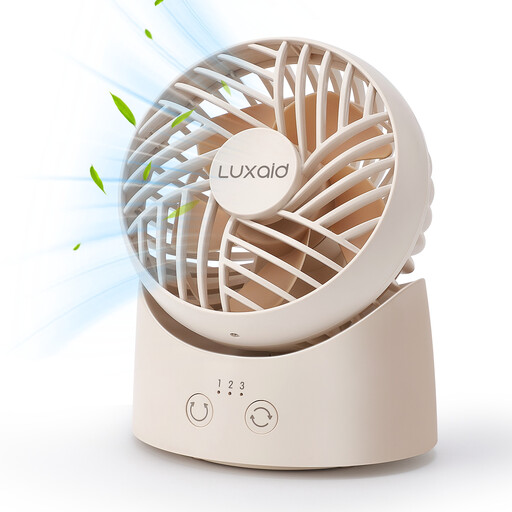
Why it suits this type of user : Its compact design fits easily on a desk or bedside table. It has Type-C charging and three speed settings.
The stated actual capacity is 1,800 mAh, despite different information on the packaging, as flagged by the manufacturer.
60° oscillation, up to 8 hours’ stated battery life and an easy-to-carry design.
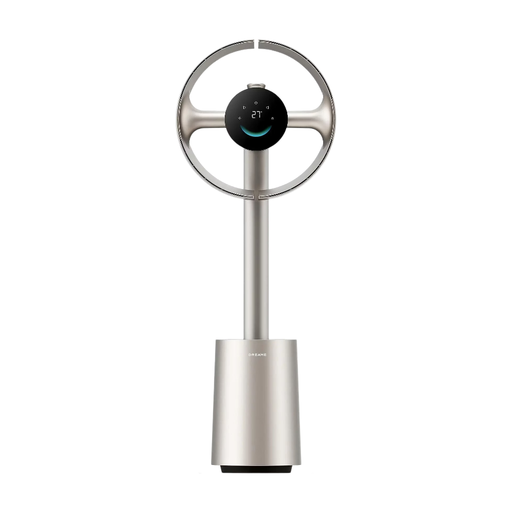
Why it suits this type of user : It’s designed for anyone looking for connected controls, wide air distribution and an appliance they can use all year round.
The listing gives details of the oscillation angles, washable filter and different control options, rather than relying on a vague promise about airflow.
Up to 180° of horizontal and 90° of vertical oscillation, Wi-Fi app control and a washable primary filter.
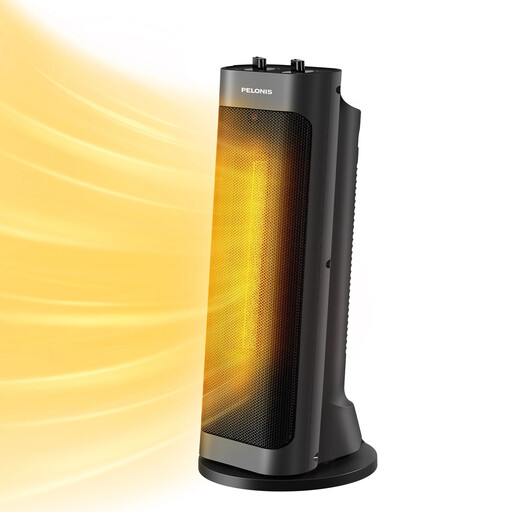
Why it suits this type of user : With a thermostat, side-to-side oscillation and safety features, it’s suited to occasional heating in a small room.
Its maximum power is complemented by several settings and an adjustable thermostat, so it doesn’t run at 2,000 W all the time.
Four stated heating modes, 70° oscillation, tip-over shut-off and overheat protection.
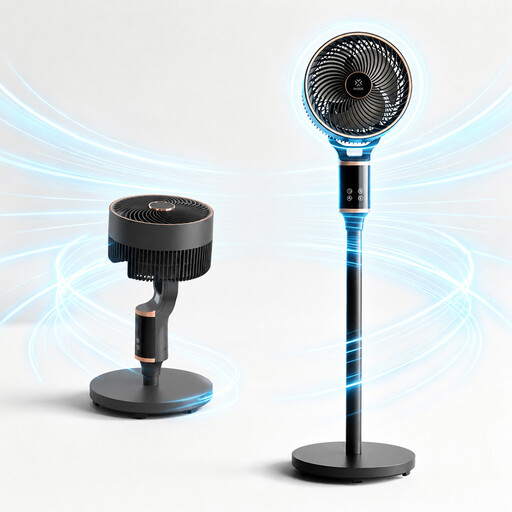
Why it suits this type of user : It converts from a pedestal fan to a desk fan, making it a versatile choice for different needs around the home.
Its stated 40 W power consumption and 12 speeds help distinguish air circulation from maximum power alone.
90° 3D oscillation on two axes, remote control, 1–12-hour timer and adjustable height from 52.5 to 102 cm.
We’ve put together a comprehensive selection, updated in real time, of products that meet these demanding criteria and European safety standards.
It all depends on its wattage and how long you use it for. A 35–40 W fan generally uses much less electricity than a 1,500 or 2,000 W fan heater. To estimate the cost, multiply the power in kilowatts by the number of hours you use it, then by the rate in your electricity tariff.
It’s best to use a timer and thermostat, and always follow the instructions. Keep the heater uncovered, on a stable surface and away from fabrics. Automatic shut-off if it tips over or overheats adds an extra layer of safety, but doesn’t replace careful positioning.
This depends on how often you use it, how much dust and moisture it is exposed to, and how well you maintain it. Unplug the appliance before cleaning it, never force the oscillation mechanism and stop using it if you notice any visible damage to the cable, plug or casing.