
Livraison le jour même ou le lendemain

Qualité garantie

Débloquez vos offres de bienvenue: Livraison GRATUITE | Jusqu'à -80 % | 30 jours d'essai gratuits à JoyPlus
Téléchargez l'application
When the temperature starts to drop, the fan heater becomes the perfect ally for quickly warming up a room. Whether for an office, bedroom, or bathroom, this electric space heater provides near-instant heat. However, the market is flooded with models making sometimes misleading claims. Between excessive power ratings and unverifiable claims of silence, it's easy to get lost and make the wrong choice.
As a product expert at Joybuy, my role is to help you navigate the options. Let's forget the marketing jargon and focus on the criteria that really matter, so you won't regret your purchase. Here are the most common pitfalls and, most importantly, how to avoid them.
Choosing a portable heater shouldn't be so complicated. Yet, certain features highlighted by manufacturers can mislead you.
To select a suitable device, focus on concrete technical specifications. Here are the three points you must check.
The power, expressed in watts (W), should be suited to the room's size. As a general rule, you need about 100W per square metre for a standard insulated room.
But for a device to truly qualify as a low-energy space heater, its power must be paired with smart features. An adjustable thermostat is essential: it switches the device off when the target temperature is reached and turns it back on if needed. The ECO mode is a real bonus: it automatically adjusts the power to maintain the temperature while limiting consumption to the bare minimum. Ceramic fan heater (PTC) technology is also a wise choice, thanks to its better thermal inertia and more even heat distribution.
Noise is a major comfort factor, especially for prolonged or nighttime use. Here are some benchmarks to interpret sound levels:
A worthy small electric heater must include several safety systems to prevent household accidents.
To illustrate how these criteria apply in practice, here are a few models that meet specific needs while avoiding the pitfalls we've mentioned.
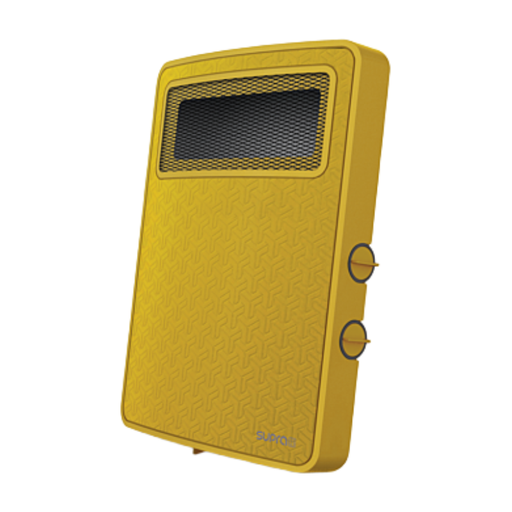
Why it stands out: Ideal for those looking for a simple and effective solution for a rapid temperature boost in a secondary room. Its compact design and carrying handle make it easy to move wherever it's needed.
This model doesn't claim to be an energy-saving champion. It offers two heat settings (1000W/2000W) and a mechanical thermostat for simple, direct control, preventing the waste of continuous operation.
Includes essential safety features (tip-over, overheat protection) and an IP21 certification, making it suitable for safe use in a bathroom (away from direct water spray zones).
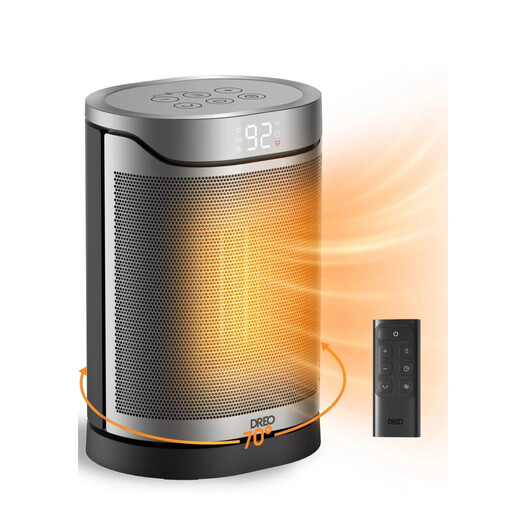
Why it stands out: Perfect for a bedroom, child's room, or office. It's designed for those who prioritise a quiet environment without sacrificing heating performance. Its precise thermostat and adjustable power modes allow for fine-tuned management of comfort and consumption.
It debunks the "silence" myth with a quantified figure: a sound level of 25 to 42 dB. It also avoids the overconsumption trap thanks to its PTC ceramic technology and precise thermostat, which optimise the use of its 1500W.
Very quiet operation and 8 safety features, including a flame-retardant casing and a patented FortPlug, for complete peace of mind, even at night.
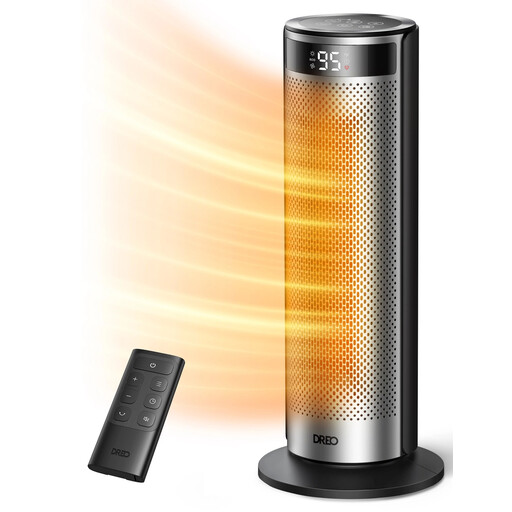
Why it stands out: Designed for living areas up to 25 m?, this tower model combines power with even heat distribution. Its 70° oscillation and large PTC heating element ensure that heat reaches every corner of the room.
Its 2000W power is justified here by a design intended for larger spaces. It avoids waste thanks to a precise thermostat (adjustable from 5 to 35°C) and smart power control.
Fast and uniform heating for medium to large rooms. Relatively quiet (25-42 dB), it includes a remote control, a timer (up to 12h), and a child lock for maximum user convenience.
Find our complete selection of products that meet these selection criteria and safety standards.
Consumption depends on three factors: power (in watts), duration of use, and optimisation features. A 2000W (or 2 kW) device running at full power for one hour will consume 2 kWh (kilowatt-hours). To manage your budget, opt for a model with a precise thermostat and an ECO mode, which significantly reduce consumption by only heating when necessary.
Yes, provided it is specifically designed for this purpose. Check that the device has at least an IP21 certification. This ensures it is protected against vertical water drips. It must be placed outside of direct water spray zones (away from the shower or bathtub) and should never be placed directly below a power socket.
A ceramic fan heater (PTC) is often considered more efficient. The ceramic element has better thermal inertia: it accumulates heat and releases it more gently and for longer, even when the fan is running at low speed. This provides a more comfortable feeling of warmth and better temperature regulation, which translates into real long-term energy savings compared to a traditional coil heater.