
Livraison le jour même ou le lendemain

Qualité garantie

Débloquez vos offres de bienvenue: Livraison GRATUITE | Jusqu'à -80 % | 30 jours d'essai gratuits à JoyPlus
Téléchargez l'application
A fan can cool a room, improve air circulation in a workshop, or go with you wherever you are. But the differences between models go far beyond the power rating alone. A poorly chosen appliance can quickly become bulky, noisy, a pain to clean, or useless once its battery gives up.
Before you head to the checkout, keep three pitfalls in mind:
A desk fan or a small portable model is perfect for an office, a bedside table or a personal space. For a larger room, an oscillating pedestal fan or a floor model will distribute the airflow better.
The diameter of the blades, the height and the tilt angle directly affect how far the airflow reaches. A directional floor fan, like those designed for workshops, can direct air towards a damp wall, a carpet or a very specific area. Also think about checking the actual footprint and the stability of the base.
Bladeless models limit direct access to the rotating parts and can sometimes blend into a room more easily. That doesn't mean you can ignore safety instructions: keep the appliance away from water, for example.
Don't rely solely on the electrical power, measured in watts. This tells you about the motor's energy consumption, but on its own it doesn't tell you how much air will be moved. When it's listed, the airflow value gives you a much more concrete point of comparison.
A high-speed fan can be particularly useful in a workshop, a basement, or for speeding up drying. For sleeping or working, a gentler speed is usually better. Multiple levels, a night mode and automatic oscillation let you adapt the airflow to each situation.
A remote control adds real convenience, especially when the fan is placed some distance away. A timer also stops you from leaving it running unnecessarily all night.
For a rechargeable fan, check the battery capacity, the charging time and the stated battery life for each power level. A maximum duration achieved at a low speed doesn't necessarily reflect the real battery life at full power.
Noise should be assessed based on your intended use. A compact model can be barely noticeable on a low setting, then become significantly louder at maximum speed. Anti-slip pads, anti-vibration cushions and a stable surface all help to reduce mechanical noise.
Finally, choose appliances with accessible grilles and, where applicable, removable filters or washable parts. Always unplug the fan before cleaning it and never apply liquid to the motor or electrical components.
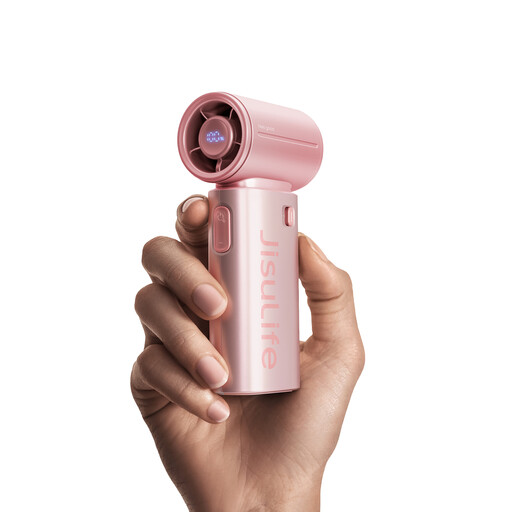
Why this choice suits this profile: At 180 g, it slips easily into a bag for commutes, travel or outdoor activities. It offers five speeds and a digital display showing the selected speed and battery level.
The stated battery life, between 3 and 22 hours, is linked to the different speed levels. So you can't take a single figure at face value for every situation.
5,000 mAh battery, five settings, LED screen, wrist strap and stated air speed of up to 10 m/s.
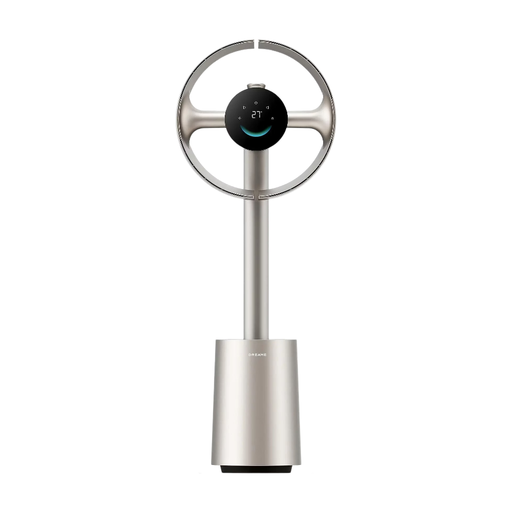
Why this choice suits this profile: This bladeless model combines a touchscreen, magnetic remote control, connected app and voice control for a particularly comprehensive home experience.
The specifications detail the oscillation angles, the available modes and the presence of a removable primary filter. So the product doesn't rely solely on the promise of even airflow.
Horizontal oscillation up to 180° and vertical up to 90°, three modes, temperature sensor and washable filter.
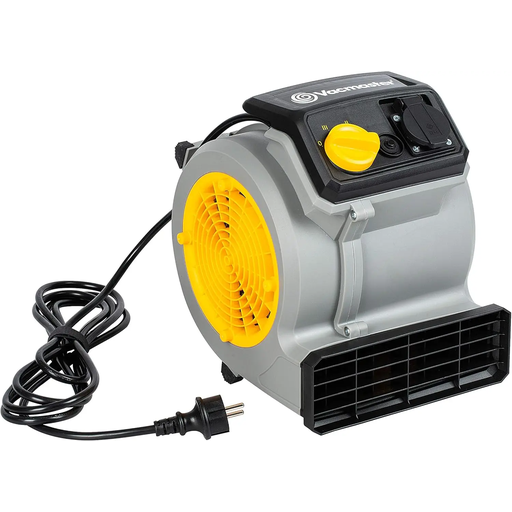
Why this choice suits this profile: This floor fan is designed to ventilate, cool and dry a workshop, gym or basement. Its adjustable direction lets you target the area you need to treat precisely.
The product page lists three speeds, a stated airflow of 245 L/s and a noise level of 75 dB, so you can factor the noise into your choice of room and use.
124 W power, tilt up to 45°, three speeds and built-in socket for linking multiple units depending on the setup.
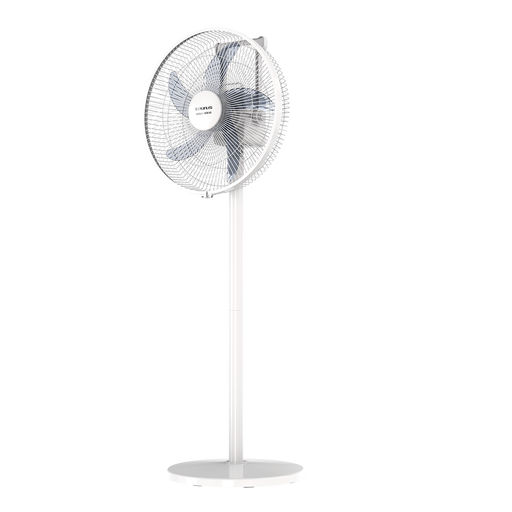
Why this choice suits this profile: Its four-in-one design lets you use it on the floor, on a desk, as a tower or mounted on the wall, depending on the space available in your home.
The battery, timer and five speeds are listed separately. This lets you clearly distinguish between mobility, battery life and airflow adjustment.
Stated battery life of up to 8 hours, 35 W DC motor, automatic oscillation, remote control and night, breeze and normal modes.
We've put together a comprehensive, real-time updated selection of products that meet these demanding criteria, while complying with European safety regulations.
It moves the air around and enhances the feeling of coolness on your skin, but it doesn't lower the temperature like an air conditioner. Close the blinds during the hottest hours and run the fan when the outside air cools down to help with air exchange.
Go for a model with a low speed, a night mode, a timer and a switchable oscillation. When the information is available, also check the stated noise level. Then place the fan away from the bed, on a stable surface.
It all depends on its power and how long it's used. To get an estimate, multiply the power in kilowatts by the number of hours of use, then by your electricity rate. A 35 W appliance uses less per hour than a 124 W model, but the airflow and intended use aren't necessarily the same.