Households doing a big weekly food shop
You need to be able to put your shopping away in the fridge without piling food on top of itself. A full shop and frequent door openings are among the situations covered in Que Choisir’s test protocol.


To store a full weekly food shop, first work out how much usable space you need for fresh and frozen food separately. Then check that the appliance will fit through the access points and that its doors and drawers can open fully. A fridge-freezer can be a good choice if width is limited; a multi-door model needs more space, while a separate freezer requires a dedicated spot and a regular need for extra frozen storage. To assess how well it keeps food cold after a big shop, look for test results for the exact model rather than relying on the name of a feature alone.
You need to be able to put your shopping away in the fridge without piling food on top of itself. A full shop and frequent door openings are among the situations covered in Que Choisir’s test protocol.
If you store prepared portions and frozen food, you’ll need to consider the freezer’s capacity and layout separately from those of the fridge. If you regularly need more frozen storage than a single appliance can provide, a separate freezer may be worth comparing.
A large capacity is no use if the appliance won’t fit through the access points on delivery or its drawers can’t open once it’s installed. Samsung recommends checking that its RM70F63NER multi-door model will fit through the access points while still packaged; Electrolux reminds buyers to make sure drawers and baskets can open fully.
Start by working out how much space you need in each compartment, then check the appliance’s dimensions against the delivery route and its final position. A fridge-freezer, a multi-door model and an additional freezer each meet different space requirements. Then compare their energy use and the test results for the model you’re considering.
| Feature | What to check | Consumers concerned |
|---|---|---|
| Space for fresh and frozen food | Compare the usable capacity of each compartment separately, then check the shelf and drawer layout. | If the fridge is overflowing after the food shop while the freezer is barely full, I don’t want to choose based on total capacity alone. Around 36% of the consumers concerned would make this their priority. |
| Keeping food cold after the shop | Look for tests of the exact model covering how it cools after food is added and how it freezes a load of food. | When several items go in at once and the door is opened frequently, I want to know how the temperature responds. This would be the priority for around 29% of the consumers concerned. |
| Installation and opening | Measure the appliance, delivery access points and the clearance needed for ventilation and for the doors and drawers to open. | In a narrow kitchen, I need to be able to get the appliance in and use all its compartments once it’s in place. Around 21% of the consumers concerned would make this their main consideration. |
| Energy use and maintenance | Compare the annual energy consumption on the energy label for appliances of a similar capacity, and check which compartments have a frost-free function. | If the appliance is running continuously in my home, I want to keep its energy use under control and know what maintenance it will need. This would be the main concern for around 14% of the consumers concerned. |
An appliance may have plenty of space overall but still lack room in the compartment you use most. This is especially important if you need to freeze some of your big food shop.
Think about what you usually store over the course of a week, then compare the usable capacity and layout of the fresh and frozen compartments separately.
The space where the appliance will go won’t tell you whether it will fit through doorways and around corners, or whether its drawers can open once it’s installed.
Check the access points, the dimensions of the packaged appliance where these are provided, and the installation diagram for your chosen model. Also allow for the specified ventilation clearance and space for the doors and drawers to open.
A label such as No Frost describes a feature; it doesn’t tell you how quickly the appliance cools or freezes food when fully loaded. Que Choisir tests these situations as part of its fridge-freezer test protocol.
Look for test results for your chosen model covering added food, door openings and freezing, rather than assuming how it performs from the name of its technology.
A separate freezer gives you extra storage, but it needs its own space and runs continuously too. ADEME points out that an appliance’s size and features can affect its energy use.
Choose this option if you regularly need extra frozen storage, and compare the annual energy consumption shown on the labels of the appliances you’re considering.
These examples illustrate different formats and don’t imply anything about other models from the same brands.
Its freestanding fridge-freezers include options wider than a 60 cm appliance, without going straight to a multi-door model.
Its RM70F63NER multi-door model is worth considering if your kitchen and access points can accommodate a wide appliance.
Its chest freezers let you consider having separate frozen storage if you have room for a second appliance.
These fridge-freezers include multi-door models and a standard fridge-freezer. For a big food shop, compare their stated capacities with your needs in each compartment, then check whether you can install one at home. Total capacity alone won’t tell you how much space is set aside for the freezer.
 Image unavailable
Worth considering if you’re looking for a four-door appliance to organise a big food shop, once you’ve checked the space available in each compartment.
The title lists a total capacity of 467 L, Total No Frost and an energy rating of E. Check the dimensions and door clearance to make sure it will fit in your home.
 Image unavailable
This multi-door model is worth comparing if you’re looking for a large total capacity and have enough space to install it.
The title lists a total capacity of 495 L and an energy rating of E. Check the fridge and freezer capacities separately, as well as the clearances required for this model.
 Image unavailable
This fridge-freezer is worth considering if you’d prefer one appliance, provided it has enough capacity for your usual food shop.
The title lists a total capacity of 282 L and an energy rating of E. Compare the capacity of each compartment with what you actually store, especially if you freeze food regularly.
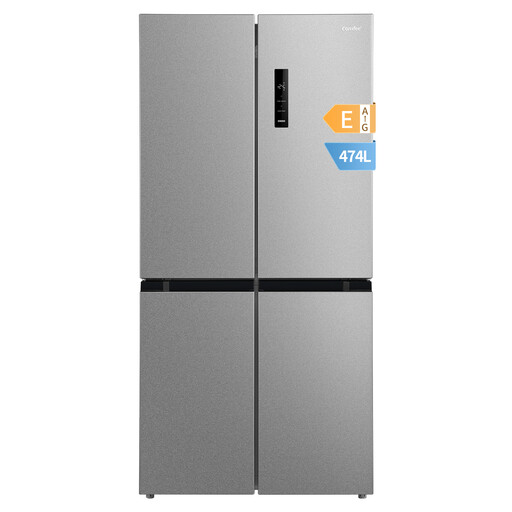 Image unavailable
Worth considering if you want to organise your food shop in a four-door appliance, while checking how much space it provides for frozen food.
The title lists a total capacity of 474 L and an energy rating of E. Before choosing, check the usable capacity of each compartment and the dimensions needed to get it in and install it.
 Image unavailable
Its stated total capacity makes it an option worth comparing for a big food shop, though it doesn’t tell you how much space is actually available in each compartment.
The title lists a capacity of 444 L, a frost-free function and an energy rating of E. Check the fridge and freezer capacities separately, as well as the external dimensions, before making your decision.
Start with what your household actually keeps between food shops, separating fresh from frozen food. Que Choisir suggests a general guide of 100 to 150 L for one person, plus 50 L for each additional person. Adjust this starting point to the amount you buy each week and how you use your freezer.
Not without checking its overall size and the usable space in each compartment. A multi-door model may suit you if you need a large capacity, but also measure the delivery access points and the room needed to open the doors. Samsung specifically advises checking that its RM70F63NER will fit through the access points while packaged.
Look for test results for the exact model, covering added food, door openings and freezing. Que Choisir includes these situations in its test protocol; a feature listed on a product page doesn’t tell you the results of these tests on its own.
Compare the energy rating and annual energy consumption, particularly for appliances with a capacity that suits your needs. ADEME notes that you can check the energy label for fridges online and in shops. Also consider the capacity you choose, especially if you’re thinking about adding a second appliance.
Only if the model’s operating conditions cover the temperatures in your garage. Liebherr states that its CFe 2500 Pure chest freezer is suitable for temperatures down to −15 °C, but this doesn’t apply to every freezer. Check the operating temperature range and the instructions for the product you choose.