Families who often wash household laundry
If sheets, towels and children’s clothes regularly make up large loads, choose a capacity that suits this laundry without overlooking how full the drum will be for everyday washes.


For everyday family washing with children, Que Choisir recommends using 8 to 10 kg as a guide; a capacity of 12 to 15 kg is mainly worthwhile if you regularly wash bulky items. If you only wash a duvet occasionally, using a launderette can save you from choosing a washing machine sized around that one item, provided its care label allows machine washing and the machine you use is suitable.
If sheets, towels and children’s clothes regularly make up large loads, choose a capacity that suits this laundry without overlooking how full the drum will be for everyday washes.
A duvet’s weight alone won’t tell you whether it can go in the washing machine. Its care label, the programme you select and the load limit stated in the manual all matter too.
If you do family washing regularly but only wash a thick duvet occasionally, compare a capacity suited to everyday use with the option of using a launderette now and then.
Start with the size of the loads you wash most often, then check the space available and the care instructions for your bulkiest items separately.
Worth considering: Que Choisir recommends 8 to 10 kg as a guide for a family with children whose usual loads include clothes, sheets and towels.
Limitation: This capacity doesn’t guarantee that a large duvet will be suitable for the programme it needs.
Worth considering: According to Que Choisir, 12 to 15 kg capacities are mainly worthwhile if you regularly wash bulky items.
Limitation: If most of your washes are small, the large drum may often be underfilled.
Worth considering: Choose a capacity suited to your usual laundry if items too large for your machine are few and far between.
Drawback: You’ll need to travel and check that the machine, programme and drying options are suitable for the fabric.
| Factor | What to check | Consider your needs |
|---|---|---|
| Everyday capacity | Compare the capacity in kg of dry laundry with your usual loads. Que Choisir recommends 8 to 10 kg as a guide for a family with children; a larger capacity is best suited to households that regularly wash large loads. | I often wash sheets and towels with the family laundry and want to avoid running extra cycles. |
| Duvets and delicate fabrics | Check the care label, then look up the maximum load for the appropriate programme in the manual. The stated capacity may not apply to every programme. | A duvet needs to be washable according to its care instructions, without being crammed into the drum. |
| Drum loading and consumption | Consider how full the drum will be for your everyday washes. To compare two models, the energy label gives details including electricity use per 100 cycles and water use per cycle for the Eco 40-60 programme. | If most of my washes are small, a very large capacity would mainly cater for occasional use. |
| Style and installation | Measure the width, height and depth, the access route and the space needed to open the machine. The Que Choisir guide generally puts the capacity of top-loading washing machines at between 5 and 8 kg. | I need to be able to install and open the machine in its intended location, not just fit the drum into the space. |
| Everyday use | Compare spin noise, the length of the Eco 40-60 programme and how easy the machine is to access for maintenance. Also check the washing and spin details specific to each model. | If the washing machine is near living areas, noise and maintenance matter just as much as capacity when I’m choosing a model. |
The load limit can be much lower for a wool, synthetic or delicate programme. Que Choisir gives the example of a model that takes 8 kg of cotton, but only 3.5 kg of synthetics and 2 kg of wool.
Before buying a machine to wash a particular duvet, check its care label against the programme and load charts in the model’s manual.
According to Que Choisir, 12 to 15 kg capacities are mainly designed for bulky items that are washed regularly. ADEME recommends running the washing machine with enough laundry to fill the drum.
Choose a machine to suit your usual washes; for an occasional bulky item, consider using a suitable machine elsewhere.
A higher capacity may mean choosing a front-loading model rather than a top-loader. You’ll also need to be able to access the machine once it’s installed.
Measure the space, the access route and the room in front of the door, and check the connections required for the model you’re considering.
The energy label also shows consumption figures, capacity, the length of the Eco 40-60 programme, spin performance and noise. The rating alone won’t tell you what load a programme for bulky items can handle.
Compare the label figures for models with a suitable capacity, then check their manuals for the programmes you’ll use.
These 8, 9 and 10 kg washing machines let you compare capacities for everyday family laundry or more frequent large loads. For a duvet, always check its care label and the load limit for the model’s programme.
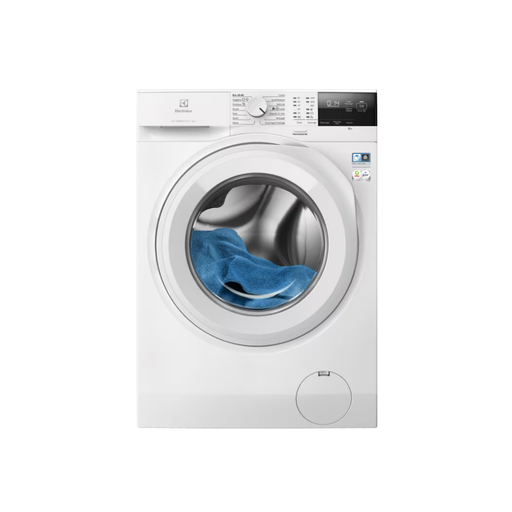 Image unavailable
An 8 kg capacity to consider if it suits your usual family loads. Before washing a duvet in it, check the care label and the load limit for the appropriate programme.
 Image unavailable
Consider how often you really wash large loads when comparing its 10 kg capacity. Its listing states an A energy class; for a duvet, check the fabric’s care label and the load limit for your chosen programme separately.
 Image unavailable
Compare this 8 kg model with your household’s usual loads, rather than with the size of a duvet alone. For a bulky bedding item, check its care label and the manual before choosing a programme.
 Image unavailable
A 9 kg capacity is worth comparing if your family laundry regularly includes household textiles. Check the space needed for installation and, for a duvet, the maximum load for the suitable programme.
 Image unavailable
Consider this 10 kg capacity if large loads are part of your regular laundry, rather than for one occasional item. The stated capacity doesn’t replace checking the load limits for each programme and the item’s care label.
No. The stated capacity doesn’t guarantee that every programme can handle that load. Check the duvet’s care label, then look up the suitable programme and its maximum load in the washing machine manual.
According to Que Choisir, 12 to 15 kg capacities are mainly worthwhile if you regularly wash bulky items such as throws or thick duvets. For a family with children, the organisation recommends using 8 to 10 kg as a guide and comparing this with your usual loads.
The Que Choisir guide generally puts the capacity of these models at between 5 and 8 kg. If you’re looking for more, consider front-loading models, checking their dimensions, door clearance and access to the connections.
Compare capacity, electricity use per 100 cycles, water use per cycle, the length of the Eco 40-60 programme, spin performance and noise, rather than looking at the energy rating alone. These figures don’t replace checking the load limits for other programmes.
It can be a good occasional option if the duvet’s care label allows machine washing. Before using one, check that the machine’s capacity, programme and drying options are suitable for your duvet.