Households looking for a “sugar-free” claim
If this claim is a must-have for you, check the pack rather than relying on “no added sugar”. Regulation (EC) No 1924/2006 sets a maximum sugar content of 0.5 g per 100 g for the “sugar-free” claim.


If you specifically need a product labelled “sugar-free”, don’t treat “no added sugar” as the same thing. According to Anses, the latter claim does not rule out sugars naturally present in the ingredients. When shopping for a large family, choose a pack size your household will get through, after checking the recipe, allergens and nutritional information for the exact product.
If this claim is a must-have for you, check the pack rather than relying on “no added sugar”. Regulation (EC) No 1924/2006 sets a maximum sugar content of 0.5 g per 100 g for the “sugar-free” claim.
A muesli with cereals and dried fruit may fit the bill, even if it contains naturally occurring sugars. Anses reminds consumers that “no added sugar” does not mean “sugar-free”.
When several people share a pack, the ingredients in the product you choose and any precautionary allergen warnings matter just as much as the pack size. Check the label on the product you’re buying before stocking up.
First, understand the difference between the two sugar claims. Then check that the ingredients are suitable for everyone sharing the pack, and choose a practical quantity.
| What to check | Check for | Who is this for? |
|---|---|---|
| Sugar claim | The exact claim on the pack and the “of which sugars” figure per 100 g. Under Regulation (EC) No 1924/2006, “sugar-free” means no more than 0.5 g of sugars per 100 g. | If a “sugar-free” claim is essential to my purchase, a muesli labelled simply “no added sugar” does not meet this requirement. Around 42% of consumers rank this distinction as their top priority. |
| Ingredients and allergens | The ingredients list, declared allergens and any “may contain” warnings on the exact product. | If I’m buying muesli to share, I need to make sure its recipe is suitable for everyone who’ll be eating it. This is the main concern for around 33% of consumers. |
| Pack size | The net weight and storage instructions after opening, once you’ve chosen a recipe. | If muesli is eaten regularly at home, I want a practical quantity without stocking up on a recipe that doesn’t suit my household. This is the priority for around 25% of consumers. |
Dried fruit can add sugars to a recipe with no added sugar. So this claim alone doesn’t meet the requirements if you’re looking for “sugar-free” muesli.
If “sugar-free” is what you’re looking for, check for that exact claim and read the sugar content per 100 g. Regulation (EC) No 1924/2006 sets the maximum sugar content for the “sugar-free” claim at 0.5 g per 100 g.
Auchan’s 750 g POUCE crunchy dried fruit muesli contains sugar and glucose syrup; its product information lists 20 g of sugars per 100 g. So a large pack doesn’t mean it contains no added sugar.
Check the ingredients and nutritional information before choosing a product to buy regularly.
Mueslis made with cereals, fruit or seeds don’t all contain the same ingredients or carry the same warnings. A label you’ve seen on another product isn’t enough to make a decision for your whole household.
Read the ingredients and any “may contain” warnings on the exact pack you’re buying.
BJORG’s organic fruit mueslis are described as having no added sugar, including a 750 g pack listed by Carrefour.
The range includes fruit, nut and seed mueslis, with features varying by recipe.
Carrefour’s range includes a 375 g fruit muesli with no added sugar and a five-cereal muesli with no added ingredients.
Auchan lists a 750 g pack of crunchy dried fruit muesli.
This 375 g BJORG organic muesli is an option to consider for family breakfasts. If you’re specifically looking for “sugar-free” or “no added sugar”, check that the product being sold carries the relevant claim.
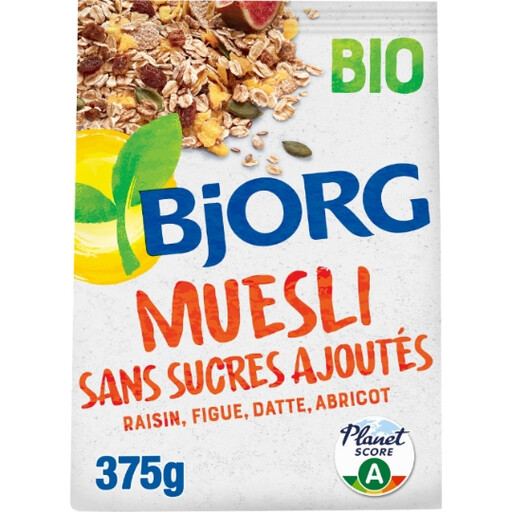 Image unavailable
This 375 g pack may suit a shared breakfast if the recipe works for your household. Before buying, check the exact product for its sugar claim, the “of which sugars” figure per 100 g, the ingredients and the allergens.
No. Anses explains that a product with no added sugar may still contain sugars naturally present in its ingredients. For the “sugar-free” claim, Regulation (EC) No 1924/2006 sets a maximum sugar content of 0.5 g per 100 g.
Because ingredients such as dried fruit naturally contain sugars. For example, Auchan’s product listing for JORDANS organic fruit and nut muesli, which is described as having no added sugar, gives its sugar content as 18.9 g per 100 g. Compare the “of which sugars” figure for the specific recipe you’re considering.
Read the ingredients, allergens and any precautionary allergen warnings on the pack you’ve chosen. Then check the storage instructions for after opening. A larger pack is only practical if the recipe suits everyone who’ll be sharing it.
Follow the instructions on the packaging. If you’ll be using the pack more than once, reseal it as directed after each use.