Households sharing a pizza
You’re looking for a larger pizza to share between several people, without assuming that the whole box counts as one portion. The net weight and the amount you serve matter more than the ‘family-sized’ label.


When choosing a family-sized frozen pizza as part of your approach to weight management, compare the nutritional values per 100 g, then consider how much you plan to serve: the weight of the box alone is not enough. Product listings from E.Leclerc and Carrefour give 226 kcal per 100 g for the 570 g Turini Régina, 249 kcal per 100 g for the 580 g Carrefour Sensation Maxi 4 Formaggi and 257 kcal per 100 g for the 570 g Turini four-cheese pizza. The ingredients and salt content can also help you choose between recipes in similar-sized packs.
You’re looking for a larger pizza to share between several people, without assuming that the whole box counts as one portion. The net weight and the amount you serve matter more than the ‘family-sized’ label.
You want to check the energy, salt and saturated fat per 100 g, then relate these values to the amount you serve. E.Leclerc and Carrefour listings show that pizzas of a similar weight can differ in these respects.
Check the ingredients in each recipe before sharing it. Among the products compared, some contain wheat and milk; the Turini Régina also contains pork. The label on the pack you buy is the one to check.
Start with the amount you plan to serve, then compare the values per 100 g and the ingredients in recipes suitable for your guests. As the DGCCRF explains, the nutritional information per 100 g lets you compare products on a like-for-like basis.
| Criteria | What to check | Who is it for? |
|---|---|---|
| Portion served | Net weight and the amount planned for each person; calculate this using the values per 100 g. | If I’m sharing a large pizza, I want to distinguish my portion from the contents of the box. Around 33% of consumers would prioritise the amount served. |
| Nutritional values | Energy, saturated fat and salt per 100 g, then for the amount served. | Before choosing a recipe, I want to be able to compare its nutritional content on a like-for-like basis. Nutritional values would be the main consideration for around 42% of consumers. |
| Ingredients and storage | Ingredients, allergens and storage instructions on the pack you buy. | When several people are eating the same pizza, I need to take into account ingredients that anyone avoids and store the product according to its label. This would be the top priority for around 25% of consumers. |
The size describes a pizza to share, not the amount to serve one person. Based on the weights and values per 100 g published by E.Leclerc and Carrefour, the three pizzas compared, weighing 570 to 580 g, contain around 1,288 to 1,465 kcal per box, depending on the recipe.
Decide how much you plan to serve, then calculate its nutritional values using those given per 100 g.
Despite their similar weights, E.Leclerc and Carrefour listings give 226 kcal per 100 g for the Turini Régina, 249 kcal per 100 g for the Carrefour Maxi 4 Formaggi and 257 kcal per 100 g for the Turini four-cheese pizza. Weight alone doesn’t make these recipes equivalent.
First compare the values per 100 g, especially energy, salt and saturated fat, then take the portion you plan to serve into account.
The Carrefour Bio grilled vegetable pizza weighs 380 g and its product listing gives 205 kcal per 100 g. This pack is smaller than the three family-sized pizzas compared here: the recipe name doesn’t replace the need to check the weight and nutritional information.
Check that the amount is right for your meal and read the nutritional values for the exact recipe.
Ingredients vary between the pizzas compared. Carrefour’s product listings for frozen pizzas also advise against refreezing a defrosted product.
Check the allergens, storage instructions and cooking directions on the pack you buy.
Carrefour’s product listings let you compare a 380 g Carrefour Bio grilled vegetable pizza with a 580 g Carrefour Sensation Maxi 4 Formaggi.
According to their E.Leclerc listings, the Turini Régina and four-cheese family-sized pizzas compared here each weigh 570 g.
The Ristorante Mozzarella documented by Dr. Oetker France is a 355 g pizza, so it’s worth distinguishing it from a larger family-sized format.
Auchan’s frozen pizza range includes Buitoni Piccolinis weighing 270 g: a pack of mini pizzas rather than one large pizza.
Auchan’s frozen pizza range brings together a variety of recipes and formats, including mini pizzas and multipacks.
Lidl France lists pizzas among its frozen food categories.
This selection includes a 500 g frozen pizza presented as suitable for sharing and two multipacks of lahmacun. These Turkish flatbreads come in packs with several individual pieces, offering another way to divide up the contents, but they aren’t classic family-sized pizzas.
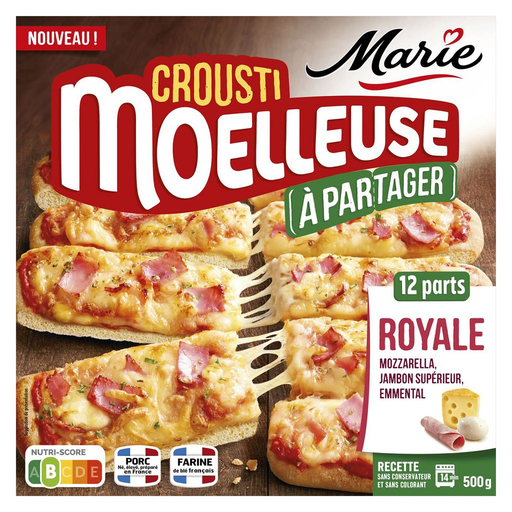 Image unavailable
This 500 g pizza can be shared between several people. Decide how much to serve and check the ingredients and nutritional values on the packaging.
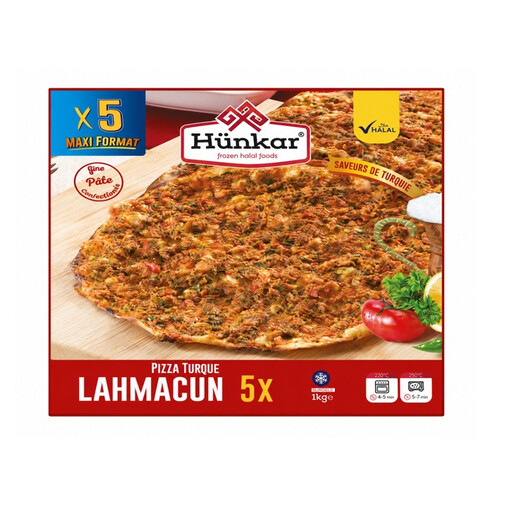 Image unavailable
The five lahmacun can be shared between several people or meals. The pack weighs 1,000 g in total; check the weight of each piece you serve to calculate its share of the nutritional values. These are Turkish flatbreads, not a classic family-sized pizza.
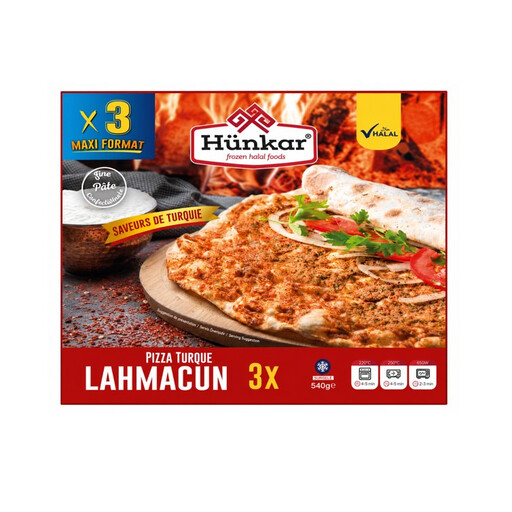 Image unavailable
This pack of three weighs 540 g in total and can be shared between several people. To find out the nutritional content of each piece you serve, check its weight and the nutritional values on the pack. Like the other pack of lahmacun, this isn’t a classic family-sized pizza.
The two figures answer different questions: kcal per 100 g helps you compare recipes, while the amount you serve helps you assess your portion. The DGCCRF explains that nutritional information per 100 g provides a common basis for comparison; you can then multiply this value by the weight of the portion you plan to serve.
No. ‘Family-sized’ describes the product format, not an individual portion. To plan how to share it, choose an amount that suits the meal and use the net weight and values per 100 g to calculate its nutritional content.
Salt and energy are separate aspects of a recipe. The Anses lists pizza among the foods that contribute to salt intake. If this matters to you, compare the amounts given per 100 g, then for the portion you plan to serve.
In particular, check for ingredients that your guests need to avoid: the Turini and Carrefour products compared contain wheat and milk, while the Turini Régina also contains pork. Always check the ingredients list and allergen information on the pack you buy, as these depend on the specific recipe.
No. The Carrefour listings for the frozen pizzas consulted advise against refreezing a defrosted product. Follow the storage and cooking instructions on your pizza’s packaging.