Choose your fridge and freezer space based on what your household actually stores. A fridge-freezer gives you two separate compartments if you regularly use both fresh and frozen food, while a fridge focused on fresh food may be enough if you rarely freeze anything. If you keep a large stock of frozen food, consider a separate freezer too. In every case, compare the usable capacity of each compartment, energy consumption in kWh/year and the climate class suited to the room.
Which households are these options right for?
Families who prepare meals for several days
If home-cooked meals and fresh food take up most of your shelf space, start by looking at the fridge’s usable capacity and layout. UFC-Que Choisir recommends choosing capacity to suit your shopping habits rather than relying on household size alone.
Households that freeze food often
If you freeze portions in advance or buy frozen food in bulk, compare the usable capacity in litres and the freezer drawers. UFC-Que Choisir suggests a separate freezer as an option for larger families when a fridge-freezer doesn’t offer enough space.
Households installing the appliance outside the kitchen
If you’re putting the appliance in a garage, cellar or very warm room, check that the ambient temperatures throughout the year stay within the climate range stated for the model. This matters just as much for a separate freezer as for a fridge-freezer.
What should you check before choosing?
Start with what you usually store, then compare the capacity of each compartment with the space available and the conditions where you plan to install the appliance.
| What to consider |
What to check |
What I need |
| Capacity split |
Compare the usable capacity in litres of the fridge and freezer separately, then look at the layout of the shelves and drawers. The total capacity alone doesn’t show you where the space is. |
I keep cooked meals and fresh food for several days, but I also want to know how many portions will actually fit in the freezer. |
| Capacity and size |
UFC-Que Choisir gives an average starting point of 100 to 150 L for one person, then 50 L for each additional person. Adjust this guide to suit your shopping and frozen food, and measure the space available, including the recommended clearances. |
We sometimes shop for several days at a time, so I need room for our food without choosing an appliance that won’t fit in the room. |
| Freezing options |
A single-door fridge with a small freezer compartment, a two-door fridge-freezer, a fridge-freezer with a separate freezer compartment and a separate freezer don’t all offer the same amount of freezer space. Check the star rating and whether the model is rated to freeze fresh food if you plan to freeze portions. |
If I regularly freeze home-cooked meals or buy lots of frozen food, I need to check whether the compartment will be big enough or whether a separate appliance would be useful. |
| Annual energy consumption |
Look at the kWh/year figure and energy rating together, then compare appliances with a similar capacity and layout. ADEME points out that refrigeration appliances run continuously. |
I want to compare the stated electricity use of appliances that can hold my food, rather than choosing based on the energy rating alone. |
| Room temperature |
Check the room’s minimum and maximum temperatures and compare them with the model’s climate class. According to Bosch’s guide, the SN, N, ST and T ranges differ; check the installation instructions too. |
The temperature in my garage or cellar changes with the seasons, so the appliance needs to be suitable for the actual temperature range. |
What mistakes should you avoid?
-
Looking only at the total capacity
A large capacity may mostly be taken up by the fridge, even though the portions you prepare need more freezer space. UFC-Que Choisir describes a typical fridge-freezer of around 300 L, with two thirds for fresh food and one third for frozen food as a guide; the split in the model you choose may be different.
Make a list of the fresh food, cooked meals and frozen food you usually store over a week, then compare the usable capacity of each compartment.
-
Assuming a small freezer compartment is suitable for every use
Having a freezer compartment doesn’t, on its own, tell you whether it can freeze fresh food.
If you plan to freeze home-cooked meals, check the star rating and the model’s stated suitability in its product details or manual.
-
Comparing kWh/year without checking capacity
ADEME says refrigeration appliances run continuously and publishes different average consumption figures for different types. These averages don’t predict how much a particular model will use.
Compare the stated kWh/year figures for appliances with capacities and layouts that meet your needs. Also consider any extra features you’ll actually use.
-
Overlooking the temperature where the appliance will be installed
As Bosch explains, the climate class indicates the range of ambient temperatures the appliance is designed for. A garage or conservatory may fall outside this range at certain times of year.
Check the room’s temperature extremes, the climate class and the installation instructions for the model you’re considering.
A few things to know about the brands
Bosch
Bosch’s guides distinguish between models focused on fresh food, occasional freezing and regular use of both compartments.
- Bosch presents its single-door models as suited to fresh food and home-cooked meals, and its fridge-freezers as offering a separate freezer compartment.
- This guidance doesn’t tell you how much capacity your household needs: compare the usable capacity in litres and the climate class for the specific model.
Beko
Beko offers fridge-freezers in a range of capacities, including models with a large freezer compartment.
- Beko’s product details for the BRCNE50140ZXBN list 356 L of fridge space and 158 L of freezer space, showing why it’s worth checking the two capacities separately.
- Beko notes that a fridge-freezer may not offer enough freezer space for a household that stores lots of frozen food, so check the capacity of the model you’re considering.
Whirlpool
Whirlpool offers freestanding and integrated fridge-freezers, with No Frost configurations available on selected models.
- The brand describes two No Frost cooling systems on the W9C841COX model; this configuration applies to that model and not necessarily to the whole range.
- When choosing, also check the capacity of each compartment, the kWh/year figure and the care instructions for the specific model.
Fridge-freezers on Joybuy
These appliances have both a fridge and a freezer compartment. Their capacities and dimensions let you compare different ways of dividing space between fresh and frozen food. Start by choosing one with enough room for your household’s needs.
 Image unavailable
Candy CFQQ5T817EPS, four-door, 467 L
Worth considering if you regularly store fresh and frozen food and have enough room for a four-door appliance.
The product details list 311 L for the fridge and 156 L for the freezer, along with a four-star freezer rating and Total No Frost. Stated energy consumption: 290 kWh/year; class E; dimensions: 83,3 × 65 × 181,5 cm.
Check the installation space and compare the kWh/year figure with those of appliances with a similar capacity and layout.
View on Joybuy
 Image unavailable
CHiQ JR263LGE, 262 L, Low Frost
If space is limited, its stated width of 54 cm is worth comparing with the room available and your household’s storage needs.
The product details list 187 L of fridge space and 75 L of freezer space, with three drawers and a four-star compartment. They state 215 kWh/year, class E and an N-ST climate range of 16 to 38 °C.
The Low Frost freezer is listed as requiring manual defrosting, so factor in this maintenance and check the temperature where you plan to install it.
View on Joybuy
 Image unavailable
LG GBBSJ1CCSW, 333 L, NatureFRESH™
This model lets you consider the space for fresh food, the cooling compartment and the freezer separately.
The stated capacities are 183 L for the fridge, 37 L for the cooling compartment and 113 L for the freezer. The product details list Total No Frost, 169 kWh/year and class C; dimensions: 597 × 1 860 × 674 mm.
If you want to freeze home-cooked meals, confirm that the compartment is suitable for freezing fresh food. The installation instructions recommend at least 5 cm of clearance at the back, above and at the sides.
View on Joybuy
 Image unavailable
CHiQ JR227LSE, 227 L, Low Frost
Its stated width of 54 cm may make it worth considering for a kitchen where every centimetre counts, provided both compartments offer enough space for what you store.
The product details list 153 L of fridge space and 74 L of freezer space, a four-star freezer, a reversible door and class E.
To compare energy consumption and check whether it’s suitable for installation in a cold or warm room, see the kWh/year figure and the model’s climate range.
View on Joybuy
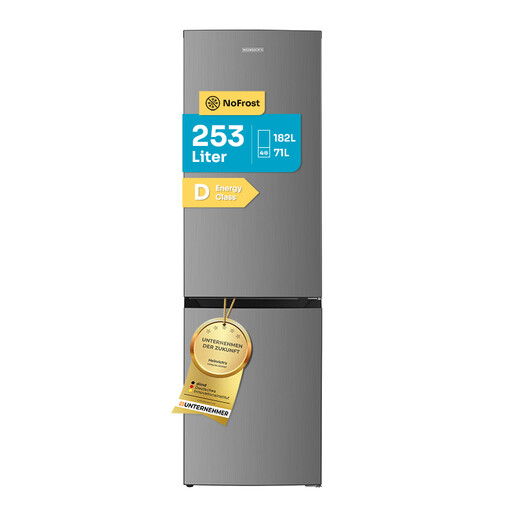 Image unavailable
Heinrich´s, 253 L fridge-freezer, stainless steel finish
Its capacity split may suit you if fresh food takes up more space than frozen food in your usual shop.
The product description lists 182 L for the fridge and 71 L for the freezer, with No Frost. The title states a noise level of 39 dB, and the description mentions class D.
If you freeze fresh meals, check that the freezer is suitable for this. Also confirm the dimensions, kWh/year figure and climate class before choosing where to put it.
View on Joybuy
Frequently asked questions
How do you estimate the right capacity for a family?
Use the capacity in litres as a starting point, then adjust it to suit your shopping habits. UFC-Que Choisir gives an average guide of 100 to 150 L for one person, then 50 L for each additional person. Next, compare the fridge and freezer capacities separately, based on how much space you need for prepared meals and frozen food.
Is a small freezer compartment enough for freezing home-cooked meals?
Don’t assume it is just from the name of the compartment. If you want to freeze fresh food or prepared meals, check its star rating and whether the product details or manual state that it’s suitable for this.
Should you check the energy rating or the kWh/year figure?
Check both, but focus on kWh/year when comparing appliances with similar capacities and layouts. ADEME points out that fridges and freezers run continuously, so their capacity and features should suit the way you use them too.
Which climate class should you choose for a garage or cellar?
Choose a model whose stated temperature range covers the room’s minimum and maximum temperatures. Bosch’s guide gives the following ranges: SN: 10 to 32 °C, N: 16 to 32 °C, ST: 18 to 38 °C and T: 18 to 43 °C. Check the climate class and installation instructions for the specific model.


