Households that do a big shop
If you buy food for several days at a time, compare the space for fresh food with the space for frozen food separately. A large total capacity doesn’t guarantee a layout that suits your habits.


If you shop less often, start by considering the space available and how much room you need for fresh and frozen food. A fridge-freezer is worth considering if width is limited; a multi-door model makes it easier to access a large fresh-food section, while an American-style or side-by-side model means checking that you need the extra capacity and have enough room for it. Then compare the noise level, the energy consumption shown on the label and the installation requirements for the specific model.
If you buy food for several days at a time, compare the space for fresh food with the space for frozen food separately. A large total capacity doesn’t guarantee a layout that suits your habits.
Easy-access drawers and separate compartments can matter just as much as capacity in litres when several people put food away or take it out of the fridge.
Before choosing these features, measure the delivery route and the space where the appliance will go. Then check the manual to see whether the model needs a water supply.
The design can help narrow down your options, but the capacity of each compartment and your kitchen’s constraints should help you choose between models.
Consider this if: you want an integrated freezer and the available width rules out an appliance close to 90 cm wide.
Check: the actual space for frozen food and how easy the drawers are to access, rather than looking at total capacity alone.
Consider this if: several people regularly use the fresh-food section and want it separate from the freezer drawers. Que Choisir describes this layout as having two fridge doors and one or more drawers below.
Check: its overall dimensions and, for some water features, whether it needs a plumbing connection.
Consider this if: your fresh and frozen food stocks justify a large appliance, and your kitchen and access routes can accommodate it.
Check: Que Choisir recommends allowing around 1 m of width for American-style fridges. Measure the model you choose rather than treating this as a universal dimension.
| Criteria | What to check | Your needs |
|---|---|---|
| Capacity and storage | Compare the usable capacity in litres of the fridge and freezer separately. Look at the layout of the shelves, bins and drawers. | I want to store several days’ worth of shopping without running out of space for frozen food or overfilling the shelves. |
| Temperature and air circulation | Check how to monitor the temperature at the coldest point. Anses recommends a temperature of 0 to +4 °C in this area and advises against overfilling the appliance, so cold air can circulate. | After a big shop, I need to be able to organise the food without blocking the airflow. |
| Noise | Compare the noise emissions in dB and the noise class shown on the energy label. Que Choisir uses less than 40 dBA as a guide for the quietest fridges. | In an open-plan kitchen or one close to bedrooms, I’d rather check the model’s noise level before choosing a large appliance. |
| Access and installation | Measure the appliance, its intended position and the route through doors, corridors and lifts. Also check the packaged dimensions and required clearances. Consult the manual if you’re considering a water or ice feature. | A large fridge must be deliverable, have room for its doors to open and be installed with the required ventilation. |
| Energy | Compare the A to G energy class, the stated consumption and the capacity shown on the label. According to the European Commission, the label also shows noise emissions; take the size of the appliances into account when comparing them. | I want to assess energy consumption in relation to the capacity my household actually needs, rather than relying on the energy class alone. |
Two appliances with a similar total capacity may divide the space for fresh and frozen food differently. The number and layout of the drawers also affect everyday use.
Think about the food you usually store, then compare the capacity and layout of both compartments.
A large appliance also needs to fit through doors, corridors and lifts along the delivery route. Samsung, for example, recommends checking that the packaged appliance will fit through the access route for its large multi-door models.
Measure the entire route and compare it with the packaged dimensions of the model you’ve chosen.
Que Choisir points out that some multi-door models with a dispenser need a water supply. Whether a connection is required depends on the model, not just its design.
Check the product details and manual to find out what installation is required before choosing this feature.
Noise matters in an open-plan room. Bosch requires sufficient rear ventilation for the relevant appliances, while Anses advises against overfilling the fridge to maintain the circulation of cold air.
Compare the noise level, follow the clearances in the manual and check the temperature at the coldest point after installation.
These models illustrate features to compare on specific appliances; they don’t represent every range from each brand.
The KAD93AIDP side-by-side is an example of a large model with a water connection.
The GML643PZ6F multi-door model is an example of a layout to consider for family food storage.
The RM70F63NER and RF24BB620EB1EF multi-door models show why access needs to be checked for each large appliance.
These appliances include multi-door models and a side-by-side for family food storage. Compare their capacity with your usual shopping, then check the dimensions and installation requirements for the model you choose.
 Image unavailable
Worth considering if you want to organise the family shop in a four-door appliance. The product listing specifies Total No Frost and an E energy class; compare the space it needs with your delivery route and installation requirements.
 Image unavailable
Worth comparing if you’re looking for a main three-door appliance and don’t want to choose on total capacity alone. The product name specifies Total No Frost, My Zone, Wi-Fi and an E energy class; compare its compartments with the food you usually store.
 Image unavailable
Worth considering for big shops, while checking how much of its capacity is available for frozen food. The product is listed with an E energy class; confirm its configuration and dimensions, and check the installation requirements for any dispenser before deciding where to put it.
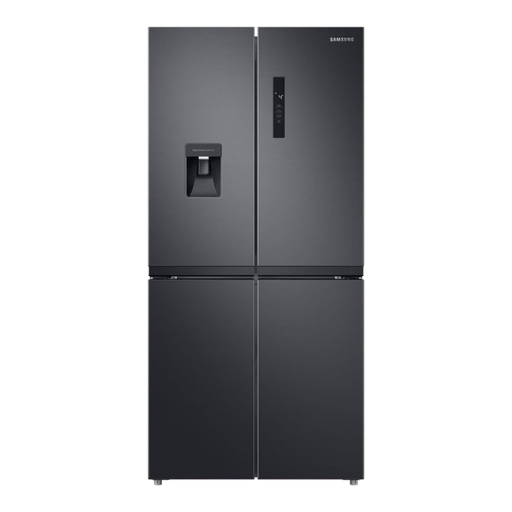 Image unavailable
Worth comparing for a household that stores both fresh and frozen food. The product is listed with an E energy class; confirm its exact configuration, whether the packaged appliance will fit through the access route, and whether water or ice features need a connection.
 Image unavailable
Worth considering if your kitchen can accommodate a side-by-side and your food stocks need its two compartments. The product title lists 333 L of fridge capacity, 192 L of freezer capacity, No Frost, 37 dB and an E energy class; check the model’s dimensions and energy consumption before comparing it with other options.
Que Choisir suggests starting with 100 to 150 L for one person, then adding 50 L for each additional person. Adjust this guide to suit your shopping habits and check the fresh-food and freezer capacities separately: the same total capacity can meet very different needs.
Anses recommends keeping the coldest point between 0 and +4 °C. Check the temperature in this area and avoid overfilling the appliance, so cold air can circulate after your shop.
Not necessarily; installation requirements depend on the model. Que Choisir says some multi-door models with a dispenser need a water supply, and Bosch specifies a connection for its KAD93AIDP. Check the product details and manual for the model you’re considering.
Measure the space where it will go and the entire delivery route, including doors, corridors and lifts. Take the packaged dimensions into account if they’re available. Also check that the doors can open and allow for the ventilation clearances specified for the model.
According to the European Commission, the energy label for household fridges in the European Union shows the A to G energy class, consumption, capacity and noise emissions. Consider these details together, comparing appliances with capacities that meet your needs.