Families who do one big shop a week
If you store fresh food, prepared meals and frozen food all at once, start with the quantities you actually keep. The usable capacity of each compartment matters more than the total capacity alone.


To store the whole week’s shopping, first compare the fridge and freezer capacities separately, then measure your kitchen and the delivery route. A high-capacity fridge-freezer is worth considering if space is limited; a multi-door model gives you separate compartments, while an American-style or side-by-side fridge needs more room and is best suited to households that need plenty of storage. Whichever you choose, check the noise level and energy consumption of the specific model.
If you store fresh food, prepared meals and frozen food all at once, start with the quantities you actually keep. The usable capacity of each compartment matters more than the total capacity alone.
A high-capacity fridge-freezer is an option if there isn’t room for a wider appliance. Also measure the door clearance and the route from your home’s entrance to the kitchen.
A multi-door or side-by-side model may suit you if you need separate compartments or plenty of storage. Before choosing one, make sure its dimensions, access requirements and energy consumption work for your household.
First decide how much space you need for fresh and frozen food, then rule out any formats that won’t fit in your kitchen or along the delivery route.
Consider this if: you do a big weekly shop but your kitchen can’t accommodate an appliance around 90 cm wide.
Bear in mind: it may offer less compartmentalised storage than a four-door model; check the capacity of each compartment.
Consider this if: you’d like to separate different food items more easily and have enough room for the appliance.
Bear in mind: the doors and compartments affect how you organise your food, but their layout doesn’t replace checking the usable capacity.
Consider this if: you need plenty of storage and your kitchen and access routes can accommodate a wide appliance.
Bear in mind: Que Choisir highlights the size and energy consumption of American-style fridges. Compare specific models rather than relying on the format alone.
| Consideration | What to check | Your needs |
|---|---|---|
| Capacity and storage | Compare the net capacity of the fridge and freezer separately. Look at the layout of the shelves, bins and drawers to see how they’ll work for a week’s shopping. | I mainly store fresh food, or lots of frozen food: I need a split that suits my shopping, not just a large total capacity. |
| Dimensions and access | Measure the width, depth and height of the space, then check the doors, corridors and any lifts along the delivery route. Check the manual for clearance requirements and door-opening space. | The appliance needs to be delivered and installed in my home, with enough room to open the doors and access the drawers. |
| Temperature | Check the available information on how stable the temperature remains when food is added. According to Anses, check that the coldest part is between 0 °C and 4 °C, particularly when the appliance is full. | After putting away the shopping, I want to be able to check the actual temperature rather than relying only on the name of a cooling feature. |
| Noise and energy consumption | Compare the stated noise level in dB(A), annual energy consumption in kWh and capacities of the models you’re considering. Also check that the climate class is suitable for the room. | Noise matters to me in an open-plan kitchen; as the appliance runs continuously, I also want to compare its energy consumption. |
A large appliance may still leave too little room in the compartment your family uses most, especially if you buy a lot of frozen food.
Think about a typical week’s shopping, then compare the net capacity, drawers and shelves in each compartment of every model.
A multi-door or side-by-side model may fit its spot but still not make it through a doorway, corridor or tight turn during delivery.
Measure the access points and check the dimensions of the appliance and its packaging, as well as the clearance requirements in the manual.
An air-circulation or cooling feature alone doesn’t tell you how the appliance handles a full load of shopping. Anses recommends checking the coldest part, particularly when the appliance is very full or its doors are opened frequently.
Check the features of the exact model and, after installation, make sure the coldest part is between 0 °C and 4 °C.
Two appliances with different capacities and formats can’t be compared on their energy rating alone. Noise and the features you use also matter in everyday life.
For each model you’re considering, check its stated annual energy consumption in kWh, noise level and compartment capacities.
These brand examples give you models to compare; the specifications apply to the models named, not to each brand’s entire range.
Beko’s freestanding fridge-freezer range is a good place to look for a high-capacity appliance without immediately moving up to a multi-door format.
Haier’s freestanding multi-door models are a useful reference for comparing access to compartments and the space needed for installation.
Samsung’s American-style range offers models to consider if your household needs plenty of storage and has a sufficiently wide kitchen.
These multi-door and side-by-side models offer a range of capacities to compare for the family shop. Check the compartment layout and the space needed for each model.
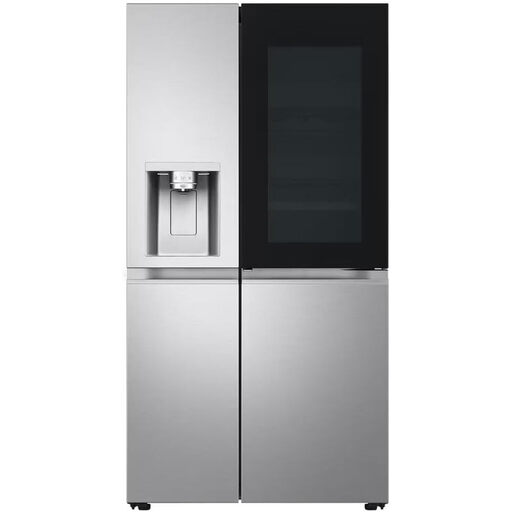 Image unavailable
Worth considering if your weekly shop calls for plenty of storage. Its 628 L figure is the total capacity: also compare the fridge and freezer capacities, then measure the space and delivery access.
 Image unavailable
Its four doors may appeal to households that want to organise their shopping into separate sections. The title lists a total capacity of 467 L and Total No Frost; compare the capacity of each compartment. Also check that the non-reversible doors have enough clearance in your kitchen.
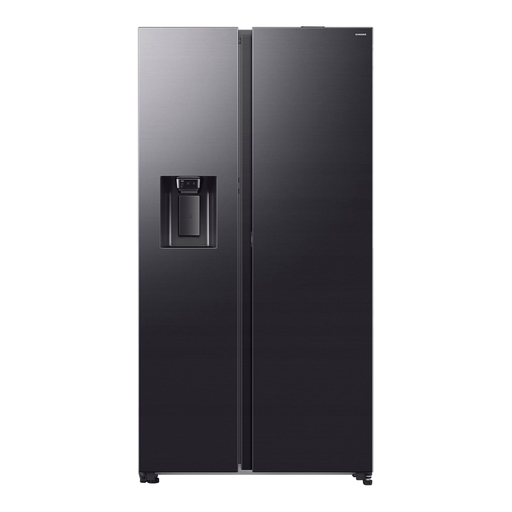 Image unavailable
This 640 L model is for households considering a large amount of storage and with room for a side-by-side appliance. Compare the capacities of the two compartments and check access, installation clearances, and the connection requirements for the water and ice dispenser.
 Image unavailable
This 495 L multi-door model may suit households wanting to split their shopping across several compartments. Compare their capacities with the amount of fresh and frozen food you store, then check the delivery route and installation requirements before choosing.
 Image unavailable
To compare this model with your usual shopping, its title gives a fridge capacity of 333 L and a freezer capacity of 192 L; it also lists No Frost and 37 dB. Check the dimensions, delivery access and energy consumption details for the exact model.
Anses recommends keeping the coldest part between 0 °C and 4 °C. Check it after putting away the shopping, when the kitchen is warm or if the doors are opened frequently.
No: compare the fridge and freezer capacities with what your family actually stores. As a general guide for a household of four, Beko gives a fridge capacity of 250 to 300 L and a freezer capacity of around 80 L; adjust this to suit your eating habits.
Look at the annual energy consumption in kWh as well as the energy rating, then compare it with the capacity and type of appliance. If the models have very different capacities, the rating letter alone won’t tell you everything you need to know.
No. Que Choisir recommends allowing around 1 m of width for an American-style fridge, compared with around 70 cm for a standard model. Also measure the delivery route and the space needed to open the doors of your chosen model.