Households that shop for several days at a time
If you need to store food for several meals between shops, look at the fridge capacity and how the shelves and drawers will accommodate your groceries. Don’t focus on the total capacity alone.


If you do a big food shop for the family every few days, start by considering how much space you need for fresh and frozen food separately. A fridge-freezer is a good fit if both compartments are large enough; a multi-door model makes it easier to organise food into different zones, while an American-style fridge gives you side-by-side access to chilled and frozen food. Two separate appliances let you choose the size of each storage area independently, provided you have suitable space for both.
If you need to store food for several meals between shops, look at the fridge capacity and how the shelves and drawers will accommodate your groceries. Don’t focus on the total capacity alone.
A large total capacity doesn’t guarantee a large freezer. Compare the freezer’s own capacity with the amount of frozen food you usually keep in stock.
A multi-door or American-style model could be an option if you can get it into your kitchen and its doors can open with the clearance specified in the instructions.
Consider it if: you mainly need to store fresh food and the freezer in your chosen model is large enough for the time between shops.
Bear in mind: a suitable total capacity can hide a freezer compartment that’s too small for your needs.
Consider it if: several doors or drawers would make it easier to organise a large family food shop.
Bear in mind: this layout can take up as much space as an American-style model, as UFC-Que Choisir points out.
Consider it if: you want side-by-side access to the fridge and freezer and have room for a wide appliance.
Bear in mind: UFC-Que Choisir recommends allowing around 1 m of width. Check the dimensions and capacity of each compartment for the specific model you’re considering.
Consider it if: you need to choose the size of each storage area independently.
Bear in mind: you’ll need to make space for two appliances and check the installation requirements and energy label for each.
Once you’ve chosen a format, compare the compartments and installation requirements of the specific model. Two appliances with similar total capacities won’t necessarily suit the same needs.
| Factor | What to check | My needs |
|---|---|---|
| Capacity split | Check the fridge and freezer capacities in litres separately. Also consider the layout of the shelves and drawers in relation to the food you need to store. | I want enough room for fresh meals without squeezing my usual supply of frozen food into the freezer. |
| Capacity between shops | UFC-Que Choisir suggests starting with 100 to 150 L for one person, then adding 50 L for each additional person. Adjust this guide to suit how often you shop and how much you store fresh versus frozen. | We shop for several days at a time, so I’m looking for a capacity that suits what our household actually stores, not a one-size-fits-all figure per person. |
| Access to food | Compare a bottom freezer with multi-door drawers and side-by-side compartments. Check how much space there is in each section, especially if you use the freezer often. | If I regularly buy frozen food, access to the freezer matters just as much as its stated capacity. |
| Installation | Measure the width, height and depth, as well as access routes and door clearance. Allow for the space specified in the instructions, and check whether a water connection is needed for your chosen dispenser. | A wider appliance is only useful if it can be delivered, installed and opened without getting in the way in my kitchen. |
| Energy and noise | The European Commission says the label shows details including energy consumption in kWh/year, capacity and noise. Compare these figures between appliances with similar capacities and formats. | In an open-plan kitchen, I consider the stated noise level as well as the energy consumption for the size I need. |
Different splits between fridge and freezer can suit very different shopping habits. UFC-Que Choisir recommends considering how often you shop and how much room you need for frozen food.
Estimate how much food you have just before your next shop, then compare those needs with the capacity of each compartment separately.
UFC-Que Choisir notes that a multi-door model can take up as much space as an American-style one. So, checking the width of the space where it will go isn’t enough to confirm that it can be brought into the kitchen or that its doors will open properly.
Measure access routes and available space. Check the delivery dimensions if they’re listed, as well as the clearance required in the instructions for your chosen model.
An energy rating alone doesn’t tell you the annual energy consumption or how much food the appliance can hold. The European energy label shows kWh/year, compartment capacities and noise levels.
Compare these figures across models with similar capacity requirements, and check the details for the exact model in the European Commission’s EPREL database.
These examples give you an idea of different formats and dimensions; they don’t cover every range from each brand.
The KGV58VLEAS fridge-freezer is an example of a model geared towards fresh food storage, while staying under 90 cm wide.
The Cube 90 HCR5919ENMB is an example of a four-door multi-door model for a kitchen with room for a wide appliance.
The RS80F64KEFEF is an example of a large-capacity, side-by-side American-style fridge-freezer.
The GSXV90MCAE is an American-style fridge-freezer with separate capacities listed for the fridge and freezer.
The RB5K330GSFC and RQ768N4GBE models show two sizes to compare, depending on the space available.
This selection includes multi-door appliances and a fridge-freezer for storing fresh and frozen food between family food shops. Compare their layouts and compartments with your needs; this selection doesn’t cover every option mentioned above.
 Image unavailable
This four-door design is worth considering if you want to organise the family food shop across several zones. The model name lists a total capacity of 467 L, Total No Frost and an E rating. Check the fridge and freezer capacities separately, as well as whether the appliance will fit through your doorways.
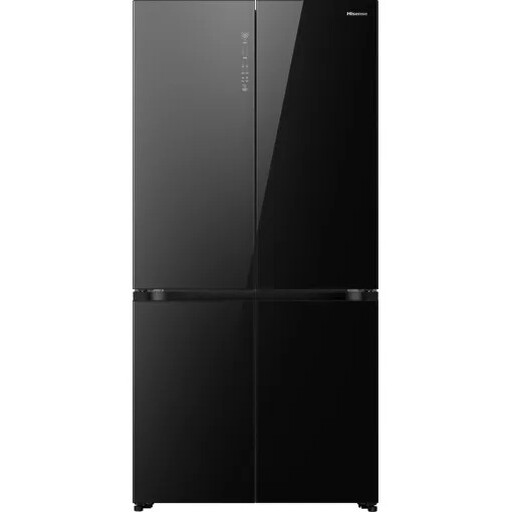 Image unavailable
This 591 L model could suit a large family food shop, but don’t assume its total capacity tells you how much room there is for frozen food. Hisense lists a width of 91.1 cm, No Frost frost-free cooling and 37 dB(A). Measure access routes and check how the compartments are arranged for the setup you’ll be using.
 Image unavailable
For a food shop with fresh and frozen items, compare the space offered by each compartment rather than focusing on the stated 495 L alone. The model name lists an E rating; check the door layout and the dimensions needed for installation.
 Image unavailable
This three-door design is worth comparing if you want to keep fresh and frozen food in separate sections. The model name lists a capacity of 360 L, Total No Frost, an E rating, Wi-Fi and My Zone. Compare the freezer capacity with the amount you usually keep in stock, and check the access routes into your kitchen.
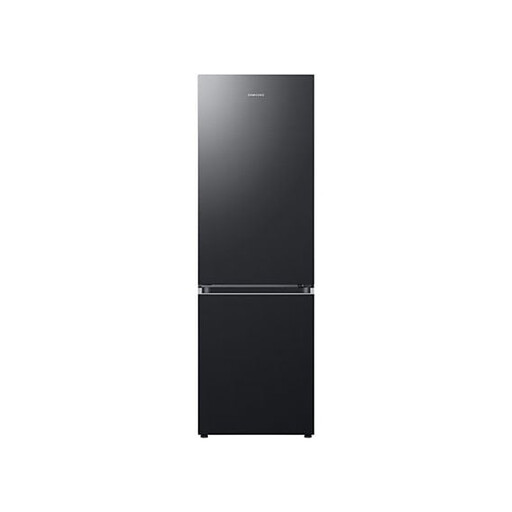 Image unavailable
This fridge-freezer is worth considering if one appliance can meet your fresh and frozen food storage needs. The model name lists a capacity of 344 L and a D rating. Check the freezer capacity, depth and noise level separately before comparing it with a wider format.
Start with what you usually buy and estimate separately how much space fresh and frozen food takes up between shops. UFC-Que Choisir’s guide — 100 to 150 L for one person, then 50 L for each additional person — is a useful starting point, not a one-size-fits-all capacity recommendation.
No. A multi-door model is a good option if its doors or drawers genuinely make it easier to organise your food shop and it fits in your kitchen. Keep a fridge-freezer on your shortlist if its fridge and freezer capacities are sufficient: UFC-Que Choisir points out that a multi-door model can take up as much space as an American-style one.
Measure the space where it will go, the access routes into your kitchen and the room needed to open the doors. Then check the clearance required in the instructions. UFC-Que Choisir recommends allowing around 1 m of width for an American-style model; only the dimensions of your chosen model will let you plan its delivery properly.
Compare annual energy consumption in kWh, fridge and freezer capacities, and noise levels, taking into account the capacity you need. According to the European Commission, the label also shows an A to G rating; scan the QR code to access the model’s entry in the EPREL database.
Anses recommends keeping the coldest part of the fridge between 0 °C and 4 °C. After installation or changing the temperature setting, check the temperature in that spot rather than relying solely on the display on the front.