Families who mainly store fresh food
If a few days’ worth of shopping fills the shelves and salad drawers, check the fridge capacity and the space available for dishes before looking for a larger freezer.


For the weekly family shop, first choose the fridge and freezer capacities based on what you actually store, then check the dimensions, noise level and annual energy consumption. A standard-width fridge freezer may suit you if both compartments have enough space. A multi-door model is worth considering if you need to store larger quantities, as long as your kitchen and access routes can accommodate its size.
If a few days’ worth of shopping fills the shelves and salad drawers, check the fridge capacity and the space available for dishes before looking for a larger freezer.
If the drawers are full before your next shop, compare the freezer capacity in litres separately from the appliance’s total capacity.
If the space is fixed or your kitchen opens onto a living area, weigh up your desired capacity against the dimensions, noise level and annual energy consumption of the model you’re considering.
To choose between a fridge freezer and a multi-door model, start with the compartment that’s short of space in your home. Then compare appliances that can fit your shopping, without forgetting where they’ll go in the kitchen.
| Criterion | What to check | Who it matters to |
|---|---|---|
| Fresh food storage | Compare the fridge capacity in litres and the layout of the shelves and drawers. | When there’s no room for the meals and fresh food from the weekly shop, I want more accessible space without unnecessarily increasing the freezer capacity. Around 36% of consumers in this situation would prioritise this need. |
| Space for frozen food | Check the freezer capacity in litres, as well as the number and size of its drawers. | If my frozen food already fills the drawers, the total capacity doesn’t tell me whether the next appliance will solve my storage problem. This would be the priority for around 36% of consumers in this situation. |
| Fit and everyday use | Measure the space and check how the doors open, then compare the kWh/year and dB ratings of models with similar storage capacities. | With a narrow or open-plan kitchen, I need an appliance that fits in its space without overlooking noise or energy consumption. Around 28% of consumers in this situation would put these constraints first. |
Two fridges with a similar total capacity can divide the space between fresh and frozen food differently. So a large capacity figure doesn’t guarantee enough room in the compartment you need.
Make a list of the foods that are difficult to store, then check the capacity of each compartment on the energy label and the model’s product information.
Measuring the space isn’t enough if the appliance won’t fit through the doorways or its doors can’t open properly once it’s in place. For example, Haier lists the HCR59F18DNMB as 905 mm wide and 738 mm deep.
Measure the space, delivery routes and clearance for the doors, then compare these with the dimensions of the exact model.
An unsuitable access route or location can also complicate delivery or mean you need a different installation solution.
The European Commission says the label also shows energy consumption in kWh/year, storage capacities and noise levels. The rating letter alone won’t answer every question about how the appliance will work for you.
Compare these details across appliances with capacities suited to similar needs, rather than choosing between a fridge freezer and a large multi-door model based on just one figure.
More storage doesn’t replace the precautions you need to take between the shop and putting food away.
The DGCCRF recommends keeping transport time to a minimum, putting food in the fridge or freezer promptly and following its storage instructions.
These example models illustrate different sizes and formats. Always check the specifications for the exact model and variant you’re considering.
Worth exploring if you’re looking for a freestanding, 60 cm-wide fridge freezer with a bottom freezer.
Worth a look if you want a standard-width fridge freezer with a higher total capacity.
A model to consider if your family’s storage needs have you thinking about a multi-door appliance.
Worth considering if you’re looking for a large multi-door model and your kitchen and access routes can accommodate it.
These models offer several ways to store the family shop: multi-door appliances for larger quantities, a standard-width fridge freezer and an integrated fridge freezer. Compare how the fresh and frozen food storage is divided, along with any installation requirements, before choosing.
 Image unavailable
Worth considering if your shopping calls for a multi-door appliance. The title lists Total No Frost and an E energy rating. Check the capacity of each compartment, then measure the space and clearance for the doors.
 Image unavailable
Worth considering if you’re looking for plenty of space for the family shop and have a suitable place for it. The stated energy rating is E. Check the exact door layout, the fresh and frozen food capacities and the space needed to open the doors.
 Image unavailable
Compare it with multi-door models if you want fresh and frozen food storage in one fridge freezer. The title lists Total No Frost and an E energy rating. Check that each compartment has enough capacity to last until your next shop.
 Image unavailable
Worth considering if your kitchen needs an integrated appliance and this capacity can accommodate your household’s shopping. The title lists TwinTech No Frost and an E energy rating. Check that it’s compatible with your housing unit and doors, and check the capacity of each compartment and the kWh/year on the energy label.
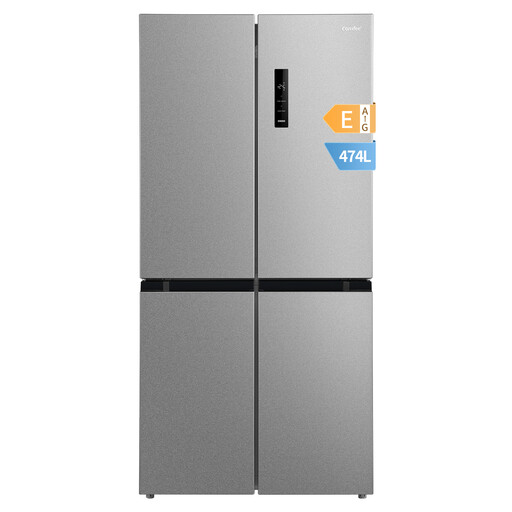 Image unavailable
Worth considering if you’re looking for a four-door appliance for a large family shop. The title lists an E energy rating and mentions a Flip Tray. Check the fresh and frozen food capacities, kWh/year, noise level and dimensions before comparing it with the other models.
Compare the energy rating, annual consumption in kWh, storage capacities and noise level. The European Commission says this information appears on fridge energy labels. For your shopping, check the space for fresh and frozen food separately.
Darty describes total no-frost technology as working in both compartments to prevent frost from forming. Check which technology is listed for the exact model: a different marketing name doesn’t necessarily describe the same set-up.
Put fresh and frozen food in the appropriate compartment promptly. The DGCCRF also recommends keeping transport time to a minimum, following the temperatures shown on packaging and checking your appliance’s manual for advice on where to store food.
You can take an old electrical appliance to a collection point or recycling centre, or return it to a retailer, in line with guidance from the Ministry for the Ecological Transition. If you’re considering an out-of-warranty repair instead, the Ministry of the Economy says the repair bonus requires, among other things, using an approved repairer. Check the scheme’s other conditions too.