Households of two to four people who shop weekly
A fridge-freezer lets you consider fridge and freezer capacity in a single appliance. Check the capacity of each compartment rather than relying on the total volume.


If you shop for a household and like to keep a well-stocked kitchen, start by comparing fridge and freezer capacity separately. UFC-Que Choisir suggests a general guide of 100 to 150 litres for one person, plus 50 litres for each additional person, adjusted to suit your shopping habits. A fridge-freezer is a good starting point if its split between fridge and freezer space meets your needs and room is limited. A multi-door or American-style model, or two separate appliances, may suit other storage needs, provided you check access, door clearance and the installation requirements for your chosen model.
A fridge-freezer lets you consider fridge and freezer capacity in a single appliance. Check the capacity of each compartment rather than relying on the total volume.
Freezer capacity becomes a key consideration if you batch-cook or regularly buy frozen food. You could also consider two separate appliances if this is an ongoing need and you have space for both.
A multi-door or American-style model may suit you if you need more storage space. Your choice will still depend on the available width, the delivery route and the clearance needed to open the doors.
First, choose a capacity that suits the food you store, then check that the format can be delivered, installed and used in your kitchen.
Worth considering: if one appliance gives you enough room for fresh and frozen food.
Keep in mind: freezer capacity may limit how much frozen food you can buy in bulk, even if the total volume seems sufficient.
Worth considering: if you want a fridge with two doors and a freezer with one or more drawers, a layout described by UFC-Que Choisir.
Keep in mind: some water dispensers need to be connected to the mains water supply, so check the model’s requirements.
Worth considering: if you need a large capacity and have enough room in your kitchen.
Keep in mind: UFC-Que Choisir notes that an American-style model can be almost a metre wide. Measure your delivery access too.
Worth considering: if your ongoing need for freezer space exceeds the capacity you can get from a fridge-freezer.
Keep in mind: you’ll need space for both appliances and should check the installation requirements for each one.
| Criteria | What to check | Consider your needs |
|---|---|---|
| Usable capacity | Compare fridge and freezer capacity in litres separately. UFC-Que Choisir suggests a general guide of 100 to 150 litres for one person, then 50 litres for each additional person; adjust this to suit your shopping habits. | I mainly store fresh food, or lots of frozen food: the split between compartments matters just as much as the total capacity. |
| Space and installation | Check the dimensions of the appliance and its packaging, the delivery route, door clearance and the ventilation requirements in the manual. For a built-in model, check the dimensions of the exact appliance niche too. | A large capacity is no use if the appliance won’t fit through to the kitchen or its doors can’t open properly once it’s installed. |
| Noise and energy | According to the European Commission, the EU label shows information including the A to G energy class, kWh per year, capacity and noise emissions. Compare appliances of similar formats and capacities. | In an open-plan kitchen, I want to be able to assess the stated noise level. For everyday use, I also check the kWh per year, not just the energy rating letter. |
| Fresh food storage | Make sure you can control the temperature and store food without overfilling the compartments. Anses recommends keeping the coldest part of the fridge between 0 °C and +4 °C. | If I regularly store prepared meals and fresh food, I need enough room to put them away without blocking the flow of cold air. |
Two appliances with the same total capacity may divide the space between fresh and frozen food differently. A large fridge won’t make up for a freezer that’s too small for your needs.
Make a note of how much space you need in each compartment, then compare the stated capacity in litres for both.
An appliance may fit in your kitchen but not through the doors or corridors on the way there. You’ll also need enough room to open its doors.
Measure the delivery route and the door clearance, then check the manual for the model’s ventilation and clearance requirements.
If delivery isn’t possible, or you need to rearrange your kitchen, installation could become more complicated.
The A to G rating alone doesn’t tell you the stated annual energy consumption, compartment capacity or noise level.
Check the EU label for kWh per year, capacity and noise emissions too, comparing appliances of similar formats.
More capacity is no substitute for suitable storage or the right temperature setting. UFC-Que Choisir also describes American-style fridges as more energy-intensive than standard formats.
Make sure the extra capacity suits your usual shopping habits. For fresh food, Anses recommends keeping the coldest part of the fridge between 0 °C and +4 °C and advises against overfilling it.
A brand worth considering for a freestanding fridge-freezer. According to Bosch’s product information, the KGN39VLCT-B measures 203 × 60 × 66,5 cm and offers 260 l of fridge capacity and 103 l of freezer capacity.
A brand worth considering if you have a specific built-in niche or are planning to pair a separate fridge and freezer. Liebherr offers built-in appliances designed for different niche heights.
A brand worth considering for larger formats: Samsung states that its American-style RS80F66KBTEF model has a capacity of 634 l and measures 912 × 1 784 × 726 mm.
This selection on Joybuy includes fridge-freezers, multi-door models and a side-by-side model to suit different storage needs. Compare their capacity with your available space and check the installation requirements for each model.
 Image unavailable
This multi-door format may suit a household looking to organise its food in a 467 l appliance. The product name specifies Total No Frost and an E energy rating. Check the dimensions, delivery access and door clearance for your kitchen.
 Image unavailable
This 360 l model offers another three-door format to compare for fresh and frozen food storage. Its name specifies Total No Frost, an E energy rating, Wi-Fi and My Zone. Check the capacity of each compartment and the installation requirements to see if it suits your needs.
 Image unavailable
If you store lots of frozen food, the product information lists 333 l of fridge capacity and 192 l of freezer capacity. It also specifies No Frost, 37 dB and an E energy rating. Check the dimensions, delivery access and the model’s kWh per year before comparing it with other formats.
 Image unavailable
This 495 l model may be worth considering if you’re looking for a larger format to store food for your household. Check the fridge and freezer capacities separately, the door clearance and, if you want to use a water dispenser, the connections required in the manual.
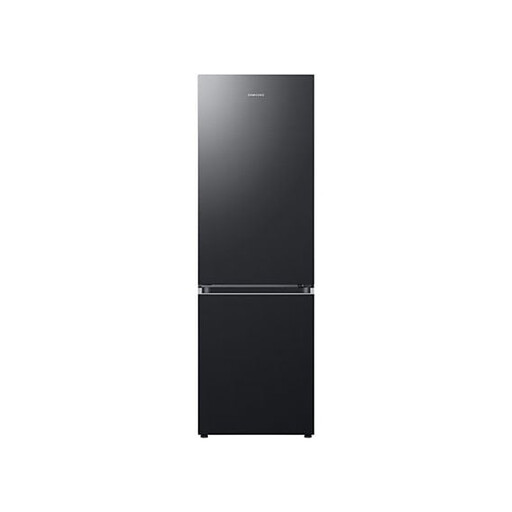 Image unavailable
This 344 l fridge-freezer lets you store fresh and frozen food in a single appliance. Check the capacity of each compartment, the depth, noise level and kWh per year to see if it suits your kitchen and your habits.
UFC-Que Choisir suggests a general guide of 100 to 150 litres for one person, then 50 litres for each additional person. Adjust this to suit how often you shop, and compare fridge and freezer capacity separately.
Measure the space where the appliance will go, as well as the doors, corridors and any lifts along the delivery route, taking the packaged dimensions into account. Then check door clearance and the model’s ventilation requirements. Samsung points out that the door-opening angle depends on the installation.
According to the European Commission, the EU label for the appliances concerned shows the A to G energy class, annual consumption in kWh, capacity and noise emissions. Compare these details across fridges of similar formats and capacities; the QR code takes you to the model’s information in EPREL.
Not necessarily: it depends on the model. UFC-Que Choisir notes that some front-facing water dispensers on multi-door models need to be connected to the mains water supply. Check the product information and manual for the model you’re interested in.
Anses recommends keeping the coldest part of the fridge between 0 °C and +4 °C. Check the temperature regularly and avoid overfilling the fridge so that cold air can circulate.