Families stocking up on frozen food
If you buy in bulk or prepare portions in advance, work out how much extra freezer capacity you need beyond your fridge freezer, then check how much room you have for a separate appliance.


If you want to add a large frozen food store and have enough floor space, consider a chest freezer. If you regularly look for foods stored in different categories, an upright freezer with drawers may suit you better. If you’re also short on fridge space and only need a modest increase in freezer capacity, compare larger fridge freezers by looking at their freezer capacity in litres, rather than just their total capacity. In every case, check the dimensions, the climate class for the room, energy consumption, noise levels and the model’s storage time in the event of a power cut.
If you buy in bulk or prepare portions in advance, work out how much extra freezer capacity you need beyond your fridge freezer, then check how much room you have for a separate appliance.
If you regularly look for different portions or packets, the drawers in an upright freezer make it easier to keep things separate. Remember to allow enough room to open the door and pull out the drawers.
If you’re also short on space for fresh food, it’s worth comparing a larger fridge freezer. Check its freezer capacity separately: a high total capacity doesn’t necessarily mean there’s lots of room for frozen food.
Consider one: if you need lots of room for family-sized frozen food stocks or bulky containers, and have enough floor space.
Bear in mind: food at the bottom takes more organising and is less easy to reach.
Consider one: if you regularly need to access different foods and want to organise them in drawers.
Bear in mind: check that the door and each drawer can open fully in the space you have in mind.
Consider one: if you need more room for both fresh and frozen food without adding a second appliance.
Bear in mind: only part of the total capacity is set aside for frozen food.
| Criteria | What to check | Think about your needs |
|---|---|---|
| Freezer capacity | Compare the capacity in litres for frozen food, not just the total capacity. For a fridge freezer, check the fridge and freezer capacities separately. | I want to know whether I need a large amount of extra freezer space or just a little more room in my main appliance. |
| Access and storage | Look at the model’s drawers, baskets and compartments. Check how easy it is to reach food at the bottom of a chest freezer. | For portions I use often, I’d rather be able to find them without moving everything else around. |
| Installation | Measure the space, access route and clearance needed to open the appliance. According to ADEME, the climate class should suit the room’s ambient temperature; check the manual for ventilation requirements too. | My garage, cellar or kitchen needs to suit the model and the temperatures it may reach throughout the year. |
| Energy use and noise | Compare the energy rating, kWh/year and dB(A) listed for each model. The European Commission says the label also gives the storage volume. | If the appliance will be near a living area, its noise level matters as much to me as its stated annual energy use. |
| Storage time in the event of a power cut | Check the stated number of hours for each model and pay attention to the conditions used for the measurement. In its tests, Que Choisir measures how long food stays below −9 °C during a simulated power cut. | I store a large amount of food or want to compare how long different models are said to keep it frozen during a power cut. |
A fridge freezer may seem spacious without offering much freezer space: Whirlpool lists a total capacity of 355 L for the WHK25404XBR5E, of which 106 L is for frozen food.
Work out how much extra freezer space you need, then compare the capacity for frozen food and the exact dimensions of each appliance.
The temperature in a garage, cellar or utility room may fall outside the ambient temperature range a model is designed for. ADEME recommends checking that the climate class is suitable for the room where you plan to install it.
Check the room’s temperatures throughout the year, then check the climate class and ventilation instructions for the model you’re considering.
The energy rating alone doesn’t tell you the annual energy use, noise level or storage time in the event of a power cut. As two separate examples, Beko lists 36 hours for the CF200EWN chest freezer, while Bosch lists 14 hours for the GSN51AWDV upright freezer.
For each model you’re considering, check the kWh/year, dB(A) and storage time in hours as well as its energy rating, taking its capacity and format into account.
These specifications apply to the models mentioned, not to every freezer made by each brand.
The CF200EWN is an example of a freestanding chest freezer to consider for extra storage.
The GSN51AWDV is a freestanding upright freezer to compare if easy access to your food is important to you.
Two models illustrate different choices: adding an upright freezer, or replacing a fridge freezer when you also need more room for fresh food.
These models include chest freezers in different capacities and a drawer-style upright freezer for extra frozen food storage. If you also need more room for fresh food, compare the fridge and freezer capacities of a fridge freezer separately before choosing an additional appliance.
 Image unavailable
Consider this chest freezer if you need plenty of space for frozen food, provided you have room for it and can organise easy access to items at the bottom.
The model name lists an E energy rating, LED lighting, a five-setting temperature control and a removable basket. The fridge and freezer modes are switchable, so don’t assume they can be used at the same time.
Before planning where to install it, check the model documentation for its climate class, clearance requirements and storage time in the event of a power cut.
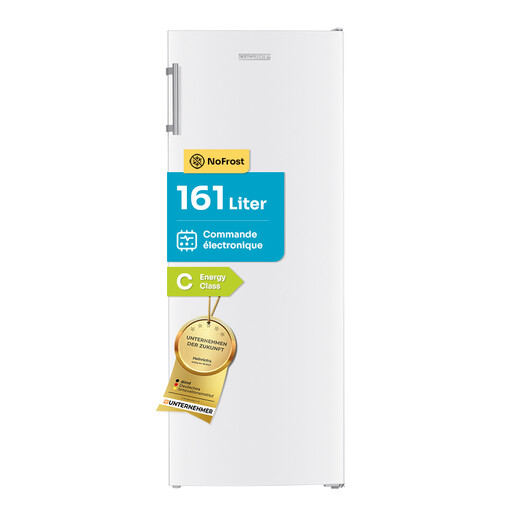 Image unavailable
This upright freezer may suit you if sorting and easy access to frozen food matter more than having a very large family-sized reserve.
The product title mentions drawers, trays, a reversible-hinge door, an alarm, a temperature range of −14 °C to −22 °C and a C energy rating. Compare its 161 L capacity with the extra space you need.
Before choosing where to put it, check its dimensions, the space needed to open the drawers, its climate class and its storage time in the event of a power cut.
 Image unavailable
At 95 L, this offers a more modest amount of extra space than a large chest freezer. Compare its capacity with the amount of frozen food storage you want to add.
The product name lists an E energy rating, a seven-setting thermostat and a removable basket. The fridge and freezer functions are described as switchable, rather than as two compartments that can be used at the same time.
If you plan to install it in a cellar or garage, check the model documentation for its climate class, as well as its clearance requirements and stated storage time in the event of a power cut.
 Image unavailable
This chest freezer is for more limited extra storage rather than a large family-sized reserve. Check whether 99 L will give you the space you need.
The product title mentions a removable wire basket, a sliding lid, an adjustable thermostat and an E energy rating.
Before comparing it with other chest freezers, check this model’s defrosting method, annual energy use, storage time in the event of a power cut and climate class.
 Image unavailable
With a stated capacity of 140 L, this chest freezer sits between the under-100 L models featured here and the 291 L AUCMA chest freezer. Choose according to how much extra space you need.
The product title mentions a storage basket, a counterbalanced lid, an adjustable temperature control, adjustable feet and an E energy rating.
Check the room needed to open the lid, as well as the model’s annual energy use, noise level, storage time in the event of a power cut and climate class.
No. Compare the capacities of specific models rather than judging by format alone. Que Choisir says chest freezers can hold up to 600 L, while upright freezers typically hold around 200 L and can reach 400 L. Floor space and access to food are important factors too.
Compare the model’s energy efficiency rating, annual energy use, storage volume and noise emissions. The European Commission says this information is shown on the label. Consider it all together, as the energy rating letter alone doesn’t cover every factor that matters in day-to-day use.
Yes, provided the room’s ambient temperature stays within the range specified by the model’s climate class. ADEME recommends checking the temperature range suitable for the installation location. Also check the manual for the required clearance and ventilation.
It lets you compare the stated storage time between models, but doesn’t guarantee the same duration in every home or under all conditions. The testing method matters: in its test procedure, Que Choisir measures how long food stays below −9 °C during a simulated power cut.