Households that shop less often
If your fridge fills up after each big shop, compare the space you need for fresh and frozen food separately. Whether you choose one or two appliances also depends on the space available in your home.


If your fresh food and usual supply of frozen food fit in one appliance, compare the capacity of each compartment in a fridge-freezer, fridge-freezer combination or multi-door model. If you regularly freeze meals or buy a lot of frozen food, a separate freezer may suit you better: an upright freezer makes it easier to organise food in drawers, while a chest freezer takes up more floor space and needs to be organised carefully. Whichever you choose, check the dimensions and the permitted ambient temperature at the intended location.
If your fridge fills up after each big shop, compare the space you need for fresh and frozen food separately. Whether you choose one or two appliances also depends on the space available in your home.
If you regularly store portions and prepared meals, it’s worth considering a separate freezer. An upright freezer’s drawers help you organise food, while a chest freezer gives you more flexibility for bulky items but needs to be organised carefully.
A separate room can accommodate a supply of frozen food, provided the appliance fits and is easy to access. Above all, check that the permitted ambient temperatures for the model match those in the room, especially if it isn’t heated.
Start by working out how much space you need for fresh and frozen food, then decide whether you have room for a second appliance. The format isn’t the only deciding factor: access to your food and installation requirements matter too.
| Factor | What to check | What I need |
|---|---|---|
| Fresh and frozen capacity | Compare the net capacities of both compartments, not just the total capacity. For fridge space, UFC-Que Choisir gives an average guide of 100 to 150 L for one person, plus 50 L for each additional person; adjust this to suit your shopping habits. | After shopping, I want enough room to put away fresh food without reducing the space set aside for frozen food. If I freeze food regularly, I check the freezer capacity separately. |
| Choosing a format | A fridge-freezer combination keeps fresh and frozen food in one appliance. A multi-door model may suit you if you want a larger integrated appliance, provided its dimensions fit. If you want a separate freezer for frozen food, compare upright and chest models based on the space available. | I’d prefer one place for fresh and frozen food, or I have a room where I can install a separate freezer for larger shops. |
| Access to food | Look at the drawers in an upright freezer, how easy it is to reach the bottom of a chest freezer, and whether the doors can open fully in your kitchen. UFC-Que Choisir notes that chest freezers can hold up to 600 L, but their open compartments need to be organised carefully. | I often take out small portions and want to find them quickly. Alternatively, I can use a chest freezer for large supplies or bulky items. |
| Location | Measure the appliance, the route to the room and the space needed to open doors, drawers or the lid. As ADEME advises, check the recommended ambient temperature for the freezer you choose. | If the appliance is going in a cellar, garage or pantry, I check that the temperature range specified for the model suits the room. |
| Everyday use | Compare the stated storage time in the event of a power cut, annual energy consumption and noise levels for the models you’re considering. UFC-Que Choisir measures how long food stays cold during a simulated power cut, among other things; don’t assume the storage time based on the format alone. | I want to consider both the appliance’s everyday running costs and how long it’s stated to keep food frozen during a power cut. |
A large stated capacity doesn’t tell you how much space is available for frozen food. If your household stores a lot of it, the freezer compartment may fill up before the fridge.
Estimate how much fresh and frozen food you store separately, then compare the net capacity of each compartment.
A chest freezer takes up floor space and needs enough clearance for the lid to open. The temperature in an unheated cellar or garage may also fall outside the range permitted for some models.
Measure the route, the space available and the clearance needed to open the lid, then compare the room’s temperatures with the limits specified for the model.
A chest freezer can hold bulky items, but food at the bottom may be harder to find than in the drawers of an upright freezer.
If you often take out small portions, look at how an upright freezer is organised. If you choose a chest freezer, plan a system that works for the food you store.
An alarm or automatic defrosting doesn’t make it any less important to check a model’s storage time during a power cut, annual energy consumption and noise levels.
First compare these features across appliances that suit your space and storage needs. Then choose any useful convenience features to match the way you’ll use it.
These brands offer models to compare across different formats. The features mentioned apply to the ranges or models specified, not to every appliance they make.
Bosch Electroménager France offers fridge-freezers and multi-door models: two formats to consider if you want to store fresh and frozen food in one appliance.
Liebherr offers a range of chest freezers for households considering a separate supply of frozen food.
Beko is a brand to consider if you’re looking for a chest freezer for a separate room.
Electrolux France features the KUN7NE18S built-in upright freezer, which may suit you if you have a suitably sized housing unit.
This selection includes fridge-freezers that keep fresh and frozen food together, as well as an upright freezer for extra dedicated storage. First compare their capacities and the space they need with your shopping habits.
 Image unavailable
For storing fresh and frozen food in one appliance, this model has a stated capacity of 235 L for the fridge and 125 L for the freezer. It has three freezer drawers and features Total No Frost, a storage time of 11 h and dimensions of 185 × 59,5 × 66,7 cm. Check the installation clearances and permitted ambient temperatures for your chosen location.
 Image unavailable
If you’re looking for a large appliance that combines fresh and frozen storage, this model has a stated capacity of 311 L for the fridge and 156 L for the freezer. It features four doors, two freezer drawers, Total No Frost and a storage time of 10 h. Measure the clearance needed to open the doors and check the installation clearances and permitted ambient temperatures.
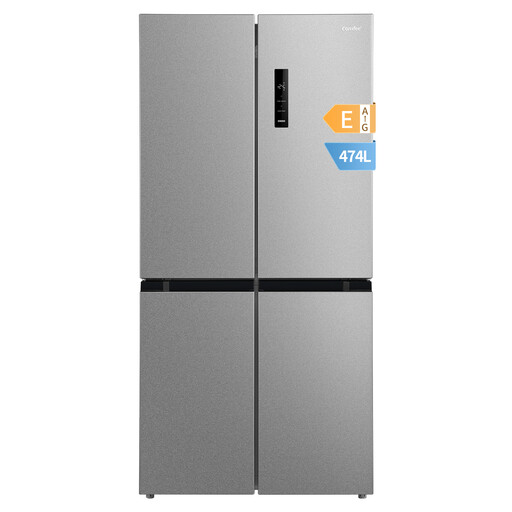 Image unavailable
This four-door model has a stated total capacity of 474 L and may suit a household looking to store its shopping in one appliance. Its product details say that two freezer drawers can be combined to fit certain bulky items. Before deciding how much room it offers for frozen food, check the net capacity of each compartment, as well as the defrosting system, storage time during a power cut and installation requirements.
 Image unavailable
If you want a separate supply of frozen food, this freezer has a stated capacity of 161 L and three freezer drawers; its product details also specify No Frost. Compare its capacity with the amount you usually store. Also check its dimensions, ambient temperature range, storage time during a power cut and annual energy consumption for the intended location.
 Image unavailable
For storing fresh and frozen food in one appliance, this model has a stated total capacity of 444 L and features Total No Frost. Its product details give an ambient temperature range of 10 to 43 °C. Check the net capacity of each compartment, the interior layout and the dimensions before deciding whether it suits your kitchen and frozen food supplies.
Choose based on how you like to organise and take out food: an upright freezer’s drawers make it easier to sort small portions, while a chest freezer offers space for large supplies and bulky items, if you have enough floor space. UFC-Que Choisir says chest freezers can hold up to 600 L; nevertheless, compare the capacity of the models you’re considering with what you actually need.
Yes, provided the room’s temperature stays within the range permitted for the model you choose and there’s enough space for installation. Check its minimum and maximum ambient temperatures: Beko France’s stated suitability for temperatures as low as -15 °C applies to its HSM14540, not to every freezer.
It helps you compare how long a freezer keeps food cold without a power supply, according to the method used to measure it. UFC-Que Choisir simulates a power cut as part of its testing process; check the figures for the specific model rather than estimating them from its size or format.
Start with the capacity of each compartment and annual energy consumption, then check the noise level, permitted ambient temperatures and the model’s dimensions. The European Commission lists these details in the EPREL records for relevant appliances, helping you check whether a model suits your supplies and its intended location.
Arrange for it to be taken away when your new appliance is delivered or when you visit a shop. ADEME says an old refrigeration appliance can be handed over to the retailer or delivery person when you replace it; arrange collection with the retailer before your new appliance arrives.