Households stocking up
You buy or prepare food in bulk and need more freezer space for the long term. Your main considerations are capacity and floor space, two criteria highlighted by Que Choisir.


To increase your family’s frozen food storage capacity for the long term, choose according to usable capacity, available space and how often you’ll need access. A chest freezer suits a large stock of food, while an upright freezer makes it easier to organise items in drawers. An under-counter model may be enough as an extra freezer. Que Choisir highlights the importance of ease of use as well as capacity. Consider a large fridge freezer mainly if you also need more fridge space, and compare freezer capacity separately.
You buy or prepare food in bulk and need more freezer space for the long term. Your main considerations are capacity and floor space, two criteria highlighted by Que Choisir.
You want to find different foods quickly and make sure the drawers, door opening and maintenance are all convenient. Que Choisir reminds us that ease of use matters too.
You have space outside the kitchen. Compare the actual temperatures in the room with the range the model can handle, especially in winter.
Start by choosing a style to suit the amount of food you store and how you access it. The differences between chest, upright, under-counter and fridge-freezer models go beyond capacity.
Choose this if: you take out portions often and have enough room for the door and drawers to open.
Bear in mind: drawers make it easier to organise food, but their dimensions may limit storage for larger items.
Choose this if: you’re stocking up on a large amount of food or storing bulky items, and have enough floor space.
Bear in mind: you’ll need to organise food to reach items at the bottom, and the defrosting method varies by model.
Choose this if: you’re looking for an extra freezer and its capacity is enough for your needs once you’ve checked how much food you store.
Bear in mind: some compact models are designed to be built in; check the dimensions of the space and the installation requirements.
Choose this if: you also need to replace or upgrade your fridge and want both functions in one appliance.
Bear in mind: the total capacity includes both compartments, so it doesn’t tell you the freezer capacity on its own.
For a household in France looking to increase its freezer capacity for the long term, the needs below represent distinct buying priorities.
| Criteria | What to check before buying | Who prioritises it most |
|---|---|---|
| Freezer capacity | List the food you want to store together and compare the usable capacity of the freezer compartment. Don’t confuse it with the total capacity of a fridge freezer. | If I buy food in bulk, I want to know how much frozen food will actually fit in the appliance. Around 25% of consumers concerned make capacity their top priority. |
| Access and storage | Check the layout and dimensions of the drawers or baskets, as well as the exact defrosting method. | If I take out portions often, I want to find and remove food without rummaging through the whole freezer. Around 20% of consumers prioritise easy access to portions. |
| Location | Measure the access route, available height and door clearance. Compare the room temperature with the conditions the model can handle. | If the appliance is going in a pantry or garage, I need to check both its dimensions and the actual room temperature. Around 20% of consumers put suitability for the location first. |
| Everyday use | Compare kWh/year and noise in dB(A), then check whether it needs manual defrosting. | For an appliance that runs all the time, I want to compare electricity use, noise and maintenance before choosing. Around 20% of consumers prioritise these everyday-use factors. |
| Keeping food frozen | Check the stated power-cut storage time or a test of the exact model, but don’t treat it as a guarantee that food will be safe after a power cut. | If a family stockpile needs to last through a power cut, I want to know the stated storage time and how to check the food afterwards. Around 15% of consumers make keeping food frozen their top priority. |
The total capacity of a fridge freezer includes the fridge compartment, so it can disguise the fact that the freezer may not have enough space for the food you want to store.
Compare the capacity of the freezer compartment alone with that of the standalone appliance you’re considering.
The permitted temperature range and suitability for cold conditions depend on the specific model. The name of the room won’t tell you whether its temperature is suitable.
Check the room temperature and the limits given in the model’s instructions.
If the location isn’t suitable, you may need to move the appliance or choose another model.
Manufacturers use different technologies. A system that reduces frost doesn’t necessarily eliminate the need to defrost.
Check the cooling technology and care instructions for the exact model.
If defrosting is still required, allow time for this maintenance.
The stated duration varies between appliances and depends on the conditions under which it was measured. On its own, it doesn’t tell you whether food will still be safe to eat after a breakdown.
Keep the door closed during a power cut, then check the food and follow the food safety guidance for thawed products.
You may have to throw away thawed food if it can’t be stored safely.
The GSN58AWCV is an example of a family-sized upright freezer with drawers.
The CFd 2505 Plus is an example of a large-capacity chest freezer.
The HSM14540 is a mid-capacity chest freezer for home use.
The LUB3AE88S is a compact built-in freezer to consider as an extra appliance.
The RB38T650ESA/EF is an example of a fridge freezer to consider if you also need more fridge space.
This selection includes an upright freezer with drawers and chest freezers ranging from 95 to 291 l, so you can compare options for extra storage or a family stockpile to suit the space you have available.
 Image unavailable
This upright freezer could suit you if you want to keep different portions organised separately.
161 L; three freezer drawers and two drawers; No Frost; energy rating C.
 Image unavailable
This chest freezer could suit you if you’re looking for mid-sized storage and would like a basket to help keep things organised.
140 L; energy rating E; basket; counterbalanced lid; dimensions: 637 × 556 × 846 mm.
 Image unavailable
With a stated capacity of 291 L, this chest freezer could suit you if you need more storage. You can switch between fridge and freezer modes, but they can’t run at the same time.
Energy rating E; 226 kWh/year; 38 dB; five-level digital control; dimensions: 1100 × 597 × 872 mm.
 Image unavailable
This compact model could suit you if 95 L is enough as an extra freezer. You can switch between fridge and freezer modes, but they can’t run at the same time.
Energy rating E; 165 kWh/year; 38 dB; seven-level thermostat; removable basket; dimensions: 550 × 475 × 848 mm.
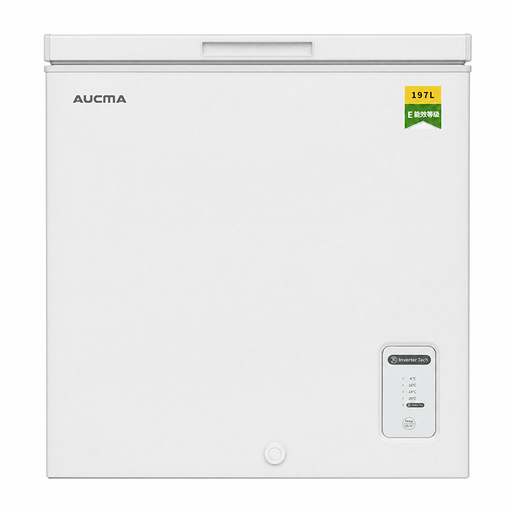 Image unavailable
This 197 L chest freezer could help you increase your frozen food storage. You can switch between fridge and freezer modes, but they can’t be used at the same time.
197 kWh/year; 38 dB; five-level digital control; removable basket; dimensions: 816 × 554 × 848 mm.
No. Compare the ambient temperature range stated for the model with the actual temperatures in the room. Liebherr states that the CFd 2505 Plus chest freezer, and Beko that the HSM14540, are specifically suitable for temperatures as low as −15 °C. This doesn’t apply to every model.
The French Ministry of Agriculture recommends setting it to −18 °C. Also check the instructions to distinguish between storing food that is already frozen and freezing fresh food, which depends on the compartment and its specifications.
No. Check the technology and care instructions for the specific model. Bosch states that the GSN58AWCV is No Frost, while Liebherr describes SmartFrost on the CFd 2505 Plus as a technology that reduces the need to defrost.
No. The storage time is specific to the model and the conditions under which it was measured. In its testing protocol, Que Choisir measures, among other things, how long it takes for the temperature to rise from −17 °C to −9 °C without power. After a breakdown, check the food; the French Ministry of Agriculture advises against refreezing food that has thawed.
Compare the capacity of the freezer compartment alone with the usable capacity of the standalone appliance. A fridge freezer’s total capacity also includes the fridge compartment, so it doesn’t tell you how much room is available for frozen food.