Buying priorities
Start with the capacity you are genuinely missing, then choose the format based on how often you access your food and the conditions in the room where the appliance will be installed.
| Priority |
What to check |
Your needs |
| Additional capacity |
Compare the frozen-food compartment capacity, not the total capacity of a fridge freezer. A chest freezer can hold up to 600 L according to Que Choisir; upright models are often around 200 L and can reach 400 L. |
I want to know how many portions, bags or bulk items I genuinely need to add to my reserves. A small supplementary appliance may be enough if the shortfall is only occasional. |
| Access and storage |
Look at the number, size and ease of use of the drawers. For a chest freezer, check the baskets available and plan a system for organising and rotating your stock. |
If I regularly need to find prepared meals, I prefer separate compartments. If I mainly store large bags or parcels, an open chest may be more suitable. |
| Space and installation room |
Measure the width, depth, height, delivery routes and the space needed to fully open the lid or door. Check the climate class or the ambient temperatures permitted for the model. |
I need to be able to install the appliance without obstructing movement around the room. For a garage, cellar or cold utility room, I check that the operating conditions match the space. |
| Energy consumption and temperature retention |
For models of a similar size and intended use, compare kWh/year, frozen-food capacity and noise levels. Also check the stated holdover time in the event of a power cut and how it was measured. |
I want to compare clear long-term information rather than relying solely on an energy-efficiency letter. The EU energy label includes annual consumption, capacities and noise levels, among other details. |
Joybuy products
Joybuy options for increasing your family’s freezer space, including chest freezers for bulk reserves, a drawer freezer for everyday organisation and a compact supplementary model.
 Image unavailable
AUCMA 291 L convertible chest freezer
Suitable for bulk shopping and family reserves when you have enough floor space.
291 L capacity, top opening, removable basket, LED lighting, five-level digital control and stated consumption of 226 kWh/year. Stated dimensions: 1100 × 597 × 872 mm.
For a garage or cold cellar, check the climate class or ambient temperature range, as well as the holdover time in the event of a power cut. With only one basket specified, plan a category-based storage system.
Joybuy
 Image unavailable
Heinrich’s 161 L No Frost upright freezer
An organised option for separating portions and foods you access frequently.
Stated capacity of 161 L, three drawers, two shelves, No Frost protection, LED display, alarm, reversible door and a stated temperature range of -14 °C to -22 °C.
Check the dimensions, door-opening clearances, kWh/year, holdover time in the event of a power cut and room-temperature conditions before installation.
Joybuy
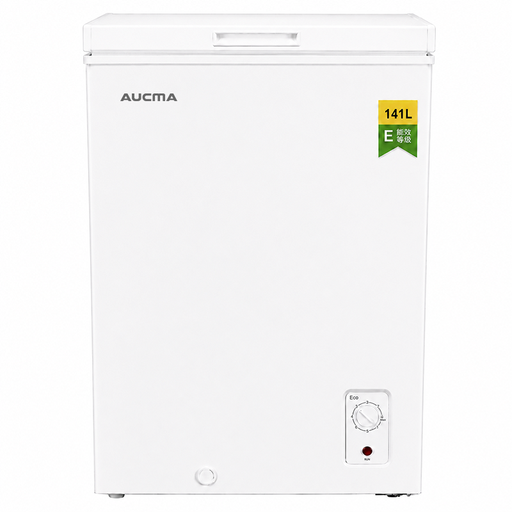 Image unavailable
AUCMA 141 L convertible chest freezer
Could suit a moderate family reserve containing bulky items.
141 L capacity, stated four-star freezing, removable basket, seven-level thermostat, defrost drain and stated annual consumption of 179 kWh/year. Stated dimensions: 632 × 554 × 848 mm.
Check the ambient temperature range and the model’s holdover time before installing it in a garage or cellar. The chest format requires regular rotation of stored food.
Joybuy
 Image unavailable
AUCMA compact 95 L convertible chest freezer
A supplementary solution when you occasionally or moderately need more freezer space.
95 L capacity, stated four-star freezing, removable basket, seven-level thermostat, adjustable feet, defrost drain and stated annual consumption of 165 kWh/year. Stated dimensions: 550 × 475 × 848 mm.
Assess the volume of food you need to add if you regularly make large family shops. Also check compatibility with the room temperature and the model’s holdover time.
Joybuy
 Image unavailable
TCL CF182EWE0FR 140 L chest freezer
An intermediate capacity for adding separate storage without opting for a large chest freezer.
Stated capacity of 140 L, storage basket, counterbalanced lid, castors, adjustable feet, mechanical controls and front defrost drain. Stated dimensions: 637 × 556 × 846 mm.
Before buying, check kWh/year, noise, holdover time in the event of a power cut and the room-temperature conditions. The basket makes some of the contents easier to reach, but an organised storage system is still useful.
Joybuy
Frequently asked questions
Does a separate freezer really offer more than a large fridge freezer?
Yes, when it addresses a distinct shortage of frozen-food storage. According to Que Choisir, separate freezers remain useful for large families thanks to their greater capacity; with a fridge freezer, compare the capacity of the frozen-food compartment rather than the appliance’s total capacity.
Can I install any freezer in a garage or cellar?
No. Check the climate class or the minimum and maximum ambient temperatures permitted for the exact model. Que Choisir points out that this class indicates the temperatures in the room where the appliance is installed; the Beko HSM14540, for example, states a minimum operating ambient temperature of -15 °C.
Which parts of the energy label should I compare?
For the relevant household refrigeration appliances, the A to G label shows the annual consumption in kWh, storage capacities, noise level and a QR code linking to EPREL, among other details. Focus on comparing kWh/year, frozen-food capacity and noise levels between appliances of a similar size and type.
Can holdover time during a power cut be compared between models?
It is a useful criterion, but check the measurement basis and the figure published for the exact model. Que Choisir’s procedure simulates a power cut and measures how long food remains preserved below -9 °C; a manufacturer’s product sheet may state holdover time using a different method. Do not assume that a chest freezer automatically lasts longer than an upright freezer without comparable data.


