Households serving two dishes together
If your main and side need different settings, two independent zones let you cook them at the same time. Check the capacity of each zone and whether there’s a function to synchronise the cooking times.


If you’re cooking a main and a side that need different settings, choose two independent cooking zones and check whether their finish times can be synchronised. A large basket or adaptable cooking chamber is better suited to a large item; if you mainly cook on trays or racks, compare a mini oven too. In every case, the usable dimensions of the cooking zones, the appliance’s footprint and the parts that need cleaning matter more than the stated total capacity alone.
If your main and side need different settings, two independent zones let you cook them at the same time. Check the capacity of each zone and whether there’s a function to synchronise the cooking times.
For a chicken, a roast or a large quantity cooked in one zone, check the basket’s usable dimensions before looking at the number of programmes. A single or adaptable cooking chamber may save you from splitting the dish between two small drawers.
Stacked drawers are worth considering if width is your main constraint. Also measure the depth and height, check how far the drawers open, and allow for the clearances specified in the instructions.
For several portions on a weeknight, start with the kind of meals you usually cook, then check that the appliance and its parts will fit in your kitchen.
Worth considering: if you mainly cook one dish or a large item.
Trade-off: a single zone won’t let you set a separate temperature for a side dish.
Worth considering: if your main and side need different settings; stacked drawers are also worth a look if you’re short on width.
Trade-off: capacity is split between the zones, while a vertical format still needs enough depth and height.
Worth considering: if you mainly use trays, racks or oven dishes rather than baskets.
Trade-off: compare the internal dimensions, installation space and parts to wash rather than assuming it will be more compact.
| Feature | What to check | What matters to shoppers |
|---|---|---|
| Cooking at the same time | Whether the two zones work independently and whether their finish times can be synchronised. | If I’m cooking a main and a side with different settings, I want to serve them together. Around 36% of shoppers would prioritise this. |
| Usable capacity | The internal dimensions of the main zone and the space needed for the dishes you usually cook. | For a large item or several identical portions, I want to avoid cooking in multiple batches. This would be the top priority for around 29% of shoppers. |
| Footprint | Width, depth, height and the clearances specified in the instructions. | When worktop space is limited, the appliance needs to fit and open without getting in the way. Nearly 21% of shoppers would put this constraint first. |
| Cleaning | How many parts need washing and whether each one is dishwasher-safe. | If I cook this way several evenings a week, I want to keep the post-meal washing-up to a minimum. Around 14% of shoppers would put ease of cleaning ahead of other features. |
The total capacity may be divided between narrow drawers, and doesn’t tell you whether your bulkiest dish will fit in one zone.
Measure the dish, then compare its size with the internal dimensions of the basket or each drawer.
Two zones let you cook different dishes separately, but the divider may get in the way of a large item or a single dish.
Choose based on what you cook most often: two separate items, or a dish that needs one large zone.
A vertical model may take up less width but need more height and depth, as well as room to open its drawers.
Measure the full space available and check the clearances specified in the model’s instructions.
An appliance with several drawers, racks or trays has more parts to remove and clean.
Check which parts are actually dishwasher-safe and how to reach areas exposed to splashes.
The range includes an adaptable cooking chamber and stacked baskets, two configurations to consider depending on whether you prioritise one large dish or two separate cooking zones.
Models with drawers of different sizes may suit households that want to use one zone for the main and the other for a side.
The Double Stack range offers two stacked drawers for households looking to save worktop width.
These appliances, with two drawers or cooking chambers, are worth considering if you want to cook two parts of a meal at the same time. Compare the space in each zone with your usual portions: the total capacity alone doesn’t tell you how large a dish will fit.
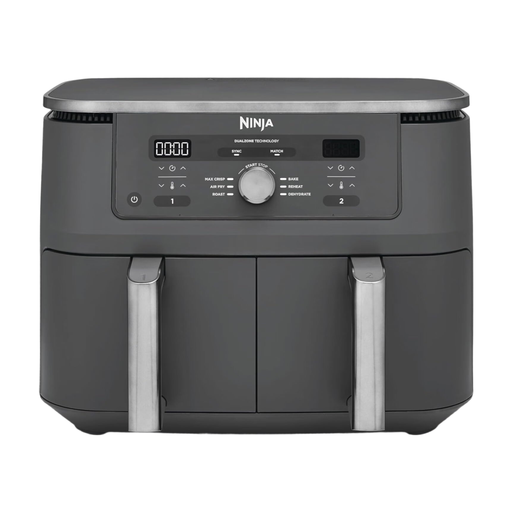 Image unavailable
Worth considering if you want to cook your main and side in separate drawers. The stated total capacity is 9.5 L; the product name says the baskets are dishwasher-safe. Check the internal dimensions and the space needed to open the drawers.
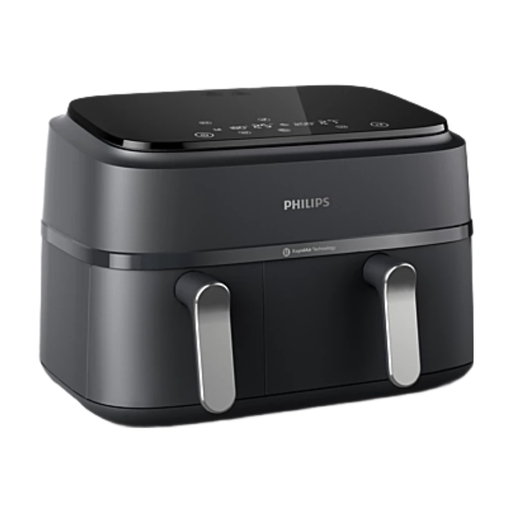 Image unavailable
The dual basket lets you cook a main and a side in separate zones. The stated 9 L capacity is the total: check the size of each basket, the usable dimensions and the space needed to open them.
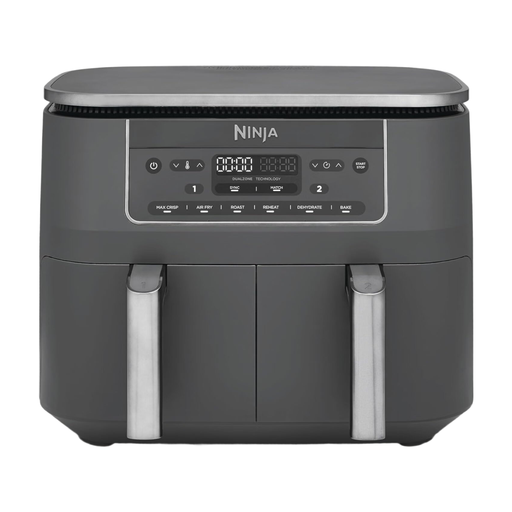 Image unavailable
This two-drawer design is worth considering when you want to cook different parts of a meal separately. The 7.6 L is the total capacity, not the capacity of one drawer; check that your dishes will fit in each zone. The product name says the baskets are dishwasher-safe.
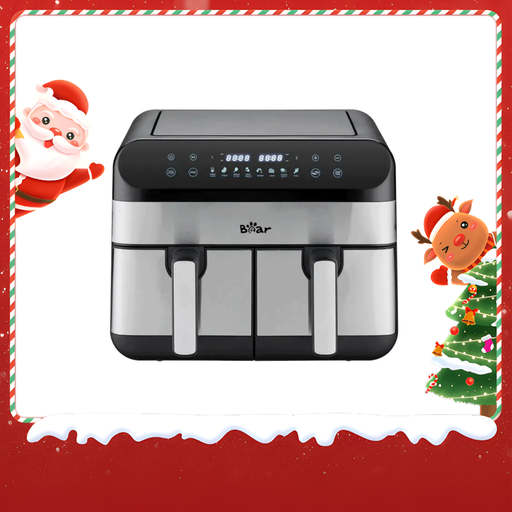 Image unavailable
Worth considering for two dishes cooked in separate baskets. The product name lists a total capacity of 9 L, a rated power of 2,400 W and independent temperature control. Check the dimensions of each basket and the care instructions before buying.
 Image unavailable
The two chambers are worth considering if you want to cook different parts of a meal separately. The 9 L refers to the total capacity; check the space available in each chamber, the appliance’s footprint when installed and the cleaning instructions for its parts.
UFC-Que Choisir gives 6 L as a guideline minimum for a family of four. This doesn’t guarantee that your portions or dishes will fit, so check the internal dimensions and, on a dual model, the capacity of each drawer.
They can for two dishes that need different settings, but not necessarily for a large item or a single dish. In that case, compare the space offered by a single or adaptable cooking chamber with the space in each separate drawer.
Count the baskets, racks and trays that need cleaning, then check whether each part is dishwasher-safe. Also look at the cleaning instructions for areas exposed to splashes.
A mini oven is worth comparing if you regularly cook with trays, racks or oven dishes rather than food spread across baskets. Check that the interior will fit your dishes, as well as the installation space and parts that need washing; the format alone doesn’t guarantee equivalent cooking results.