If you’re having a mint drink late in the evening, choose an infusion explicitly labelled caffeine-free if avoiding the caffeine in tea is your priority: France’s food safety agency, Anses, warns that caffeine in tea can delay falling asleep. If you prefer the taste of green tea or specifically require Fairtrade/Max Havelaar certification, check the ingredients and logo on the box separately. Another fair-trade claim or certification does not prove that a product has this certification.
Who are these options for?
People watching their caffeine intake in the evening
If you have a mint drink after dinner, it’s worth distinguishing between tea and herbal infusions. Anses warns that tea naturally contains caffeine, which may affect sleep. Look for an explicit “caffeine-free” label if you want to avoid it.
Shoppers looking for a specific fair-trade certification
If you’re looking for Fairtrade/Max Havelaar, check the logo, the named standard and which ingredients it covers. A “organic” claim, Rainforest Alliance or Fair for Life does not, on its own, mean the product has Fairtrade/Max Havelaar certification.
Fans of mint green tea
If you prefer a recipe made with green tea leaves, compare the ingredients in mint teas rather than treating them as herbal infusions. This means the drink still contains the caffeine naturally present in tea, which is worth bearing in mind if you’re having a cup late in the evening.
What should you check before buying?
For a late-night snack, first choose between green tea and an infusion based on whether you want to avoid caffeine. Then check the exact fair-trade standard and the ingredients in your chosen recipe.
| What to consider |
What to check |
Who it’s for |
| Caffeine in the evening |
Check the ingredients for green tea, or look for an explicit “caffeine-free” label on the infusion. |
If I have my drink close to bedtime, I prefer to avoid the caffeine in tea. Around 42% of consumers would make this their priority. |
| Fair-trade certification |
Check the logo and the name of the standard, then see which ingredients it covers and whether any conditions apply. |
I want to know exactly what a fair-trade claim covers before choosing a box; this would be the top criterion for around 33% of consumers. |
| Recipe and format |
Compare whether the product contains green tea, any added herbs or flavourings, and the number of tea bags. |
For an accompaniment to my snack, I’m mainly looking for a recipe or format that suits me; around 25% of consumers would prioritise this. |
What should you avoid confusing?
-
Assuming green tea is the same as a caffeine-free infusion
Mint green tea contains tea, and therefore naturally contains caffeine. According to Anses, caffeine can delay falling asleep and reduce the length or quality of your sleep.
For a caffeine-free cup late in the evening, look for this claim on the infusion and read its ingredients. An herbal recipe may not taste the same as mint green tea.
-
Assuming different certifications mean the same thing
Fair-trade claims, Fair for Life, Rainforest Alliance and Fairtrade/Max Havelaar are not interchangeable. Max Havelaar France describes Fairtrade as a certification system involving independent checks.
If you specifically require Fairtrade/Max Havelaar, look for its logo and wording on the box rather than relying on an “organic” or “fair trade” claim alone.
-
Assuming a claim covers the whole recipe
Carrefour France’s product page for Jardin BiO étic mint green tea states that 90% of the ingredients of agricultural origin meet fair-trade standards. This does not mean that every ingredient is covered, or that the box necessarily carries the Fairtrade/Max Havelaar label.
Check which ingredients are covered and look for any details on the box, including “subject to availability” where applicable.
-
Choosing an infusion without checking the other herbs
Pukka peppermint and liquorice infusion contains liquorice. Carrefour France’s product page warns people with high blood pressure to avoid excessive liquorice consumption and advises seeking guidance during pregnancy.
Check the ingredients and any recipe-specific warnings, even if being caffeine-free is your main priority.
Brands and recipes to know
Jardin BiO étic
A green mint tea to consider if you want to check what proportion of its agricultural ingredients is covered by a fair-trade claim.
- For this recipe, Carrefour France’s product page lists 80% green tea, 10% spearmint and 10% nanah mint extract, as well as 90% of agricultural ingredients meeting fair-trade standards.
- The wording “subject to availability” means it’s worth checking the details on the box. The claim alone does not confirm that the product carries the Fairtrade/Max Havelaar label.
Pukka
A peppermint and liquorice infusion to consider if avoiding caffeine matters more to you than the taste of mint green tea.
- Carrefour France’s product page describes this recipe as naturally caffeine-free, with 60% peppermint and 40% liquorice. It states that its ingredients are covered by Fair for Life.
- Fair for Life does not prove Fairtrade/Max Havelaar certification. Liquorice comes with warnings about excessive consumption for people with high blood pressure, as well as advice to seek guidance during pregnancy.
Lipton
A 50-tea-bag box of mint green tea to consider if you want to compare a tea-based recipe and its format.
- For this product, Carrefour France lists 64% green tea, 27% spearmint and 9% natural mint flavouring. The tea leaves are stated to be Rainforest Alliance certified.
- Rainforest Alliance is separate from Fairtrade/Max Havelaar. As this product contains green tea, remember to consider its caffeine content if you’re drinking it late in the day.
A mint infusion on Joybuy
This peppermint and liquorice infusion is a caffeine-free mint drink option for a late-night snack. If you specifically require Fairtrade/Max Havelaar, note that its Fair for Life standard is different.
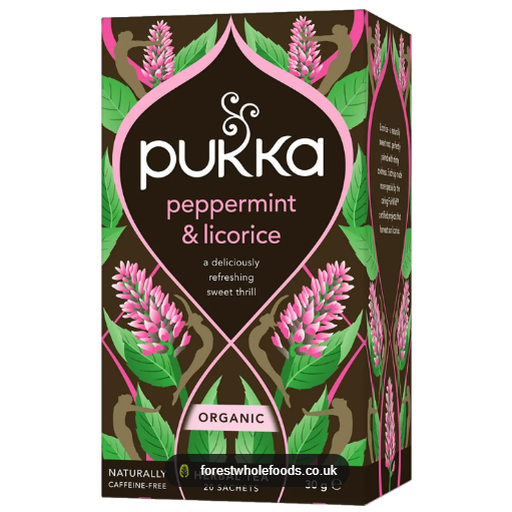 Image unavailable
Pukka Peppermint & Licorice, 20 tea bags
An infusion described as naturally caffeine-free, for anyone who prefers to avoid the caffeine in tea with a late-night snack.
This recipe combines 60% peppermint and 40% liquorice. It is stated to meet the Fair for Life standard, which is not proof of Fairtrade/Max Havelaar certification. If you’re looking for that specific label, check the wording and logo on the box.
Carrefour France’s product page for this recipe warns people with high blood pressure to avoid excessive liquorice consumption and advises seeking guidance during pregnancy.
View on Joybuy
Frequently asked questions
Is mint green tea suitable for a late-night snack?
It naturally contains caffeine, which is worth bearing in mind if you drink it close to bedtime. Anses says caffeine can delay falling asleep and reduce the length or quality of your sleep. To avoid it, look for an infusion explicitly labelled caffeine-free.
Is organic mint tea always Fairtrade/Max Havelaar certified?
No. “Organic” and Fairtrade/Max Havelaar refer to different schemes. For the Jardin BiO étic tea described by Carrefour France, the fair-trade claim covers 90% of the ingredients of agricultural origin. If you specifically require Fairtrade/Max Havelaar, check the logo and wording on the box separately.
Do Rainforest Alliance and Fair for Life prove Fairtrade certification?
No. They are separate standards from Fairtrade/Max Havelaar. Carrefour France’s product page lists Rainforest Alliance for the green tea in the Lipton product and Fair for Life for the Pukka infusion. Choose according to the standard actually stated on the product.
What should you check in a peppermint and liquorice infusion?
Check the proportion of liquorice and any warnings for the recipe, even if the infusion is caffeine-free. Carrefour France’s product page for Pukka peppermint and liquorice infusion warns people with high blood pressure to avoid excessive liquorice consumption and advises seeking guidance during pregnancy.


