To choose fair-trade chocolate for a child’s snack, check the fair-trade credentials of the specific bar, then read its ingredients, allergen information and nutritional values. Manger Bouger recommends limiting sugary foods and varying what children eat for a snack. If the Nutri-Score appears on the packaging, it can be a useful guide, but displaying it is optional in France, according to the Ministry of the Economy.
Who are these criteria for?
Parents looking to identify fair-trade credentials
You want to recognise a specific label or standard and understand which ingredients it applies to, rather than relying on a general claim about cocoa. Max Havelaar France distinguishes between certification of a product and certification of some of its ingredients.
Parents putting together a varied snack
You want to compare sugar and other nutritional information, while keeping chocolate as an occasional part of your child’s snack. Manger Bouger recommends limiting sugary foods and varying what children eat at this time.
Families mindful of allergens
You need to read the ingredients and trace warnings on each bar. Ethiquable and Kaoka product information highlights possible allergens that vary by recipe.
What should you check before buying?
Here, ‘treats’ means fair-trade chocolate being considered for a snack, rather than confectionery in general. Start by checking what the fair-trade credentials cover, then look at the ingredients of the product you plan to buy.
| Criteria |
What to check |
Who is this for? |
| Fair-trade credentials |
Look for the named logo or standard and check whether it applies to the product or only some ingredients. Max Havelaar France describes several ways in which composite products can be certified. |
If I choose this chocolate for its fair-trade credentials, I want to know exactly what the claim on the bar covers. Around 29% of consumers rank this proof as their top criterion. |
| What makes up the snack |
Compare the sugar and saturated fat per 100 g in similar bars, and check the Nutri-Score if it is displayed. In France, the Ministry of the Economy states that showing this logo is optional. |
When putting together a varied snack, I want to decide how chocolate fits alongside the other foods I offer my child. This is the main consideration for around 36% of consumers. |
| Allergens |
Read the highlighted allergens in the ingredients list and any trace warnings on the packaging you buy. The Ministry of the Economy outlines the rules for declaring allergens in prepacked foods. |
If an allergen affects my household, whether this specific recipe is suitable determines my choice. It is the main criterion for around 21% of consumers. |
| Taste and format |
Check whether your child prefers plain chocolate or a bar with added ingredients, then look at the format shown on the product. |
If no dietary restriction makes the decision for me, I first look for a texture my child will enjoy and a format that’s easy to serve. Around 14% of consumers prioritise this. |
Common misconceptions to avoid
-
Assuming every ‘fair-trade’ claim means the same label
According to Max Havelaar France, certification can cover different things in a composite product. Another fair-trade standard should not be presented as Fairtrade/Max Havelaar.
Check the name of the standard and which ingredients it covers on the bar you choose.
-
Thinking you can’t compare products without a Nutri-Score
In France, the Ministry of the Economy says that displaying the Nutri-Score is optional. As a rule, prepacked foods must carry a nutrition declaration.
If there’s no logo, use the nutritional information per 100 g and the ingredients list to compare like-for-like chocolates.
-
Relying on an old product page for allergen information
Check the ingredients and trace warnings for the exact product you’re buying. Product information from Ethiquable and Kaoka, for example, mentions possible traces of nuts or cereals containing gluten, depending on the bar.
Check the packaging before giving the product to a child affected by an allergen.
-
Making chocolate the whole snack
Fair-trade credentials tell you about the relevant production conditions, not chocolate’s nutritional place in a snack. Manger Bouger recommends limiting sugary foods and offering a varied snack.
Serve chocolate as part of the snack, for example with bread and a piece of fruit.
Brands to look at
These examples let you compare the information provided for specific bars; they don’t represent every recipe from each brand.
Ethiquable
A co-operative offering, among other products, organic chocolates described as fair trade.
- According to Ethiquable, 99.5% of the total weight of its milk chocolate and puffed rice bar comes from fair trade.
- The product information for this recipe warns of possible traces of nuts, sesame and gluten; check the packaging you buy.
Kaoka
An organic chocolate brand offering, among other products, a milk chocolate bar with 32% cocoa.
- According to Kaoka, 80% of the agricultural ingredients in this bar come from trade audited against the FiABLE standard.
- FiABLE should not be confused with Fairtrade/Max Havelaar. The product information also mentions possible traces of nuts and cereals containing gluten.
Alter Eco
Alter Eco offers a range of dark and milk chocolates which, according to the brand, are made using organic farming and a fair-trade approach.
- The range includes several milk and dark chocolate recipes, so you can look for a bar to suit the taste you’re after.
- Check the specific label, allergens and nutritional values for each recipe before choosing.
A chocolate bar available on Joybuy
This selection features a milk chocolate and puffed rice bar for which Ethiquable provides details of the fair-trade credentials of this recipe. It’s worth considering when comparing chocolates for an occasional snack, as long as you check the label on the product you buy.
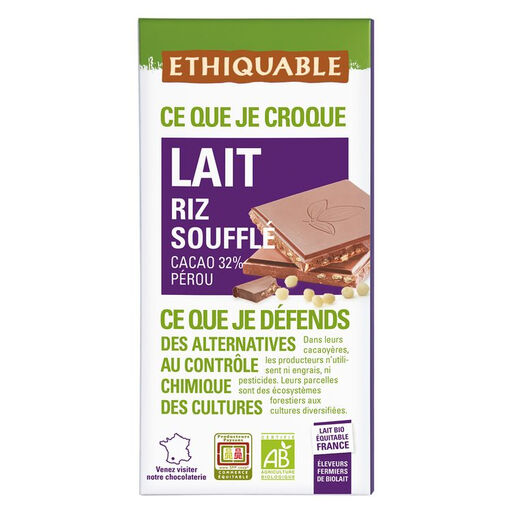 Image unavailable
Ethiquable milk chocolate and puffed rice, 100 g
Worth considering if your child enjoys milk chocolate with puffed rice and you’re looking for detailed information about the recipe’s fair-trade credentials. According to Ethiquable, 99.5% of the total weight of this bar comes from fair trade; this figure alone does not confirm that it carries the Fairtrade/Max Havelaar logo. Check the ingredients and trace warnings on the packaging you buy, especially if an allergen affects your child.
View on Joybuy
Frequently asked questions
Is the Nutri-Score compulsory on chocolate in France?
No. The Ministry of the Economy says that the Nutri-Score is optional, while a nutrition declaration is generally compulsory for prepacked foods. If the logo isn’t shown, compare the nutritional information per 100 g and the ingredients.
How can you identify Fairtrade/Max Havelaar chocolate?
Look for the logo on the product, then read the information about what the certification covers. Max Havelaar France explains that, for composite products, some certification arrangements apply to specific ingredients. So even when the logo is present, it’s worth checking exactly what is certified.
Should you check allergen information every time you buy?
Yes, check the label on the bar you buy. The Ministry of the Economy says allergens must be listed and highlighted on prepacked products. Also read any trace warnings that are relevant to your household.
How much chocolate should you include in a child’s snack?
Chocolate can be part of a varied snack, rather than the only item. Manger Bouger recommends limiting sugary foods and suggests pairing bread with a few squares of chocolate and a piece of fruit.


