Households that require Fairtrade proof
If Fairtrade is your top priority, check that a label or an explicit claim applies to the box of verbena you’ve chosen, rather than just the brand or another tea in its range.


To buy Fairtrade verbena tea for a large family, first look for proof of Fairtrade certification that applies to the specific product. An organic logo or French origin alone is not enough. Then compare the recipe and the number of tea bags with your household’s consumption. A large pack only meets your Fairtrade requirements if the certification also applies to its contents.
If Fairtrade is your top priority, check that a label or an explicit claim applies to the box of verbena you’ve chosen, rather than just the brand or another tea in its range.
If several people drink this tea regularly, the number of tea bags can help you choose the right quantity. The recipe should also suit your household before you opt for a large pack.
Pure verbena, organic tea and a verbena-and-mint blend suit different preferences. Check organic status and French origin separately from Fairtrade credentials.
When shopping for a large family, start with the requirement that can’t be replaced by another: Fairtrade proof, if it’s essential. Then compare the quantity and ingredients to find teas that meet your other needs.
| Criteria | What to check | Who it matters to |
|---|---|---|
| Fairtrade proof | Look for a Fairtrade/Max Havelaar label or a clear Fairtrade claim linked to the exact product. Fairtrade / Max Havelaar France describes independent checks for its certified products. | I want the tea I buy, not just the brand, to meet my Fairtrade requirements. Around 42% of consumers would put this proof at the top of their list. |
| Family-sized quantity | Compare the number of tea bags in recipes that suit your household: Joybuy France lists, among other products, a 100-bag Lipton pack and a 20-bag Éléphant tea. | When several people drink verbena regularly, I prefer a quantity that means I don’t have to restock too often. This would be a priority for around 33% of consumers. |
| Recipe, organic status and origin | Read the ingredients to tell pure verbena apart from a blend, then check organic and origin claims separately. The European Commission explains that its organic logo relates to organic certification, not Fairtrade. | If your household wants a simple recipe or prioritises organic status or origin, these claims can guide your choice without replacing Fairtrade proof. Around 25% of consumers would make this their main priority. |
According to the European Commission, the EU organic logo relates to organic production rules. It doesn’t, by itself, prove that a product is Fairtrade; the plant’s origin answers a different question again.
Check each claim separately. If Fairtrade is essential, look for explicit proof on the verbena product you’re considering.
The 100 tea bags in the Lipton pack listed by Joybuy France tell you how much is inside, not whether it’s Fairtrade certified. Buying a large quantity doesn’t, on its own, answer the Fairtrade question.
First check the claim or label that applies to this particular box, then decide whether the quantity suits your household’s consumption.
A blend containing mint isn’t the same as a request for verbena on its own. Joybuy France lists an Éléphant verbena-and-mint tea, while Pagès describes one of its teas as made from 100% organic verbena.
Read the ingredients for each product before choosing a pack that several people will share.
These brands illustrate differences in recipes and pack sizes. Their inclusion here doesn’t mean that all the products mentioned carry a Fairtrade label.
Joybuy France lists a 100-bag pack of verbena tea.
Carrefour France lists verbena teas under its own brands, including a 25-bag Carrefour Classic' product.
Auchan France lists an organic verbena tea containing 20 tea bags and weighing 26 g.
Pagès describes a 20-bag tea made from 100% organic verbena of French origin.
Joybuy France lists an organic Éléphant verbena-and-mint tea with 20 tea bags.
These two products offer different recipes and quantities: a 100-bag pack of verbena tea and a 20-bag organic verbena-and-mint blend. Check the Fairtrade proof separately for the product you’re interested in.
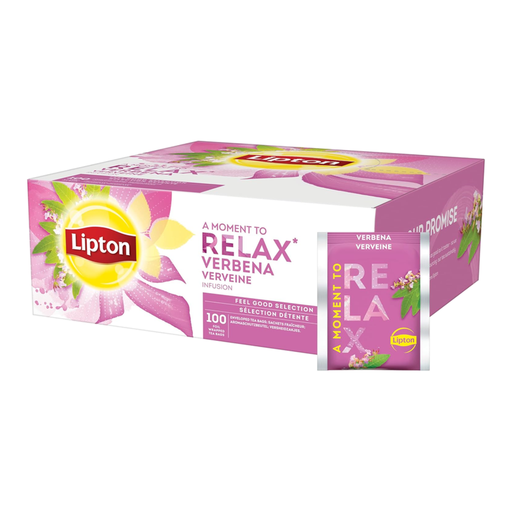 Image unavailable
This pack suits a household looking to keep plenty of verbena tea bags in the cupboard. If Fairtrade is a deciding factor, check that the proof shown applies to this specific pack.
 Image unavailable
This tea is for households looking for a blend of verbena and mint rather than pure verbena. The box contains 20 tea bags; its organic claim doesn’t replace Fairtrade proof for this product.
Look for a Fairtrade/Max Havelaar label on the box of verbena tea you intend to buy. Fairtrade / Max Havelaar France says its certified products undergo independent checks. A brand’s status, or the status of another tea in its range, isn’t enough.
No. As the European Commission explains, the EU organic logo indicates certification under organic production rules, not Fairtrade certification. If both matter to you, check for each separately on the same product.
It could be, if your household drinks this tea regularly and likes the recipe. The 100-bag Lipton pack listed by Joybuy France gives you a quantity to compare with your household’s consumption, but the pack size doesn’t prove that its contents are Fairtrade.
Yes, if Fairtrade credentials are established for the product in question. French origin alone doesn’t answer that question. Pagès says one of its teas is made from 100% French organic verbena; check for a separate Fairtrade claim before choosing it on that basis.