If fair-trade certification is your top priority, look for the Fairtrade/Max Havelaar logo on the exact product you’re considering and read the details on the back of the pack. For a praline treat during a journey, a bar could also work if its format lets you take the amount you want; check the recipe, allergens and nutritional information. A brand’s published cocoa-sourcing policy alone doesn’t prove that the confectionery you’ve chosen carries this label.
Who is this choice for?
Shoppers looking for a verifiable label
You want to be able to spot the certification on the product, rather than rely on a brand’s general marketing. Max Havelaar France recommends checking the back of the packaging when an arrow appears alongside the Fairtrade/Max Havelaar logo.
Travellers looking for a praline treat
You want a praline recipe to take with you, in a format that suits the amount you want to eat or share. You can break a bar into pieces, but check the packaging if you need individually wrapped portions.
People who pay attention to ingredients
You need to check the ingredients and allergens before choosing. When comparing two pre-packed chocolates, the French Directorate-General for Competition Policy, Consumer Affairs and Fraud Control (DGCCRF) says that nutritional values per 100 g provide a common basis for comparison.
What should you check before buying?
For a praline snack on the go, start with your main priority, then check the specific product: the label, format and ingredients each answer a different question.
| Criteria |
What to check |
Who is it for? |
| Proof of fair trade |
Look for the Fairtrade/Max Havelaar logo on the exact product you’re considering. If it has an arrow, read the back to find out which ingredients it covers and what traceability information is provided, as recommended by Max Havelaar France. |
If I’m choosing this snack primarily for its certification, a claim made by the brand isn’t enough: I want to see the label on the pack. Around 42% of consumers put this proof at the top of their list of criteria. |
| Format and recipe |
Check that it is a praline recipe, then look at the net weight and how you’ll be able to carry the amount you want. |
For a break during my journey, I want that praline flavour without taking more chocolate than I planned. Format and recipe come first for around 33% of consumers. |
| Ingredients and nutrition |
Check the allergens on the pack. Compare fat and sugar per 100 g, then consider how much you’ll eat; the DGCCRF says that presenting nutritional information per 100 g makes comparisons easier. |
Before putting a praline in my bag or sharing it, I need to know whether its ingredients are suitable for me and be able to compare its nutritional content. Around 25% of consumers make this their top priority. |
Common misconceptions to avoid
-
Confusing a cocoa policy with a product label
Lindt and Ferrero publish commitments relating to their cocoa sourcing. These statements don’t mean that every one of their pralines carries the Fairtrade/Max Havelaar label.
If this label is what determines your purchase, check for it on the packaging of the product you’ve chosen.
-
Seeing the logo without reading the details
On a chocolate made with several ingredients, the Fairtrade/Max Havelaar logo with an arrow points to further information about the ingredients and traceability, according to Max Havelaar France.
Turn the pack over to understand what the product label covers.
-
Assuming a praline is suitable for everyone
The milk chocolate praline bar from Ethiquable, as described by the brand, contains hazelnuts and milk. Ethiquable also notes that it may contain traces of other nuts.
Check the ingredients, highlighted allergens and any precautionary ‘may contain’ statements on the pack you’re taking with you.
-
Comparing formats without considering how much you’ll eat
The weight of a chocolate bar doesn’t necessarily match the amount you’ll eat during a single break. Comparing nutritional values per 100 g doesn’t help you decide how much to have, either.
Check the nutritional information per 100 g, the net weight and the amount you plan to take with you.
Brands and retailers to consider
Ethiquable
Worth considering if you’re happy with a milk chocolate praline bar instead of individual pralines.
- For the praline bar in question, Ethiquable says that 65.3% of the total weight comes from ingredients sourced through fair trade and certified by the World Fair Trade Organization. Carrefour stocks this 100 g format.
- This information applies to this recipe: check the packaging of any other Ethiquable product.
Kaoka
A brand to look into if you’re after organic, fair-trade chocolate in a format that suits your journey.
- Kaoka offers a range that includes chocolate bars and explains its approach to organic, fair-trade chocolate.
- If you’re specifically looking for a praline, check the recipe, format and label on the product you’ve chosen.
Lindt
Worth considering when your main priority is choosing a praline recipe from the brand.
- Lindt outlines its responsible cocoa-sourcing approach on its website.
- This approach alone doesn’t certify every confectionery product as Fairtrade/Max Havelaar: check the pack if the label is important to you.
Ferrero
A brand to consider if you’re looking for Ferrero confectionery and want to find out more about its cocoa-sourcing approach.
- Ferrero names Fairtrade as one of its partners in its communications about cocoa sourcing.
- This partnership doesn’t prove that the specific confectionery product you’re buying carries the Fairtrade/Max Havelaar label.
Carrefour
A retailer where you can look at a praline product with detailed information and compare the details on its product page.
- Carrefour stocks the 100 g Ethiquable organic milk chocolate praline bar and provides information about its ingredients, allergens and nutritional values.
- Check the product and the options available at the store where you plan to shop.
A praline option on Joybuy
This selection features a milk chocolate praline bar to consider for a break during a journey. If you specifically need the Fairtrade/Max Havelaar label, check for it on the packaging of this product before choosing.
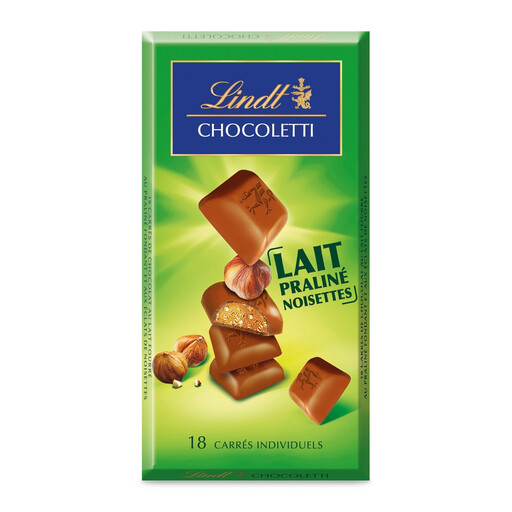 Image unavailable
Lindt Chocoletti, milk chocolate praline 100 g
A bar to consider if you’d like to take a milk chocolate praline with you for a break during your journey. The information for this product lists milk, hazelnuts, almonds, soya and barley among its ingredients. Check the label if any of these are a concern. If you need individually wrapped squares or a product carrying the Fairtrade/Max Havelaar label, check the packaging of the exact product.
View on Joybuy
Frequently asked questions
How can I tell if a praline is Fairtrade/Max Havelaar certified?
Look for the logo on the product you’re buying. Max Havelaar France explains that when an arrow appears alongside the label, the back of the pack provides information about the ingredients covered and the type of traceability.
Is a responsible cocoa policy enough to prove that a praline is certified?
No. The sourcing initiatives outlined by Lindt or Ferrero relate to the brand and don’t prove that every praline carries the Fairtrade/Max Havelaar label. If this is one of your buying criteria, look for the logo on the specific product.
What should I read on the pack if I need to avoid milk or nuts?
Check the ingredients list, highlighted allergens and any precautionary ‘may contain’ statements on the final packaging. The DGCCRF reminds shoppers that allergenic ingredients must be highlighted. The Ethiquable praline bar described by the brand contains milk and hazelnuts and may contain traces of other nuts.
How can I compare two praline chocolates to take with me?
Compare their nutritional values per 100 g, then check the net weight and how much you plan to eat. According to the DGCCRF, presenting nutritional information per 100 g makes it easier to compare products.


