If fair trade is a priority for your village fête, choose a cone whose product packaging explicitly carries the Fairtrade/Max Havelaar label. A Rainforest Alliance mention does not prove this certification. Before working out how many to buy, also check how many cones are in each box, the allergens in each recipe and whether you can keep the ice cream frozen until serving.
Who are these criteria for?
Organisers who need proof of fair trade
If you need to explain your choice to volunteers or attendees, look for the Fairtrade/Max Havelaar label on the specific cone you plan to buy. A brand’s general statement about its sourcing isn’t enough to confirm this certification.
Stallholders catering for a varied crowd
To plan your service and answer attendees’ questions, check how many cones are in each box, as well as the ingredients and allergens in each flavour. The DGCCRF reminds businesses that allergens must be highlighted in the ingredients list on prepacked foods.
Buyers responsible for keeping ice cream frozen during the fête
If you’re organising transport and storage, check that your planned equipment can meet the storage instructions on the packaging. The Ministry of Agriculture gives −18 °C as the reference temperature for frozen storage.
What should you check before buying?
First decide whether Fairtrade/Max Havelaar certification is a requirement for the ingredients in question. Then check the recipe and storage conditions for the product you choose.
Fairtrade/Max Havelaar label
Keep in mind: look for this label on the specific cone if your choice must meet a Fairtrade/Max Havelaar requirement.
Limitation: don’t assume it’s present based on the chocolate flavour, the brand or another certification alone.
Rainforest Alliance mention
Keep in mind: consider this if you’re happy with a certification that’s different from Fairtrade/Max Havelaar, and check which ingredients it applies to.
Limitation: this mention doesn’t allow you to describe the cone as Fairtrade/Max Havelaar certified.
| Criterion |
What to check when buying |
Consumers concerned |
| Proof of fair trade |
Check the Fairtrade/Max Havelaar logo and what it covers on the packaging of the product you choose. |
To present the chocolate we serve as meeting my fair trade criteria, I want to see a specific mention on the product. About 36% of consumers put this proof first. |
| Recipe, allergens and portions |
Read the ingredients and allergen information, including any ‘may contain’ statements, and note how many cones are in each box. |
To answer questions from a varied crowd, I need to know the recipe being served and how many portions are available. This comes first for around 28% of consumers. |
| Keeping the product frozen |
Compare the product’s storage instructions with the freezer and transport arrangements you have planned. For frozen storage, the Ministry of Agriculture gives −18 °C as the reference temperature. |
If the journey or stall set-up makes storage difficult, I need to be able to keep the cones frozen until serving. Keeping the product frozen is the top priority for around 36% of consumers. |
Serving mistakes to avoid
-
Confusing a sourcing statement with Fairtrade/Max Havelaar certification
Rainforest Alliance and Fairtrade/Max Havelaar are separate certifications. A brand’s statement about its cocoa doesn’t prove that the cone you buy carries the label you’re looking for.
If Fairtrade/Max Havelaar is one of your criteria, check the logo and wording on the packaging before describing the ice cream to attendees.
-
Counting portions without checking each recipe
Allergens vary between products and flavours. The word ‘chocolate’ alone doesn’t tell you which ingredients or traces are declared.
Keep the packaging for the products served at your stall so you can check the ingredients, allergens and number of cones.
-
Buying cones before planning how to keep them frozen
Transport, storage and the time before serving must all be compatible with the storage instructions for frozen products.
Before buying, check what freezer equipment is available and how you’ll transport the cones, then follow the instructions on the packaging.
Depending on the fête venue, also plan for the power supply and set-up of your freezer equipment.
Brands and retailer to consider
Cornetto
Its cones are worth considering if you’re looking for individual portions to serve at a fête. Carrefour, for example, lists a box of four vanilla and cocoa cones.
- A Cornetto product listing published by Carrefour states that ingredients marked with an asterisk are Rainforest Alliance certified, and that the product should be kept at −18 °C.
- This doesn’t prove Fairtrade/Max Havelaar certification. Check the allergens for the specific recipe before serving it, too.
Magnum
The brand can be a useful point of comparison for chocolate ice creams, as long as you distinguish its products from cones if that format is essential.
- Magnum says it sources cocoa and vanilla from Rainforest Alliance-certified farms.
- This statement refers to a different certification from Fairtrade/Max Havelaar. It confirms neither that label nor that a particular product comes in a cone format.
Carrefour
The retailer gives you a way to compare pack sizes and the information listed for different cones.
- Its product listings can help you find the ingredients, allergens and number of cones in a product.
- Check what’s available at the store you plan to use before organising your service: an online catalogue listing doesn’t guarantee local availability.
Chocolate cones to consider on Joybuy
This box format could work well when planning portions for a village fête. If Fairtrade/Max Havelaar is one of your criteria, check that the label appears on the packaging for this product before buying. Another certification mention isn’t a substitute.
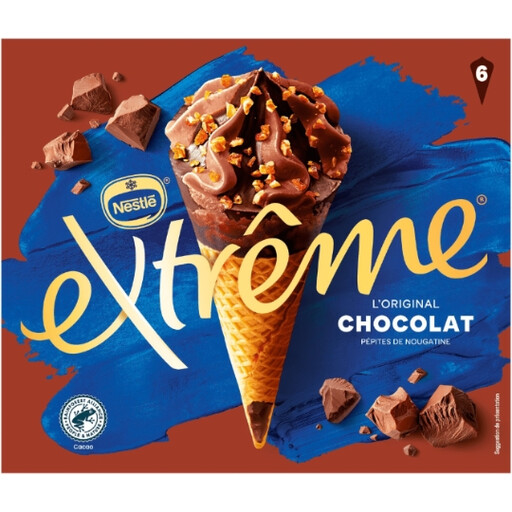 Image unavailable
EXTRÊME Chocolate Ice Cream Cones x6, 426 g
The box of six cones makes it easy to work out how many portions to have ready for your stall.
Check the packaging for allergen information and storage instructions. If you require Fairtrade/Max Havelaar certification, also make sure this specific product explicitly carries the label.
View on Joybuy
Frequently asked questions
Does a Rainforest Alliance logo prove that a cone is Fairtrade/Max Havelaar certified?
No. Rainforest Alliance and Fairtrade/Max Havelaar are separate certifications. If your fête requires the latter, look for its logo or wording on the packaging of the cone you buy, rather than relying on a general statement from the brand.
What information should you keep handy at the stall?
Keep the packaging for the cones you’re serving, or a legible copy of the information, so you can check the recipe and allergens. The DGCCRF states that allergens must be highlighted in the ingredients list on prepacked foods.
What temperature should ice cream cones be stored at?
Follow the storage instructions for the product you buy. The Ministry of Agriculture gives −18 °C as the reference temperature for frozen storage and recommends setting your freezer to −18 °C. Check that your equipment can keep the cones frozen during transport and throughout the fête.
Are chocolate cones automatically suitable for people with allergies?
No. Ingredients and ‘may contain’ statements depend on the recipe, so check the packaging for each product before answering attendees’ questions. Cornetto product listings published by Carrefour mention milk and wheat, as well as possible traces of other allergens depending on the recipe. These details shouldn’t be assumed to apply to all cones.


