When stocking your cupboard, start by choosing the fair trade standard that matters to you: Fairtrade/Max Havelaar, Fair for Life or a Bio Équitable en France supply chain. These standards are not interchangeable. For each blend, check the label, which ingredients it covers and the proportion where stated, rather than relying on the brand name alone.
Who are these options for?
Shoppers who look for the Fairtrade/Max Havelaar label
You want to see this specific standard on every box. For a blended herbal tea, the logo and details on the back of the pack help you identify which ingredients are covered, as explained by Max Havelaar France.
Households looking to mix up their choices
You’re planning to keep several flavours in the cupboard. Compare each blend individually: Pukka product listings published by Carrefour France show that the proportion of ingredients certified to Fair for Life standards varies from one herbal tea to another.
Shoppers interested in French plant supply chains
You prefer a fair trade supply chain in France for the plants in your herbal tea. Ethiquable, for example, presents its Digestion blend under the Bio Équitable en France standard, which is distinct from Fairtrade/Max Havelaar. Check where the plants in each blend come from.
What should you check before buying?
Choose the standard you’re looking for before comparing blends. A percentage of fair trade ingredients is only meaningful if you know which standard it refers to and which ingredients it covers.
Fairtrade/Max Havelaar
Choose this if: you’re specifically looking for this label on your herbal teas.
Keep in mind: for a blend, the logo alone doesn’t tell you whether every ingredient is covered. Read the information on the back, as recommended by Max Havelaar France.
Fair for Life
Choose this if: you’re happy with a different fair trade standard and want to compare which ingredients it covers in each blend.
Keep in mind: the stated proportion can vary from one box to another, even within the same brand, as shown by Carrefour France’s Pukka product listings.
Bio Équitable en France
Choose this if: your priority is a French fair trade supply chain for the plants in your herbal tea.
Keep in mind: this is not the same standard as Fairtrade/Max Havelaar. Check the origin of each plant in the blend, too.
| Criteria |
What to check |
Who it matters to |
| What the label covers |
Look for the exact logo and, for a blend, check the back of the box for the ingredients or proportion covered. |
I want to recognise Fairtrade/Max Havelaar on every herbal tea, without assuming the brand name is enough. Around 33% of shoppers prioritise this specific standard. |
| Blend ingredients |
Compare the ingredients covered and their percentage only when the figures use a comparable basis and standard. |
I want to know what the fair trade claim covers in each blend so I can enjoy a range of flavours. This is the priority for around 25% of shoppers. |
| French supply chain |
Look for the Bio Équitable en France standard and check the origin of each plant individually. |
I prefer a French fair trade supply chain, but don’t want to assume that every plant in a blend is French. Around 25% of shoppers put this supply chain first. |
| Stocking up and when you’ll drink it |
Check the number of tea bags, net weight, flavours and whether it contains tea or carries a caffeine-related claim. |
I buy several boxes with different flavours and want to distinguish blends containing tea from those labelled caffeine-free. Pack size and intended use come first for around 17% of shoppers. |
Mistakes to avoid
-
Assuming “fair trade” applies to the whole blend
A blended herbal tea may contain ingredients with different levels of coverage. According to Carrefour France’s listing for Jardin BiO étic Rooibos Cacao Fruits Rouges, rooibos that meets Fairtrade/Max Havelaar standards makes up 75% of the total weight.
Before buying several boxes, check the label, which ingredients it covers and the stated proportion for the exact product.
-
Treating all standards as the same label
Fairtrade/Max Havelaar, Fair for Life, FairWild and Bio Équitable en France are distinct standards. A percentage shown under one does not prove that a product is certified under the others.
Decide which standard meets your needs, then compare the information provided for each blend.
-
Assuming a claim on one box applies to the whole brand
Carrefour France’s Pukka product listings state that 80% of the ingredients in Fruits Rouges Détox, 44.5% in Digestion and 24.5% in Nuit Enchantée are certified to Fair for Life standards. These figures apply to those blends, not all Pukka herbal teas.
Check the exact flavour and pack size on the product listing and packaging before stocking up.
Brands to consider by product
Jardin BiO étic
Carrefour France’s listing for Rooibos Cacao Fruits Rouges says that the rooibos is sourced through Fairtrade/Max Havelaar fair trade.
- In this blend, rooibos makes up 75% of the total weight.
- This information does not apply to the brand’s other herbal teas.
Pukka
Several Carrefour France product listings give details of Fair for Life coverage for individual Pukka blends.
- The listings for Fruits Rouges Détox, Digestion and Nuit Enchantée state that 80%, 44.5% and 24.5% of their ingredients respectively are certified to Fair for Life standards.
- Coverage varies by blend. Fair for Life should not be confused with Fairtrade/Max Havelaar.
Ethiquable
Ethiquable describes its Digestion herbal tea as coming from a supply chain certified to the Bio Équitable en France standard.
- For this blend, the brand states that the plants are 100% organically grown and come from a Bio Équitable en France supply chain.
- This is a different standard from Fairtrade/Max Havelaar. Check the origin of the plants in each of the brand’s other blends.
Alter Eco
Carrefour France lists Alter Eco Organic Rooibos in a box of 20 tea bags, with a net weight of 40 g, and explains the Fairtrade/Max Havelaar label.
- The pack size makes it easy to compare this box with what you need for your cupboard.
- To find out exactly which ingredients are covered, check the information on the packaging for this product.
Lipton
For Lipton, Rainforest Alliance identifies a certification that applies to tea. It is separate from Fairtrade/Max Havelaar.
- If you’re looking for a Fairtrade/Max Havelaar herbal tea, check for this claim on the exact product rather than inferring it from information about the tea.
Herbal teas and tea to consider on Joybuy
These Pukka products give you the option of stocking two herbal infusions and a green tea. If fair trade is important to you, check the standard shown on each box and which ingredients it covers. Green tea won’t meet the same need as a caffeine-free herbal infusion.
 Image unavailable
Pukka Organic Gingers Herbal Tea, 36 g
A herbal infusion to consider if you’d like to add a ginger blend to your cupboard. If you’re looking for a Fair for Life product, check the claim, which ingredients it covers and the number of tea bags on the box.
View on Joybuy
 Image unavailable
Pukka Matcha Green Tea Organic, 30 g
This matcha green tea is a good choice if you’d like to keep tea in your cupboard as well as herbal infusions. Check the box for the fair trade claim, serving format and any useful information if you want to avoid caffeine.
View on Joybuy
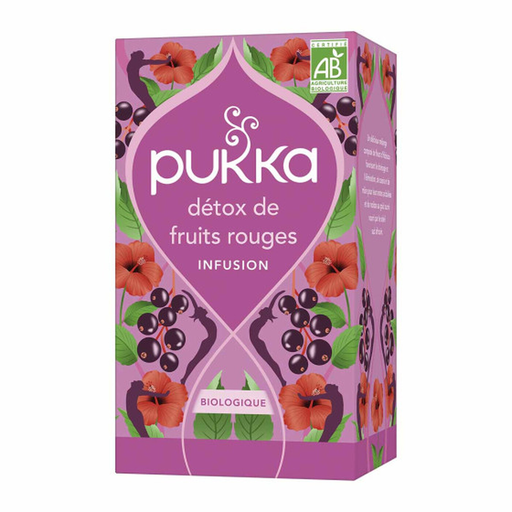 Image unavailable
Pukka Organic Red Fruits Detox Herbal Tea, 34 g
This red-fruit herbal infusion adds another blend to your cupboard. Carrefour France states that a Fruits Rouges Détox product is covered by Fair for Life. Check that the box on offer is this exact blend and carries the same claims, and check the number of tea bags.
View on Joybuy
Frequently asked questions
How can I tell which ingredients in a herbal tea are Fairtrade/Max Havelaar?
Check the type of logo and the details on the back of the box. Max Havelaar France distinguishes, in particular, between the standard label and the label with a black arrow used for composite products. For these products, the information on the back helps you see which ingredients are covered and what type of traceability applies.
Do all Pukka herbal teas carry the Fairtrade/Max Havelaar label?
No. You shouldn’t assume a product has a particular label based on the Pukka name alone. Carrefour France’s listings for Fruits Rouges Détox, Digestion and Nuit Enchantée mention Fair for Life, with different proportions of ingredients covered in each blend. Check the box you’re choosing.
Is an organic herbal tea necessarily fair trade?
No. Organic claims and fair trade information should be checked separately. For a specific blend, check the fair trade standard, which ingredients it covers and the percentage where stated.


