Canteen managers with a grinder
You’re looking for Fairtrade whole-bean coffee to make espresso with your machine, while managing the settings and restocking needed for a busy service.


For a workplace canteen, start by choosing a format that suits your machine and service setup: whole beans for a machine that can grind them, pods for the corresponding system, or ground coffee for suitable equipment. Then check the evidence of Fairtrade sourcing for the exact product you’re ordering. A brand’s general commitment or an ‘organic’ label is not enough to establish this.
You’re looking for Fairtrade whole-bean coffee to make espresso with your machine, while managing the settings and restocking needed for a busy service.
You need to be able to link proof of Fairtrade sourcing to the exact product delivered, including when a supplier offers a substitute.
You’re considering pods to simplify preparation, provided they’re compatible with the system used by your machine.
To serve Fairtrade espresso in your canteen, start with the equipment you have, then check the exact product, its flavour profile and its packaging. Whole beans, ground coffee and pods aren’t interchangeable: check that each format is suitable for your equipment.
| Criterion | What to check | Consumers concerned |
|---|---|---|
| Proof of Fairtrade sourcing | Check the claim or label for the product being delivered, then confirm it again if a substitute is offered. | If I need to justify the canteen’s coffee choice, I need proof linked to the product ordered rather than a general brand statement; around 33% of consumers would put this proof first. |
| Machine and service | Check which formats the machine accepts, whether it requires a particular pod system, and what service volume you need to manage. | When service needs to continue with the equipment already installed, I want to avoid ordering a format I can’t use; around 27% of consumers would prioritise compatibility and continuity of service. |
| Flavour profile | Read the roast and flavour descriptions, then try the product in your canteen’s machine. | If customers expect a milder or stronger espresso, I’d rather taste the coffee before placing a large order; around 20% of consumers would prioritise flavour profile. |
| Packaging | Compare pack sizes, order volumes and delivery arrangements for products with documented Fairtrade sourcing. | To manage ordering and storage, I need packaging that suits the site’s consumption; nearly 20% of consumers would make this their main criterion. |
A coffee being organic doesn’t, on its own, mean it meets a Fairtrade/Max Havelaar requirement. Carrefour lists this certification for its Carrefour Bio whole-bean coffee; Lavazza describing its Espresso Maestro Organic as organic coffee does not, by itself, provide equivalent proof for that product.
Specify the proof of Fairtrade sourcing you require in your brief and check it against the product delivered, particularly if it changes.
Malongo’s professional range distinguishes between whole beans, ground coffee and pods, depending on how they’re used. A machine designed for a particular pod system won’t necessarily accept another format.
Check your machine, any separate grinder and the pod system before choosing your coffee. Also confirm the cleaning and restocking tasks involved.
Ethiquable describes its Expresso Grains as dark-roasted, while Auchan describes Cafés Sati Pérou 500 g as mild and balanced. These descriptions won’t tell you which one will suit your canteen’s customers.
Try the products you’re considering in the machine used for service before making your choice.
Malongo offers a range for professional customers, including whole-bean coffee, ground coffee and pods, as well as products sourced through Fairtrade.
Ethiquable offers its 500 g Fairtrade and organic Expresso Grains for espresso machines or percolators.
The Carrefour Bio listing for an organic 100% Arabica whole-bean coffee names Fairtrade/Max Havelaar certification for this product.
Auchan describes Les Cafés Sati Pérou 500 g whole-bean coffee as organic and Fairtrade/Max Havelaar certified.
Lavazza describes Espresso Maestro Organic as a 1 kg pack of organic whole-bean coffee for espresso.
This 500 g ground coffee could be considered for a canteen with equipment that accepts pre-ground coffee. Confirm compatibility and proof of Fairtrade sourcing before choosing it for your service.
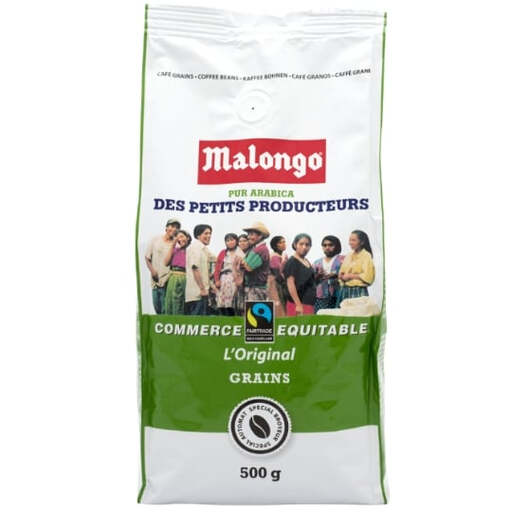 Image unavailable
Worth considering if your canteen’s machine accepts ground coffee; check compatibility before ordering.
The product name includes ‘Fairtrade’. Ask for proof of Fairtrade sourcing for the product being delivered before adding it to your specification.
No. Check the Fairtrade/Max Havelaar claim or proof separately for the product you’re buying. Carrefour lists it for its Carrefour Bio whole-bean coffee, while Lavazza Espresso Maestro Organic being described as organic isn’t enough to establish the same thing.
Choose a format that your machine accepts and that suits the way your service is run. Whole beans need equipment that can grind them, pods must match the system installed, and ground coffee requires equipment designed for that format.
Ask them to identify the exact product, provide proof of Fairtrade sourcing, confirm its format and check that it’s compatible with your machine. Also confirm delivery arrangements and, if a machine is included in the offer, who is responsible for maintenance and cleaning.