If you have a grinder
If you make espresso from whole beans, look for the Fairtrade/Max Havelaar mark on the specific product before comparing formats. Carrefour and Auchan, for example, list whole-bean coffees bearing this mark.


To make a Fairtrade espresso while you’re studying, first choose a specific coffee product that clearly carries the Fairtrade/Max Havelaar mark. Then check that the beans or grind are suitable for your machine. If you’re studying late, also consider other sources of caffeine and how they might affect your sleep. Fairtrade chocolate can go well with your study break, but check its label, ingredients and allergens separately from those of the coffee.
If you make espresso from whole beans, look for the Fairtrade/Max Havelaar mark on the specific product before comparing formats. Carrefour and Auchan, for example, list whole-bean coffees bearing this mark.
Ground coffee saves you having to grind the beans, but the grind needs to suit your equipment. E.Leclerc lists Bio Village ground coffees described as Fairtrade; check the preparation instructions on the pack you choose.
If sleep is a concern, the number of espressos you drink doesn’t tell the whole story about your caffeine intake: other drinks and foods can contain caffeine too. The Anses says caffeine can delay falling asleep and reduce the length and quality of sleep.
For a Fairtrade espresso, check the certification on the specific product first, then make sure the format suits your machine. Chocolate is a separate choice, even if you’re enjoying it during the same study break.
| Criteria | What to check | Who it matters to |
|---|---|---|
| Fairtrade proof | Look for Fairtrade/Max Havelaar on the specific coffee; don’t confuse this mark with an organic claim alone or another certification. | I want to be able to identify my coffee’s certification without having to infer it from its origin or packaging. Around 33% of consumers are said to prioritise this proof. |
| Format and machine | Choose whole beans if you have a grinder; for ground coffee, check the preparation instructions for your machine. | Without a grinder, I need coffee that works with my machine; with a grinder, I can choose whole beans. Compatibility is said to be the main concern for around 25% of consumers. |
| Caffeine and sleep | Consider all your sources of caffeine and check whether a decaffeinated option suits your preference. | When I’m studying late, I don’t want to overlook coffee’s possible effect on how easily I fall asleep. Sleep is said to come before other criteria for around 25% of consumers. |
| Chocolate to enjoy alongside it | Check its Fairtrade claim, then read the ingredients, allergen information and bar size. | I’d like to add a Fairtrade chocolate bar to my break without assuming it has the same ingredients as another bar. Chocolate is said to be the priority for around 17% of consumers. |
For a specific option to enjoy alongside your coffee, E.Leclerc lists a 100 g Bio Village dark chocolate bar with almond pieces from Peru, bearing the Max Havelaar mark. Carrefour lists an ETHIQUABLE 100% cocoa organic dark chocolate bar as Fairtrade. These are two different recipes, so check each product’s packaging for the mark you’re looking for, its ingredient list and allergen information.
These marks don’t refer to the same certification. Carte Noire describes its Espresso Bio as organic and Rainforest Alliance certified; that alone doesn’t establish that this product is Fairtrade/Max Havelaar certified.
If Fairtrade is your deciding factor, look for this specific mark on the packaging or product listing for the coffee you’re buying.
Whole beans need a grinder. On the other hand, buying ground coffee without checking the preparation instructions could mean choosing a grind that isn’t suitable for your espresso equipment.
First identify what equipment you have, then check the format and preparation instructions for the specific product.
Caffeine can come from several different foods and drinks. The Anses points out that it can delay falling asleep and reduce both the length and quality of sleep.
If you notice an effect on your sleep, take all your different sources of caffeine into account. You could also consider decaffeinated coffee or having your last cup earlier in the day.
A bar with almond pieces and a 100% cocoa dark chocolate bar don’t have the same ingredients. A Fairtrade mark alone doesn’t tell you about allergens or nutritional information.
Read the label on the bar you choose, especially the ingredients and allergen information, separately from your checks for the coffee.
A brand can help you find a range, but you’ll need to check the certification and format of the specific product: not every product from the same brand will necessarily meet the same criteria.
Carrefour lists 500 g of 100% arabica organic whole-bean coffee for people with a grinder.
E.Leclerc lists Bio Village ground pure arabica coffees from Ethiopia and Guatemala, described as organic and Fairtrade.
Auchan lists 500 g of Peruvian whole-bean coffee described as organic and Fairtrade/Max Havelaar certified.
Lavazza’s espresso range includes several products; the brand describes Espresso Maestro as organic.
Carte Noire offers Espresso Bio whole-bean coffee in a 900 g pack.
illy offers Classico, Intenso and Forte whole-bean coffees, as well as a decaffeinated option in its range.
This selection features organic ground coffee to consider if you make espresso without a grinder. Before deciding, check the grind your machine requires and look for the Fairtrade mark on the packaging of the specific product.
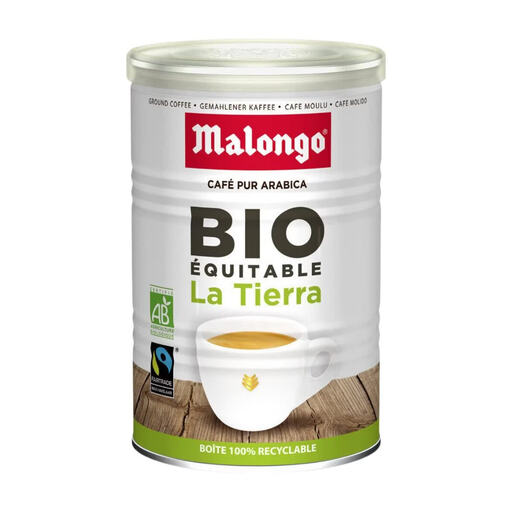 Image unavailable
This ground coffee could work for espresso without a grinder, provided the grind is suitable for your machine.
Check the packaging for the Fairtrade mark and caffeine information if you’re planning to drink it late.
Look for the Fairtrade/Max Havelaar mark or an explicit mention of it on the specific product. Fairtrade / Max Havelaar France explains the standards associated with its labels; a stated origin or an organic claim alone isn’t a substitute for this identification.
No. These claims alone don’t prove that a product carries the Fairtrade/Max Havelaar mark. If this certification is important to your purchase, check the pack or product listing for the specific espresso you’re considering.
A chocolate bar bearing the Fairtrade mark doesn’t necessarily mean that its cocoa has been physically separated throughout the supply chain. Fairtrade / Max Havelaar France says that mass balance is permitted for cocoa; check the details on the packaging, particularly if there’s an arrow alongside the mark.
Yes. According to the Anses, caffeine can delay falling asleep and reduce the length and quality of sleep. Sensitivity varies, so if your sleep is affected, consider when you have your last cup and all your sources of caffeine, rather than counting only your espressos.