When choosing Fairtrade espresso coffee, first check that the Fairtrade or Max Havelaar claim applies to the specific coffee you’re buying. Then choose whole beans if you have a grinder, ground coffee if your machine accepts it, or capsules that are explicitly compatible with your system. Organic or Rainforest Alliance certification is not proof of Fairtrade certification.
Who is this guide for?
Shoppers who value the Fairtrade label
You want certification that applies to the coffee itself, rather than just a general claim about environmental practices. According to Max Havelaar France, the Fairtrade/Max Havelaar label covers social, economic and environmental criteria.
People with a bean-to-cup machine
You’re looking for whole beans for your espresso and want a pack size that suits how much coffee you drink. Carrefour France lists Carrefour Bio Fairtrade beans in 500 g and 1 kg packs.
Capsule machine users
You prefer a quick brew, as long as the capsules work with your machine. How to dispose of them after use is another factor to consider.
What should you check when shopping?
For Fairtrade espresso, check the coffee’s certification first, then make sure the format works with your machine. You can then narrow down your options by pack size and packaging.
| Criterion |
What to check |
Who is it for? |
| Fairtrade certification |
Look for the Fairtrade/Max Havelaar label or an explicit claim that applies to the coffee in that specific product. |
I want to be sure the coffee I buy meets my fair trade criteria, even if that limits my choice of formats. Around 33% of consumers put this proof first. |
| Machine compatibility |
Check whether your machine uses whole beans, accepts ground coffee or requires a specific capsule system. |
I don’t want to buy coffee I can’t use with my machine: compatibility is the top criterion for around 27% of consumers. |
| Pack size |
Compare pack weights and choose an amount that suits how quickly you get through your coffee. |
If I don’t drink much coffee, I’d rather not have a pack sitting open for too long. Around 20% of consumers prioritise pack size. |
| Packaging and other labels |
Don’t confuse organic certification with the Fairtrade label. For capsules, check the disposal instructions too. |
I want to consider the packaging without confusing it with the coffee’s certification. Packaging and other labels come first for around 20% of consumers. |
Mistakes to avoid
-
Confusing Fairtrade with other certifications
An organic or Rainforest Alliance claim alone doesn’t prove that a coffee is Fairtrade certified. You could end up choosing a product that doesn’t meet your main requirement.
Check the packaging or product page for a Fairtrade/Max Havelaar claim, and make sure it applies to the coffee itself.
-
Choosing capsules based only on the word “espresso”
Capsule systems aren’t interchangeable: a capsule described as compatible with Nespresso won’t necessarily work with another system, such as Iperespresso.
Before you buy, compare the system used by your machine with the one shown on the box.
Choose the wrong system and the capsules may be unusable with your machine.
-
Putting all capsules in the compost
How you sort capsules depends on the type. Information about their materials alone isn’t enough to tell you where they should go.
In France, ADEME advises putting aluminium or plastic capsules in the recycling bin, bag or container for paper and packaging.
Brands to know
Carrefour Bio
Worth considering if you’re looking for Fairtrade whole beans: Carrefour France lists organic 100% Arabica Carrefour Bio coffee in 500 g and 1 kg packs.
- The product pages for these coffees state that they meet Fairtrade/Max Havelaar standards for fair trade.
- Check the pack size and the claims shown on the product you choose.
Lavazza
Lavazza offers coffee in whole-bean, ground, capsule and coffee pod formats.
- The range gives you options to suit different types of coffee machine.
- Rainforest Alliance certification on some La Reserva de ¡Tierra! products does not prove that these coffees are Fairtrade certified.
Carte Noire
Carte Noire offers whole-bean and ground coffee, capsules compatible with Nespresso Original, and coffee pods.
- The range lets you compare several formats for making espresso.
- Carte Noire describes its Espresso Bio whole beans as organic and Rainforest Alliance certified. These claims don’t prove Fairtrade certification.
illy
illy offers its coffee as whole beans, ground coffee, Iperespresso capsules and ESE coffee pods.
- The different formats make it easier to choose according to the equipment you use.
- If Fairtrade certification is a requirement, check the certification for the specific illy product before you buy.
Ground coffee to consider on Joybuy
This selection is for shoppers whose espresso machine accepts ground coffee and who are looking for a Fairtrade claim that applies to the coffee.
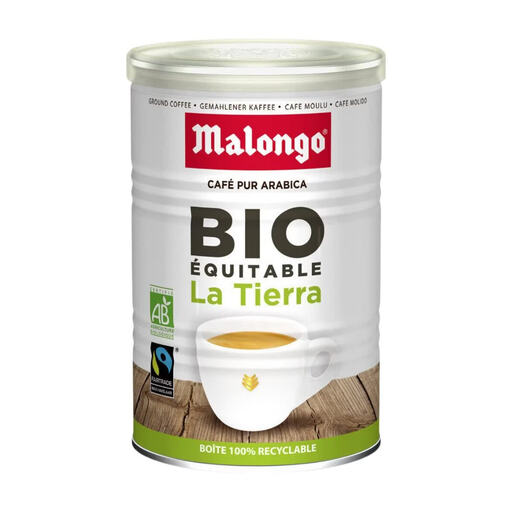 Image unavailable
MALONGO La Tierra organic ground coffee, 250 g
This ground coffee could suit you if you’re looking for an espresso coffee whose product page states that it is Fairtrade certified. Check that your machine accepts ground coffee; the pack contains 250 g.
View on Joybuy
Frequently asked questions
How can you tell if espresso coffee is Fairtrade?
Look for a Fairtrade/Max Havelaar claim that explicitly applies to the coffee in the product you choose. According to Max Havelaar France, the label is based on social, economic and environmental criteria. Claims such as “organic”, “traceable” or Rainforest Alliance alone don’t prove Fairtrade certification.
Whole beans, ground coffee or capsules: which format should you choose?
Choose whole beans if you have a grinder, ground coffee if your machine accepts it, and capsules only after checking that they’re compatible with your system. A Fairtrade label doesn’t make a format compatible with every machine.
Where should you dispose of coffee capsules in France?
According to ADEME, aluminium or plastic capsules go in the recycling bin, bag or container for paper and packaging. Check what your capsules are made of before sorting them.


