To choose Fairtrade espresso for the office, first check that the specific product you’re buying carries the Fairtrade/Max Havelaar label, then choose a format that works with your coffee machine. Beans may suit a machine that accepts them, while capsules require precise compatibility. If your team would also like decaf, check its labelling and format separately.
Who are these criteria for?
Anyone in charge of coffee breaks who cares about certification
You want to be able to check the certification on the coffee you order, rather than infer it from the brand name alone. For a single-ingredient product, Fairtrade/Max Havelaar France says its full label means the ingredient meets its standards.
Offices with bean-to-cup coffee machines
You use a machine that accepts coffee beans and are looking for a product suited to the way it brews coffee. Ethiquable, for example, offers 500 g of whole-bean Expresso coffee for espresso machines and percolators, as well as 1 kg of whole-bean Ecuadorian coffee for automatic machines.
Teams looking to offer decaf
You want to add a decaffeinated option for a machine that accepts Nespresso-compatible capsules. Carrefour describes a decaffeinated Carrefour Bio product carrying Fairtrade/Max Havelaar certification; you’ll still need to check it works with your office machine.
What should you check before ordering?
For an office espresso break, start with the certification you’re looking for and the machine you already have. Caffeine preferences and pack size can then help you choose between compatible products.
| Criteria |
What to check |
Who it matters to |
| Certification |
Look for the Fairtrade/Max Havelaar label on the specific product. If the label has an arrow, check the details on the back of the pack. |
When Fairtrade certification is essential, I want to see it on the coffee I order, not just in the brand’s marketing. Around 39% of consumers would put this proof first. |
| Machine and format |
Check whether your machine accepts beans, ground coffee or the capsule system specified for the product. |
If the office machine requires a particular format, I need to avoid ordering something we can’t use for our coffee break. Compatibility would be the top priority for around 31% of consumers. |
| Caffeine and flavour |
Check the ‘decaffeinated’ label and certification for each option. Treat the stated intensity as specific to that product. |
To cater for colleagues who want to limit their caffeine, I’m looking for a decaffeinated option that works with our equipment. Around 15% of consumers would put this choice first. |
| Pack size |
Compare the amount in each pack and the space needed to store different products separately. |
When I’m managing replenishment, I want a pack size that suits the office’s consumption without creating lots of packs to identify. Around 15% of consumers would prioritise this. |
Mistakes to avoid
-
Assuming ‘Fairtrade’ claims mean a Fairtrade label
General information about a product range isn’t enough to confirm that every coffee is certified. Fairtrade/Max Havelaar France explains what its full label means for a single-ingredient product such as coffee.
Check the label on the packaging or product listing for the specific coffee you’re planning to order.
-
Choosing your coffee before checking the machine
Ethiquable’s whole-bean coffees are intended for machines that accept this format, while Carrefour Bio’s decaffeinated capsules are described as Nespresso-compatible. These formats aren’t interchangeable.
Check the exact type of machine in your office before choosing beans, ground coffee or capsules.
An incompatible format could leave you with packs of coffee that your office machine can’t use.
-
Assuming the coffee’s certification also covers a chocolate snack
Coffee and a snack made with several ingredients need to be assessed differently. Fairtrade/Max Havelaar France says that when the label has an arrow, you should check the back of the pack to see which ingredients are covered and how they’re traced.
If you’re adding snacks to your coffee break, check their labelling separately from the espresso.
Brands to consider by product
Malongo
A range to consider if your office is choosing between beans, ground coffee and coffee pods.
- Malongo offers Fairtrade/Max Havelaar-certified coffees in several formats.
- Check the label and format on the product you choose: a range description doesn’t mean every product in it is certified.
Ethiquable
Whole-bean coffees to consider for an espresso machine, percolator or automatic coffee machine.
- Ethiquable describes its 500 g whole-bean Expresso coffee as suitable for espresso machines and percolators, and its 1 kg whole-bean Ecuadorian coffee as suitable for automatic machines.
- If you specifically require Fairtrade/Max Havelaar certification, check for the label on the pack you choose rather than relying on the word ‘Fairtrade’ alone.
Carrefour Bio
An option to consider if your office is looking for decaffeinated capsules for a Nespresso-compatible machine.
- Carrefour describes its Carrefour Bio decaffeinated Arabica coffee capsules as Fairtrade/Max Havelaar-certified and Nespresso-compatible.
- These details apply to this specific product, not all Carrefour Bio coffees. Check your machine model too.
Lobodis
A brand to consider if supply-chain traceability is one of your office’s priorities.
- Lobodis says that the Peruvian Sol y Café co-operative is Fairtrade-certified and describes how its coffees are tracked by batch number.
- This information relates to a specific supply chain, so check the label on the Lobodis coffee you’re considering.
Coffee for an office espresso break
This product is worth considering for an office espresso break, provided you confirm its certification and find out whether the coffee supplied is ground or whole bean before checking that it works with your machine.
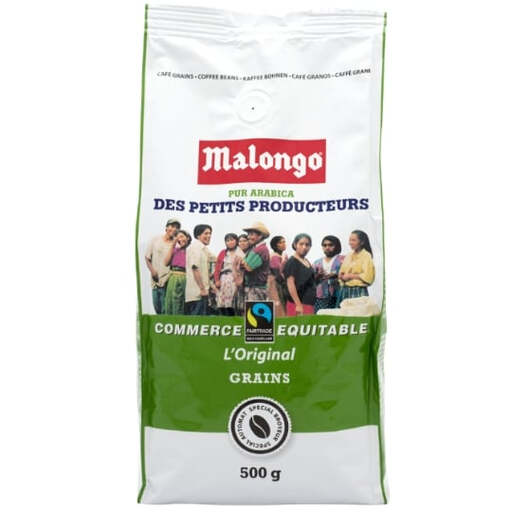 Image unavailable
MALONG Petit Producteur Fairtrade, 500 g
For Fairtrade espresso at the office, check that this product carries the Fairtrade/Max Havelaar label. It comes in a 500 g pack. Confirm whether the coffee supplied is ground or whole bean so you can choose a format your machine accepts.
View on Joybuy
Frequently asked questions
How can you check whether espresso is Fairtrade-certified?
Look for the Fairtrade/Max Havelaar label on the packaging of the specific product. For a single-ingredient product such as coffee, Fairtrade/Max Havelaar France says its full label means the ingredient meets its standards.
What does the arrow beside the Fairtrade label on a snack mean?
According to Fairtrade/Max Havelaar France, it directs you to the back of the pack to find out which ingredients in a multi-ingredient product are covered and what type of traceability applies. So check a chocolate snack separately from the coffee served with it.
Can you use whole coffee beans in any office espresso machine?
No. The machine must accept beans or have the equipment needed to prepare them. Ethiquable’s whole-bean products are intended for certain espresso machines, percolators or automatic machines. For a capsule machine, look for a product declared compatible with its system.
Are there Fairtrade-certified decaffeinated capsules?
Yes. Carrefour describes a Carrefour Bio decaffeinated Arabica coffee capsule product that is Fairtrade/Max Havelaar-certified and Nespresso-compatible. Before ordering, check that the product works with your machine model.
Do ‘organic’ and ‘Fairtrade’ mean the same thing?
No. These terms refer to different criteria. Even if a coffee carries both labels, check each claim on the product you choose rather than assuming one means the other.


