People with a bean-to-cup machine
You’re looking for coffee beans to make espresso and want to check that the specific product you buy carries the Fairtrade/Max Havelaar label.


If Fairtrade is your priority, choose a coffee whose specific product listing explicitly mentions Fairtrade/Max Havelaar, then check that its format suits your machine. For a mid-morning espresso, look out for the word ‘decaffeinated’ too if you want to limit your caffeine intake. Organic or Rainforest Alliance certification is no substitute for checking the Fairtrade label.
You’re looking for coffee beans to make espresso and want to check that the specific product you buy carries the Fairtrade/Max Havelaar label.
You want to keep your mid-morning coffee but are considering a decaffeinated option. Also check that its format suits your machine.
You want to distinguish Fairtrade/Max Havelaar certification from organic and Rainforest Alliance claims, rather than assume they all mean the same thing.
For a mid-morning espresso, check the label on the coffee itself, the format your machine accepts and, if it matters to you, whether it’s marked ‘decaffeinated’.
| What to check | Things to look for | Who it matters to |
|---|---|---|
| Fairtrade | A Fairtrade/Max Havelaar mention on the packaging or the listing for the specific product. | If I prioritise Fairtrade, I want to see certification for the coffee I’m buying, not just a general commitment from the brand; around 42% of consumers put this evidence first. |
| Coffee format | Beans, ground coffee or pods accepted by your machine; a grinder for whole beans. | I need to be able to use my chosen coffee with my machine, without changing my equipment. Compatibility is the main concern for around 33% of consumers. |
| Caffeine | A ‘decaffeinated’ label on the product, as well as any other sources of caffeine you consume during the day. | If I want to limit my caffeine intake, I’d prefer to be able to choose a decaffeinated coffee for my break; this is the top concern for around 25% of consumers. |
These claims alone don’t prove that a specific product is certified Fairtrade/Max Havelaar. You could end up choosing a coffee that doesn’t meet your Fairtrade criteria.
If this is a deciding factor, look for a Fairtrade/Max Havelaar mention on the specific coffee you plan to buy.
Whole beans need a grinder, while ground coffee needs a machine that accepts it.
First, find out which formats work with your equipment, then compare suitable products.
An incompatible format could leave you with an unusable pack unless you buy extra equipment.
The French Agency for Food, Environmental and Occupational Health & Safety (ANSES) notes that caffeine can disrupt sleep. An espresso adds to the other caffeinated drinks you consume during the day.
If you want to cut down on caffeine, look for the word ‘decaffeinated’ on the product you’re considering.
The choice may vary between stores and Drive services. An alternative product may not carry the same labels.
Before ordering or making a trip, check which product is available, along with its format and label.
This check could save you a trip if the product isn’t available at your chosen collection point.
Carrefour lists an organic 100% Arabica whole-bean coffee whose product details mention Fairtrade/Max Havelaar standards.
E.Leclerc lists Bio Village ground coffee described as pure Arabica, decaffeinated, organic and Fairtrade, in a 250 g pack.
Carte Noire describes its Espresso Bio whole-bean coffee as certified organic and Rainforest Alliance.
Lavazza describes Espresso Maestro Organic as an organic whole-bean coffee for espresso.
illy describes certifications relating to how the company is run, including in the area of energy.
These two coffees could be used to make espresso with suitable equipment. If Fairtrade/Max Havelaar certification or decaffeinated coffee is essential, check that the relevant claim appears on each product before choosing.
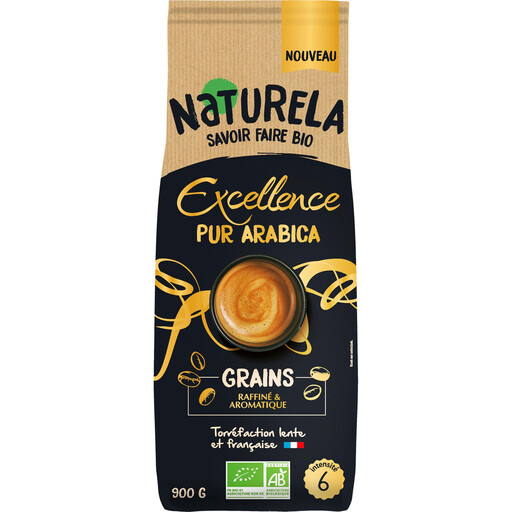 Image unavailable
Worth considering for espresso if your machine accepts whole beans and has a grinder.
The product name identifies an organic Arabica whole-bean coffee. Check the specific product for a Fairtrade/Max Havelaar label and, if needed, a ‘decaffeinated’ claim.
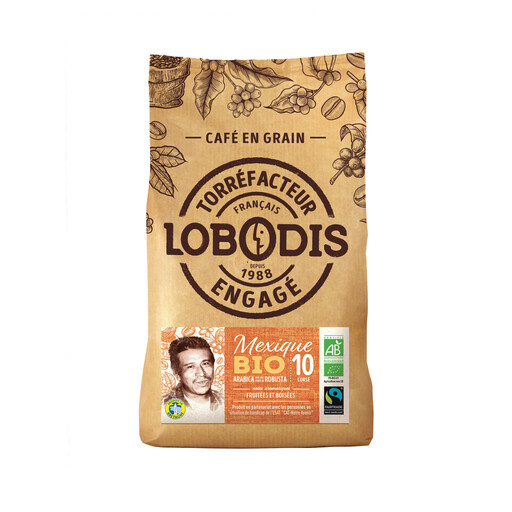 Image unavailable
To make espresso, check that this product’s format suits your machine.
500 g pack. If Fairtrade or limiting your caffeine intake matters to you, check the specific product for Fairtrade/Max Havelaar and ‘decaffeinated’ claims.
Look for a Fairtrade/Max Havelaar mention on the packaging or the listing for the specific product. Max Havelaar France describes the label as covering social, economic and environmental criteria; a general statement about the brand doesn’t identify the coffee you’re buying.
Not necessarily: these claims alone don’t prove Fairtrade/Max Havelaar certification. Carte Noire lists its Espresso Bio whole-bean coffee as organic and Rainforest Alliance certified. If Fairtrade is your priority, look for this claim separately on the product.
Choose a format your machine accepts: whole beans need a grinder, while ground coffee requires a compatible machine. Then check the Fairtrade/Max Havelaar claim on your chosen coffee, as machine compatibility doesn’t tell you anything about its certification.
Look for a product marked ‘decaffeinated’ that’s compatible with your machine. ANSES notes that caffeine can disrupt sleep, so also consider the other caffeinated drinks you consume during the day.