To choose Fairtrade espresso for a savoury breakfast, first check that the Fairtrade claim applies to the specific coffee you’re buying: an ‘organic’ label on its own isn’t enough. Then choose whole beans or ground coffee to suit your machine. If you enjoy roasted notes and pronounced bitterness, a dark roast may suit your taste, but it doesn’t replace checking the certification.
Who is this choice for?
People who want to check that their coffee is Fairtrade
If Fairtrade is important to your purchase, look for the claim on the specific product rather than relying on the word ‘organic’ alone. Fairtrade/Max Havelaar France says that, for coffee bearing its full label, the ingredients meet its standards and are traceable.
Owners of bean-to-cup machines
A machine with a grinder, or a separate coffee grinder, lets you start with whole beans; the grind must then be suitable for your brewing method. Ethiquable describes its Expresso Grains, for example, as suitable for espresso machines and percolators.
Fans of a strong espresso with breakfast
If you prefer roasted notes with a savoury meal, check the tasting profile given for the coffee you’re considering. Auchan’s listing for Ethiquable Expresso Grains describes a dark roast with pronounced bitterness. That’s a matter of taste, not a certification criterion.
What should you check?
Start by checking for Fairtrade certification on the specific product. Then rule out formats that aren’t compatible with your machine before comparing tasting profiles.
| Criteria |
What to check |
Who it matters to |
| Fairtrade |
Look for the Fairtrade/Max Havelaar label or a clear Fairtrade claim linked to the specific coffee. |
I want to be able to confirm that the coffee I have with breakfast meets my Fairtrade requirements, rather than relying on it simply being organic. Around 36% of consumers make this their top priority. |
| Format and machine |
Check that your machine accepts whole beans, ground coffee or the type of coffee pod you’ve chosen; if you buy beans, make sure they’re ground appropriately. |
If my machine can’t grind beans, I need a format I can actually use. Compatibility comes first for around 29% of consumers. |
| Tasting profile |
Check the roast and tasting notes, but don’t assume that intensity is a measure of caffeine content. |
With a savoury breakfast, I’m mainly looking for a strong cup and don’t mind if it’s more bitter. This profile is the top priority for around 21% of consumers. |
| Organic certification and pack size |
Check the organic claim and Fairtrade certification separately, then choose a pack size that suits how you use coffee. |
For my regular shop, I first check whether the coffee is organic and the pack size is right for what I want to buy. Around 14% of consumers prioritise these features. |
Mistakes to avoid
-
Confusing ‘organic’ with ‘Fairtrade’
An organic claim alone doesn’t confirm that coffee has been produced under Fairtrade conditions. Carrefour Bio’s listing for its 500 g bag of 100% Arabica whole beans explicitly states that the coffee in this product is Fairtrade/Max Havelaar certified.
Check both claims separately on the product you intend to buy.
-
Buying whole beans when you can’t grind them
Espresso beans aren’t a substitute for ground coffee in a machine that doesn’t accept whole beans.
Check which formats your machine accepts before choosing between whole beans, ground coffee and pods.
Without a suitable built-in or separate grinder, you’ll need extra equipment to use whole beans.
-
Assuming high intensity is right for everyone
The intensity rating of 9 and dark roast listed for Ethiquable Expresso Grains describe a tasting profile that may not suit you if you prefer less bitterness. This intensity rating also doesn’t, on its own, tell you how much caffeine the coffee contains.
Choose a profile that suits your taste, then check the format and Fairtrade certification separately.
Brands to know for this choice
Carrefour Bio
A 500 g pack of 100% organic Arabica whole beans whose Carrefour France listing explicitly links the coffee to the Fairtrade/Max Havelaar label.
- The listing states that 100% of the total weight of the coffee in this product comes from Fairtrade sources, in accordance with the label’s standards.
- This claim applies to the product described, not all Carrefour Bio coffees. Also check that whole beans are suitable for your equipment.
Ethiquable
Ethiquable describes its 500 g Expresso Grains as suitable for espresso machines and percolators.
- The brand describes it as a blend of organic Arabica coffees sourced from Fairtrade co-operatives; Auchan’s listing gives it an intensity rating of 9.
- The dark roast and pronounced bitterness of this product may not suit you if you prefer a milder cup.
Malongo
Malongo offers a range of organic, Fairtrade coffees in several formats, including whole beans, ground coffee and pods.
- These formats make it easier to find a product suited to different brewing methods.
- Before choosing, check the label, format and espresso suitability of the specific product.
Bio Village
E.Leclerc lists, among other products, a 250 g pack of Bio Village Ethiopian pure Arabica ground coffee with an organic Fairtrade claim.
- The ground format may suit equipment that accepts this type of coffee.
- The Fairtrade claim alone doesn’t confirm that this product’s grind is suitable for making espresso.
Coffee available on Joybuy
This ground coffee is for people whose equipment accepts ground coffee for making espresso. If Fairtrade is important to you, check the claim on the pack of the product you choose.
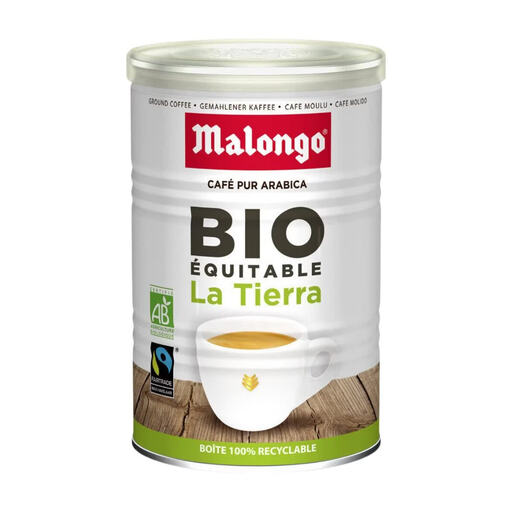 Image unavailable
MALONGO La Tierra organic ground coffee, 250 g
Worth considering if your espresso machine accepts ground coffee. Check the pack to make sure the Fairtrade claim applies to this specific product.
View on Joybuy
Frequently asked questions
How can you recognise Fairtrade/Max Havelaar coffee?
Look for the label and read the information on the pack of the coffee you’re buying. Fairtrade/Max Havelaar France says its full label means that the ingredients meet Fairtrade standards and are traceable. If there’s an arrow on the label, also read the details on the back of the pack.
Is organic coffee always Fairtrade?
No. Check both claims separately on the specific product. An organic claim isn’t proof of Fairtrade certification.
What grind should you use for espresso?
Adjust the grind according to your machine’s instructions. For its Expresso Grains, Ethiquable recommends adjusting the grind size to suit your equipment. If you buy whole beans, make sure you can grind them or that your machine has a grinder.
Does the stated intensity tell you how much caffeine the coffee contains?
No. Don’t use the intensity rating alone to work out the caffeine content; it describes the coffee’s stated flavour profile. The Anses notes that people’s sensitivity to caffeine varies and that caffeine can disrupt sleep.


