What should you check before choosing?
For a bar you plan to keep in your gym bag, check the certification for that specific product, compare its nutritional values, then make sure its storage requirements suit your journey.
| What to check |
Look for |
Who this matters to |
| Fairtrade certification |
Look for the exact label and, for a bar with several ingredients, check which ingredients are covered and what the packaging says on the back. |
If I’m specifically looking for Fairtrade/Max Havelaar, a general brand claim doesn’t tell me whether my bar carries that label. Around 44 % of shoppers put checking certification at the top of their list. |
| Sugar and recipe |
Compare sugar and fat per 100 g, then consider the portion you’ll take with you. |
If I want a treat after a workout, I want to know what’s in the portion I’ve chosen rather than relying on the cocoa percentage alone. Nutritional composition is the top priority for around 33 % of shoppers. |
| Taking it with you and allergens |
Read the storage instructions, check the packaging and review the allergens and any ‘may contain’ warnings. |
If my bag might get warm, I need to be able to store the bar as directed and check that it’s suitable for me. Around 23 % of shoppers put storage and allergens ahead of other criteria. |
Brands to consider, depending on the product
These brands offer products with information about Fairtrade, but you’ll need to check the label, recipe and nutritional information on each bar individually.
Ethiquable
Dark and milk chocolate bars, including some products that state the proportion of ingredients sourced through Fairtrade.
- Ethiquable says that 99.5 % of the total weight of its milk chocolate and puffed rice bar comes from Fairtrade.
- This claim alone doesn’t confirm that the bar carries the Fairtrade/Max Havelaar label. Check the packaging if you’re looking for this specific standard.
Saveurs & Nature
A brand that Max Havelaar France describes as carrying the Fairtrade/Max Havelaar label on its products.
- For its 40 % milk chocolate bar, Saveurs & Nature states that Fairtrade cocoa and sugar make up 80 % of the total weight.
- The label doesn’t tell you how much sugar is in a portion, so check the nutritional information separately.
Alter Eco
A range that includes an Ecuador 70 % dark chocolate bar, which the brand describes as Fairtrade.
- Alter Eco describes its partnership with the Unocace co-operative for this product.
- Check the standard printed on the bar you choose: different Fairtrade claims don’t necessarily refer to the same label.
A milk chocolate and puffed rice bar on Joybuy
This selection features a milk chocolate and puffed rice bar for shoppers who want to take a Fairtrade recipe with them and can follow its storage instructions.
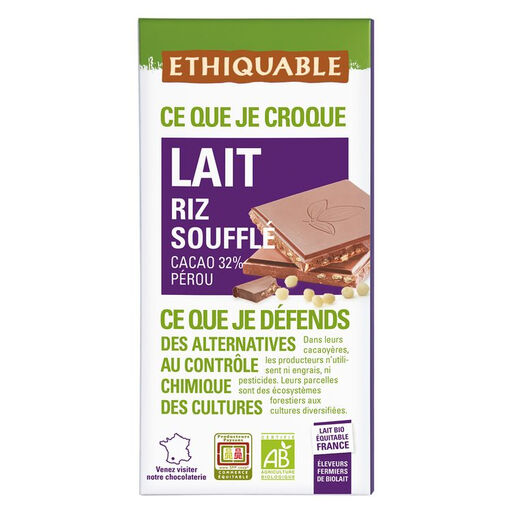 Image unavailable
ETHIQUABLE organic milk chocolate and puffed rice, 100 g
This bar is suitable for a journey when your bag stays cool, if you’re looking for a milk chocolate and puffed rice recipe. According to Ethiquable, 99.5 % of its total weight comes from Fairtrade; check the logo on the packaging if you require the Fairtrade/Max Havelaar standard. The Joybuy product page says that, before opening, it should be stored in a cool, dry place at between 16 and 18 °C, away from light. The recipe contains milk, so check the allergen list and any ‘may contain’ warnings.
View on Joybuy
Frequently asked questions
Does the sugar tax apply to chocolate bars in France?
No, not to a chocolate bar as such: the levy described by the French Ministry of the Economy applies to sugary drinks. To compare chocolate bars, check their nutritional values, particularly the sugar content.
Is Nutri-Score compulsory on a chocolate bar?
No, Nutri-Score is voluntary in France. A nutrition declaration is compulsory for the relevant pre-packed foods, according to the Directorate General for Competition Policy, Consumer Affairs and Fraud Control. It lets you compare values per 100 g even when Nutri-Score isn’t shown.
How can you identify a Fairtrade-certified bar with several ingredients?
Look for the Fairtrade/Max Havelaar logo on the bar and read the details on the back. Fairtrade says that, for a composite product carrying the label with an arrow, this information lets you check which ingredients are covered and how they can be traced.
Can you leave a chocolate bar in a gym bag all day?
Check the recommended storage temperature for the product you’ve chosen before leaving it in your bag. The Joybuy product page for the ETHIQUABLE milk chocolate and puffed rice bar says that, before opening, it should be stored in a cool, dry place at between 16 and 18 °C, away from light. A bag that could get warm may not meet these conditions.
Which allergens should you check before taking a bar with you?
Read the ingredients and check for any ‘may contain’ warnings on the packaging of the exact product. The French Ministry of the Economy states that allergens in pre-packed foods must be listed and highlighted. If the recipe contains milk, make sure you check this information in particular.


