Shoppers looking for proof of Fairtrade credentials
You want to know which ingredients are actually covered by a Fairtrade commitment, rather than relying on a general claim on the jar.


If Fairtrade is your priority, choose a spread whose specific product listing identifies a label, certification or the ingredients covered: ‘organic’ and ‘palm oil-free’ claims aren’t enough. Then compare the ingredients, allergens and nutritional values per 100 g, and check the pack size and availability through your chosen collection service. Nutri-Score can provide extra information when shown, but displaying it is optional in France.
You want to know which ingredients are actually covered by a Fairtrade commitment, rather than relying on a general claim on the jar.
You compare ingredients, allergens and nutritional values per 100 g, especially if hazelnuts, milk or soya affect your choice.
You’re looking for a pack size that suits how much you use and checking that the product is available at your chosen store.
When ordering chocolate and hazelnut spread through a grocery collection service, first decide whether proof of Fairtrade credentials is essential to your choice. Then check the ingredients and practical details for the specific product and store you’ve selected.
| Criterion | What to check | Who it matters to |
|---|---|---|
| Proof of Fairtrade credentials | Look for the label or certification and check which ingredients the claim applies to. Check the Fairtrade share if it’s stated. | I want to be able to link the cocoa in my jar to a specific Fairtrade commitment, without confusing it with organic certification. Around 40% of shoppers put this proof first. |
| Ingredients and allergens | Check the sugars and fats per 100 g, then read the ingredients and allergen information for the exact recipe. | If my household needs to take hazelnuts, milk or soya into account, the ingredients list comes before claims on the front of the pack. Ingredients and allergens are the priority for around 30% of shoppers. |
| Pack size and collection | Check the jar’s weight, storage instructions and availability at your chosen store. | I prefer a jar that suits how often we use it and is available through the collection service where I pick up my shopping. Around 30% of shoppers prioritise these practical considerations. |
These claims describe different things. Carrefour’s listing for ETHIQUABLE spread states the share of Fairtrade ingredients, while the organic and palm oil-free claims for a Nocciolata product don’t, by themselves, provide the same proof.
If Fairtrade credentials are decisive for you, look for the label or certification on the specific product, check which ingredient it covers and note the stated share.
France’s Ministry of the Economy explains that displaying Nutri-Score is optional in France. The nutrition declaration on pre-packed foods, however, gives you a basis for comparison.
Compare the values per 100 g and read the ingredients and allergen information. Use Nutri-Score as additional information if it appears on the product.
A larger pack may not suit how often your household uses the spread or the storage conditions you can provide.
Check the weight and storage instructions for the particular variety before adding it to your basket.
The charge described by France’s Ministry of the Economy applies to sugary drinks; it isn’t a way to compare jars of spread.
For this category, focus on proof of Fairtrade credentials, the label and the product available through your collection service.
ETHIQUABLE describes the cocoa in its organic hazelnut spread as Fairtrade. Carrefour’s listing for this product states that 65% of its ingredients by weight come from Fairtrade sources.
Carrefour’s listing for its cocoa and hazelnut product describes it as organic and palm oil-free, and states that it contains 18.5% hazelnuts.
Carrefour Bio’s 700 g hazelnut spread, listed for grocery collection, is described as organic and palm oil-free.
Nutella appears in the catalogues checked in several pack sizes. According to Nutella France’s ingredient information, the recipe includes sugar, palm oil, hazelnuts, cocoa and milk, among other ingredients.
E.Leclerc lists a 750 g jar of Eco+ spread, which may be worth considering if pack size is a deciding factor.
These products are mainly useful for comparing organic or palm oil-free recipes and different pack sizes. If proof of Fairtrade credentials is essential, check the specific jar before choosing: recipe characteristics aren’t a substitute.
 Image unavailable
Worth considering if you’re looking for organic cocoa and hazelnut spread in a small jar. Carrefour’s listing describes the Nocciolata product as palm oil-free; check the ingredients and allergen information on the jar you order, as well as any Fairtrade claim if that’s a priority for you.
 Image unavailable
This 400 g jar is for shoppers who prefer organic hazelnut and cocoa spread. Check the ingredients and allergen information for this product; if Fairtrade credentials are important to you, look for a claim that applies specifically to it.
 Image unavailable
This 200 g jar gives you the chance to consider an organic recipe whose ingredients are worth checking before comparing it with a classic chocolate and hazelnut spread. Check the ingredients, allergen information and storage instructions, and look separately for any Fairtrade claim.
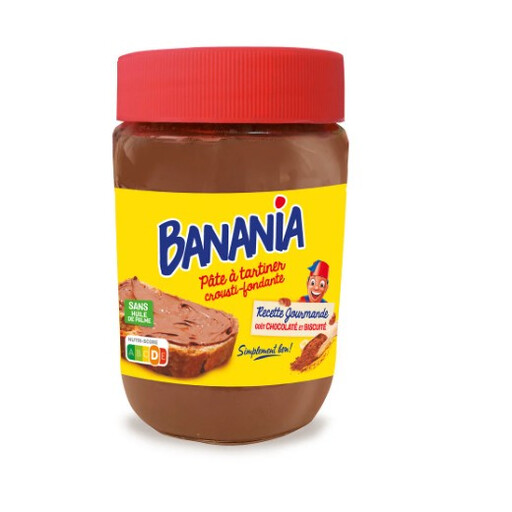 Image unavailable
Worth considering if you’re looking for a 400 g jar of palm oil-free spread. Its cocoa and banana recipe isn’t the same as a cocoa and hazelnut spread, so read the ingredients and allergen information on the jar you choose before comparing it with other products.
Image unavailable
This 750 g jar is worth comparing if you regularly eat cocoa and banana spread. Check that the size suits how you’ll use it, then read the allergen information and storage instructions for this particular variety.
No. The charge described by France’s Ministry of the Economy applies to sugary drinks, not jars of spread, so it can’t be used to compare these products.
No. As France’s Ministry of the Economy explains, displaying Nutri-Score is optional in France. The nutrition declaration lets you compare values per 100 g even when the logo isn’t shown.
Look for an identifiable label or certification and check which ingredients it covers. ETHIQUABLE describes the cocoa in its hazelnut spread as Fairtrade; Carrefour’s listing states that 65% of the ingredients by weight are Fairtrade. This information applies to this recipe, not to all organic spreads.
Read the ingredients, highlighted allergens and any ‘may contain’ warnings for the product you order, then check the label on the jar you receive. France’s Directorate General for Competition Policy, Consumer Affairs and Fraud Control reminds shoppers that allergenic ingredients must be listed and highlighted on food labels.