Shoppers who care about Fairtrade certification
You want to know whether the tea and spices are covered by a recognisable certification, rather than relying on the word ‘organic’ alone or on the brand’s general claims.


If you want a chai where the tea and spices are explicitly covered by Fairtrade/Max Havelaar, Carrefour’s listing for ETHIQUABLE Spiced Chai states that certified ingredients make up 100% of its weight. For another blend to enjoy hot, check the label and the ingredients it covers separately, then look for black tea if you’re sensitive to caffeine. The word ‘organic’ doesn’t answer either of these questions.
You want to know whether the tea and spices are covered by a recognisable certification, rather than relying on the word ‘organic’ alone or on the brand’s general claims.
You choose your blend based on whether it contains black tea, the spices listed and the format that suits you, for a cup to enjoy black or with milk.
You need to tell the difference between chai made with black tea and a spiced infusion. The Anses notes that people’s sensitivity to caffeine varies and that it can disrupt sleep.
To choose a Fairtrade chai to enjoy hot in winter, start by checking the label and which ingredients it covers. Then compare the recipe and format to suit the cup you want to make.
| Criterion | What to check | Who is it for? |
|---|---|---|
| Fairtrade credentials | Identify the label, the certified ingredients and their share of the blend. For ETHIQUABLE Chai, Carrefour states that 100% of the total weight is Fairtrade/Max Havelaar certified. | I want the certification to cover the spices too, not just the tea. Around 40% of shoppers put Fairtrade credentials at the top of their list. |
| Spiced recipe | Read the list of spices and check whether the blend contains black tea before deciding whether to drink it black or with milk. | For a winter cup, I’m mainly looking for a blend of spices that suits my tastes. The flavour and preparation of chai are the priority for around 30% of shoppers. |
| Caffeine | Look for black tea in the ingredients of the exact product; neither ‘chai’ nor ‘organic’ means it’s caffeine-free. | If I drink chai later in the day, I want to know whether it contains black tea. Managing caffeine comes first for approximately 20% of shoppers. |
| Organic certification and format | Check the organic certification, net weight and whether it comes in tea bags or loose leaf separately. | I prefer to choose between tea bags and loose leaf to suit the way I make chai, while keeping organic and Fairtrade certification distinct. Around 10% of shoppers prioritise these features. |
The two claims relate to different standards. An organic chai doesn’t, by itself, prove that its tea and spices are Fairtrade certified.
Look for the specific Fairtrade label, then check which ingredients in the blend it covers and what proportion they make up.
Chai made with black tea naturally contains caffeine. According to the Anses, caffeine can delay falling asleep and reduce the length or quality of your sleep.
If caffeine matters to you, read the ingredients on the specific product you’re buying instead of relying on the word ‘chai’ alone.
Pukka’s official website describes Original Chai as a spice blend, while a Joybuy listing under the same name also mentions black tea. This difference matters if you’re choosing your drink based on its ingredients.
Check the ingredients printed on the pack, along with the Fairtrade label and the ingredients it covers.
Its Spiced Chai is an organic black tea blended with cinnamon, cardamom, ginger and cloves, among other spices.
Pukka describes its teas as organic and Fair for Life certified. Its Original Chai page highlights cardamom, liquorice, ginger and cinnamon.
Kashmir Tchaï is an organic spiced black tea, available in tea bags and loose leaf.
These two Pukka tea-bag blends are worth considering for a hot chai. Before choosing based on Fairtrade certification or caffeine, check the label, the ingredients it covers and the ingredients listed on the pack itself.
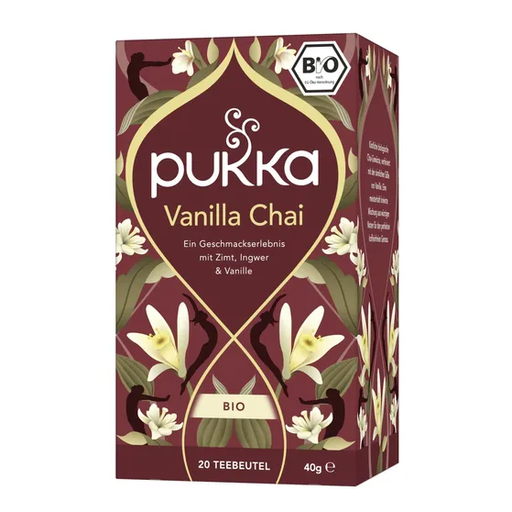 Image unavailable
Worth considering if you’re looking for a vanilla chai in tea bags to enjoy hot.
If Fairtrade certification or avoiding black tea is important to you, check the label, the ingredients it covers and the ingredients listed on the box.
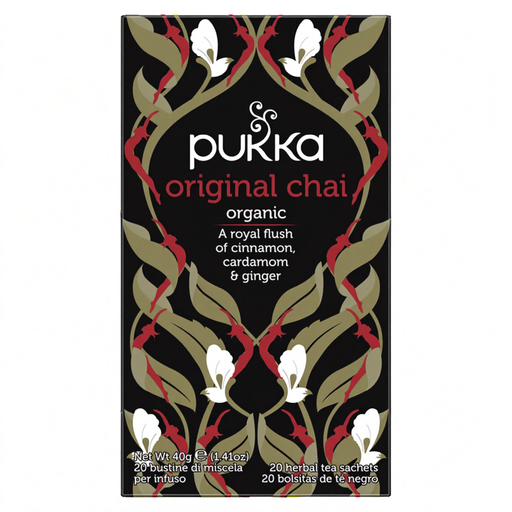 Image unavailable
Worth considering if you’d like to make a spiced chai using tea bags.
Pukka’s official page and a Joybuy listing with the same name differ on whether the blend contains black tea. If you’re choosing based on caffeine, check the ingredients on the box. If Fairtrade certification is a priority, check the label and which ingredients it covers too.
Not automatically: for a blended product, check the packaging to see which ingredients are covered. For ETHIQUABLE Spiced Chai, Carrefour specifies that Fairtrade/Max Havelaar-certified ingredients make up 100% of the total weight.
No. A recipe may contain black tea or be based on a spiced infusion. Check the ingredients on the product you’re buying to be sure. This is particularly useful for Pukka Original Chai, as the descriptions we consulted differ on this point.
Kusmi Tea recommends using water at 90 °C and brewing Kashmir Tchaï for 3 to 5 minutes. You can then drink it black or add milk, depending on your preference.
First check whether the chai contains black tea, and take your sensitivity to caffeine into account. The Anses says caffeine can delay falling asleep and reduce the length or quality of your sleep; you can’t tell what’s in a blend from its name alone.