For a holiday let, choose a chai whose packaging or product listing specifies Fairtrade or Fairtrade/Max Havelaar, then pick a format to suit the equipment available: tea bags mean you won’t need to provide an infuser, unlike loose-leaf tea. Also check what the Fairtrade claim covers, the ingredients and whether it contains black tea, in case any guests wish to avoid caffeine. A “organic” claim on its own does not establish that the chai is Fairtrade.
Who is this choice for?
Hosts looking for a clear Fairtrade claim
You want to offer Fairtrade chai without confusing this claim with “organic”. According to the Monoprix and Biogo listings, details to look out for may include Fairtrade/Max Havelaar, mass balance or the proportion of Fairtrade ingredients.
Guests with limited equipment
If the kitchen has no teapot or infuser, chai tea bags are easier to prepare. Café du Jour lists Tea of Life chai in a box of 25 individually wrapped tea bags; the Biogo listing for Clipper chai gives instructions for making it straight in a cup.
Groups who pay attention to ingredients
Before leaving chai out for guests, you can compare the spices and check whether it contains black tea. The Café du Jour listing for Tea of Life chai says it contains caffeine, while Monoprix provides details of the ingredients in its black chai tea.
What should you check before buying?
For a holiday let, start by checking what the Fairtrade claim covers, then choose a format guests can prepare with the equipment available.
| Criteria |
What to check |
Who it matters to |
| Fairtrade claim |
Look for the claim on the exact product and read what it covers, particularly where a percentage or mass balance is mentioned. |
I want to be able to explain what the Fairtrade claim means for the chai I offer my guests; around 33% of consumers say this is their main priority. |
| Easy to prepare without an infuser |
Check whether it comes in tea bags and read the brewing instructions before assuming it can be made in a cup. |
If I don’t know what equipment the kitchen has, I’d prefer a format that anyone can prepare easily; this matters most to around 27% of consumers. |
| Quantity and storage |
Compare the number of tea bags or net weight with the length of the stay; check the packaging if the box will need to be stored once opened. |
For a group stay, I want to pack enough chai without having a large amount left over to take home; around 20% of consumers prioritise this. |
| Ingredients and caffeine |
Read the ingredients list and check whether it contains black tea, as well as which spices are in the product. |
Before serving several people, I want to know what’s in the blend and spot black tea in case anyone avoids caffeine; around 20% of consumers put this check first. |
Common mix-ups to avoid
-
Confusing “organic” with “Fairtrade”
A chai described as organic won’t necessarily carry the Fairtrade claim you’re looking for. Kusmi Tea describes Kashmir Tchaï as an organic spiced black tea, which isn’t enough to establish that it has Fairtrade certification.
If Fairtrade is a buying priority, check for the claim on the packaging or the listing for the exact product.
-
Assuming all the ingredients have the same status
Product claims are worded differently: the Monoprix listing mentions mass balance for the black tea, while the Biogo listing for Clipper chai says it contains 83% Fairtrade ingredients.
Read the details alongside the Fairtrade claim rather than assuming it applies to every ingredient in the same way.
-
Forgetting to check the recipe before serving a group
The Café du Jour listing says that Tea of Life chai contains caffeine. The spice blends also vary from one product to another.
Check the ingredients list and any caffeine information for your chosen product before leaving it out for guests.
-
Taking loose-leaf chai without brewing equipment
Loose-leaf tea needs something to hold the leaves and spices while it brews, and the equipment in a holiday let can vary.
Check whether there’s a teapot, strainer or infuser; if not, choose tea bags.
Chai brands and products to compare
Tea of Life
A chai to consider when individually portioned servings make it easier to serve guests.
- Café du Jour describes this product as organic and Fairtrade, in a box of 25 individually wrapped tea bags.
- The same listing says it contains caffeine; check the recipe and claims on the product you buy.
Monoprix Bio
A box of 20 tea bags that lets you compare a detailed ingredients list with the information provided alongside the Fairtrade/Max Havelaar claim.
- The Monoprix listing describes a spiced black chai tea and specifies the ingredients covered by its Fairtrade/Max Havelaar claim.
- It mentions mass balance for the black tea: this shouldn’t be taken to mean that each ingredient is physically separated.
Clipper
A chai in tea bags whose listing lets you compare the stated proportion of Fairtrade ingredients with the brewing instructions.
- According to Biogo, this product contains 20 tea bags and is made with 83% Fairtrade ingredients; the listing recommends 250 ml of boiling water and a brewing time of 2 to 4 minutes.
- The stated proportion doesn’t mean that every ingredient is Fairtrade: check what the claim covers on the exact product.
Kusmi Tea
A brand to consider if you’re choosing between tea bags and loose-leaf tea, or if the recipe is important to you.
- Kusmi Tea describes Kashmir Tchaï as an organic spiced black tea and offers tea-bag and loose-leaf formats in its chai range.
- If you’re looking for Fairtrade chai, check for the Fairtrade claim separately on the specific product.
Chai to consider on Joybuy
This Pukka Original Chai product is worth considering for a holiday let. Before planning to serve it, check for the Fairtrade claim and confirm exactly what the 20 pieces refer to.
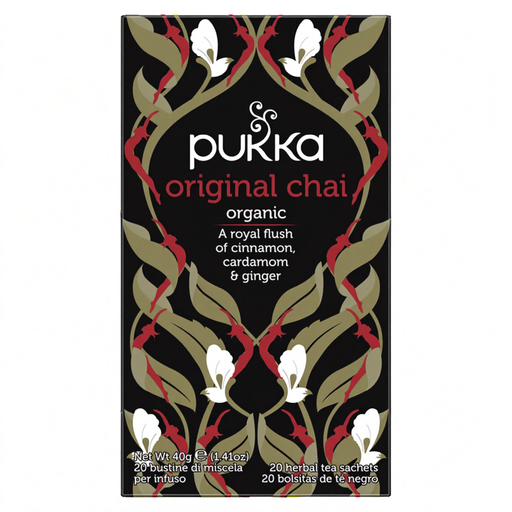 Image unavailable
Pukka Original Chai 20pcs
For a holiday let, check the Fairtrade claim on the packaging and confirm the format of the 20 pieces before relying on it being easy to prepare without an infuser.
View on Joybuy
Frequently asked questions
How can you check whether chai is Fairtrade?
Read the Fairtrade claim and any details alongside it on the packaging or the listing for the exact product. The Monoprix listing mentions mass balance for the black tea, while Biogo says Clipper chai contains 83% Fairtrade ingredients: these claims describe different things.
Which format should you choose if the holiday let has no teapot or infuser?
Choose tea bags if you need to be able to make chai straight in a cup. Café du Jour lists Tea of Life chai in individually wrapped tea bags; for its Clipper product, Biogo recommends brewing for 2 to 4 minutes in 250 ml of boiling water.
Can you assume chai is caffeine-free?
No: check the ingredients for the product you’ve chosen. Café du Jour explicitly says its Tea of Life chai contains caffeine; if this matters to your guests, check the information on the packaging too.
Is an “organic” claim enough to choose Fairtrade chai?
No, you need to check each claim separately. If you’re looking for Fairtrade chai, check for the claim on the specific product rather than relying on it being described as organic chai.


