Anyone looking for Fairtrade proof
When choosing a chai to serve with coffee and dessert, you want to know which label it carries and which ingredients it covers, rather than relying on a general claim from the brand.


For coffee and dessert, choose a chai whose label and certified ingredients are clearly listed on the product. La Fourche’s listing for Terra Etica black chai tea states that the Fairtrade / Max Havelaar-certified tea and spices make up 100% of the product’s total weight. If you want to avoid caffeine, look for an infusion without tea, then check its Fairtrade certification and ingredients separately.
When choosing a chai to serve with coffee and dessert, you want to know which label it carries and which ingredients it covers, rather than relying on a general claim from the brand.
You’re looking for a warming, spiced drink to serve with dessert, and want to choose the spices and preparation method to suit the occasion.
You need to distinguish between chai made with black tea, which contains caffeine, and an infusion without tea, particularly if you’re serving it in the evening.
First, check the certification of the specific product. Then choose between black tea and an infusion based on the flavour you’re after and whether caffeine is a factor for you.
| Criterion | What to check | Who is it for? |
|---|---|---|
| Fairtrade certification | Look for the named label or standard, the ingredients it covers and their share of the recipe, if stated. | I want to know whether the guarantee covers the tea and spices, rather than just the brand; around 46% of consumers would put this proof at the top of their list. |
| Pairing with dessert | Check the blend’s base, its spices and the preparation instructions, particularly if you plan to add milk. | With the desserts served alongside coffee, I’m mainly looking for a spiced chai flavour I enjoy; around 36% of consumers would prioritise this pairing. |
| Caffeine | Read the ingredients to tell the difference between chai made with black tea and an infusion without tea. | If I’m serving it in the evening, I want to be able to rule out black tea if caffeine is a concern; nearly 18% of consumers would put this first. |
Organic chai isn’t necessarily Fairtrade-certified. Kusmi Tea describes Kashmir Tchaï as an organic black tea with spices; this alone doesn’t prove that it has Fairtrade certification.
If Fairtrade is essential to you, check the label on the specific product and which ingredients it applies to.
Fairtrade International allows mass balance for tea, so the label doesn’t automatically mean that certified leaves have been kept physically separate from other tea at every stage.
If physical separation matters to you, look for an explicit statement about physical traceability, separately from the presence of the label.
Black tea contains caffeine, but ‘chai’ can also refer to an infusion without tea. This difference matters if you’re serving the drink to guests who want to avoid caffeine.
Check the base in the ingredients list. If it’s an infusion without tea, check its Fairtrade certification separately.
Chai tea bags and a blend prepared with milk aren’t served in quite the same way. The milky version also requires you to have milk on hand and allow time to prepare it.
Decide whether you’ll serve your chai plain or with milk, then read the instructions for the product you’ve chosen.
La Fourche’s listing for Terra Etica Organic Fairtrade Black Chai Tea describes a blend of Fairtrade / Max Havelaar-certified black tea and spices.
Pukka says its teas are Fair for Life-certified and features Spiced Vanilla Chai on its French website.
Clipper’s UK shop describes its Indian Chai Black Tea as organic and Fairtrade, and lists black tea and spices among its ingredients.
Kusmi Tea’s French collection describes Kashmir Tchaï as an organic black tea with spices.
This tea-bag option could be served with coffee and dessert. If avoiding caffeine or choosing a specific Fairtrade label matters to you, check the product details.
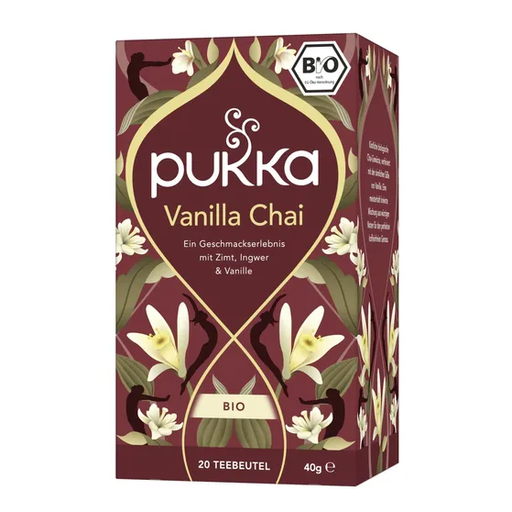 Image unavailable
A tea-bag option to consider when serving chai with coffee and dessert.
If you want to avoid caffeine or need Fairtrade / Max Havelaar certification to cover a specific share of the recipe, check the ingredients and packaging before choosing.
Check the label, which ingredients it covers and what share of the recipe is stated on the product. For Terra Etica Organic Fairtrade Black Chai Tea, La Fourche specifies that the Fairtrade / Max Havelaar-certified black tea and spices make up 100% of the product’s total weight.
Not necessarily. Fairtrade International allows mass balance for tea, which means certified and non-certified volumes can be mixed while the volumes sold on Fairtrade terms are tracked. If you’re looking for physical separation, check that this is explicitly stated.
Follow the instructions for your chosen blend. Terra Etica’s chai listing recommends steeping it for 3 to 4 minutes at 95 °C. If you’re serving it with milk or adding sugar, bear the desserts you’re serving in mind when choosing how to prepare it.
No. Chai made with black tea contains caffeine. If you want to avoid it, look for an infusion without tea by checking the ingredients, then check its Fairtrade certification separately.