Procurement managers who need to substantiate Fairtrade claims
You need to be able to find the certification, the ingredients it covers and the proportion covered for the product you order, rather than relying on the word ‘Fairtrade’ alone.


If Fairtrade is your deciding factor, choose a chai whose certification and the proportion of ingredients it covers are specified for the product you’re buying. Carrefour states that 100% of the total weight of the ETHIQUABLE Tchaï featured on its product page is Fairtrade/Max Havelaar certified, while Jardin BiO étic says that 80.5% of the agricultural ingredients meet Fairtrade standards. These percentages are calculated on different bases. For everyday service, also check the format, brewing instructions and label. Organic certification alone does not prove that a product is Fairtrade certified.
You need to be able to find the certification, the ingredients it covers and the proportion covered for the product you order, rather than relying on the word ‘Fairtrade’ alone.
You’re looking for a format that’s easy to distribute and brewing instructions your team can follow consistently.
You want to identify the tea and spices in the recipe, and check whether it contains flavourings if that matters to your offering.
First decide what evidence of Fairtrade certification you need. Then check that the format suits your service arrangements and that the ingredients list provides the information you want to share with diners.
| Criterion | What to check | Relevant to |
|---|---|---|
| Scope of Fairtrade certification | Check the certification, which ingredients it covers and the basis for the stated percentage: total weight or agricultural ingredients. | If I need to substantiate the ‘Fairtrade’ claim to diners, I want to know what proportion of the chai is covered; around 42% of consumers would put this evidence first. |
| Consistent service | Check the type of packaging, the number of units and the brewing instructions for the product you choose. | When several teams prepare drinks, I want a dose and preparation method that are easy to repeat; nearly 33% of consumers would prioritise this consistency. |
| Taste and ingredients | Compare the spice lists and check for flavourings, highlighted allergens and the best-before date on the label. | To describe the chai clearly, I need to know its recipe and what information to share with diners; around 25% of consumers would put this criterion first. |
Organic certification doesn’t tell you whether the tea and spices also meet Fairtrade standards.
Specify in your procurement requirements which certification you accept, which ingredients it must cover and what evidence is required for the product you order.
Carrefour gives the Fairtrade/Max Havelaar coverage for ETHIQUABLE Tchaï as a proportion of the total weight, while Jardin BiO étic gives its figure as a proportion of the agricultural ingredients. A direct numerical comparison would overlook this difference.
Keep each manufacturer’s wording and calculation basis on file before deciding whether the coverage meets your requirements.
Packaging shown online doesn’t confirm delivery arrangements for your canteen or availability when you place your order.
Confirm the product, packaging supplied, best-before date on arrival and replenishment options with your supplier.
A substitute product may have different ingredients or a different scope of Fairtrade certification to the claim you share with diners.
When the product arrives, check the label in French, highlighted allergens and the certification evidence for the product supplied.
Its Darjeeling/Ceylon spiced Tchaï comes in a box of 20 tea bags. It’s worth considering if Fairtrade coverage of the recipe is a priority.
Its organic Thé noir Équitable Chaï Intense is an option if you’re looking for chai with an explicitly stated proportion of ingredients covered by Fairtrade standards.
Kusmi Tea’s organic chai collection includes Kashmir Tchaï, available in several formats.
This chai is worth considering for a canteen drinks service. Before choosing it as a Fairtrade purchase, check the scope of the Fairtrade claim for the product supplied and make sure its format suits your operation.
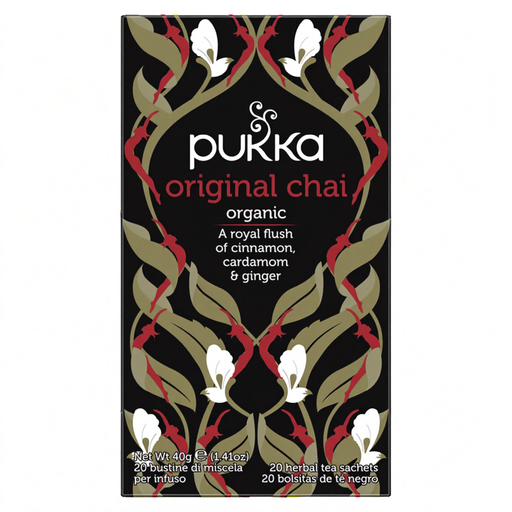 Image unavailable
If you’re considering this chai for a Fairtrade range, check the packaging for the certification and the ingredients it covers. The pack is listed as containing 20 pieces, so confirm the format and brewing instructions before planning your service.
No. Organic and Fairtrade certification are separate criteria. If Fairtrade status matters for your canteen, check the certification and which ingredients it covers for the product you choose.
Check the details on the packaging and product information sheet, as coverage can vary by ingredient and certification scheme. Fairtrade International recommends checking the back of the pack when an arrow appears alongside its mark. Also note the calculation basis for any percentage shown.
For this product, ETHIQUABLE recommends steeping for 3 to 4 minutes in water at 95 °C and advises against using boiling water. If several people take turns serving drinks, display the instructions for the product supplied at the drinks station.
No, these targets don’t specify a particular chai. According to the French Ministry for the Ecological Transition, private workplace restaurants have been subject to the target of 50% sustainable, high-quality products, including 20% organic products, since 1 January 2024. To find out how a product can be counted at your establishment, check the evidence required by its monitoring scheme.
Check the label on the product actually supplied: its name, ingredients, highlighted allergens, net quantity and applicable best-before date. In France, mandatory consumer information must be legible and provided in French, among other requirements. Keep the supplier’s product information sheet so you can track any change to the recipe or packaging.