Making a dessert with a clear fair trade commitment
If you’re serving dessert or a buffet to a group, look for the name of the fair trade standard, which ingredients it covers and, where stated, the proportion covered.


For a national celebration dessert, first choose a white chocolate that clearly states which fair trade standard it follows and which ingredients are covered. Then pick a format suited to the quantity you need. Being described as baking chocolate or organic does not, on its own, guarantee fair trade sourcing. Also compare the sugars per 100 g and check the allergens for the specific product you buy.
If you’re serving dessert or a buffet to a group, look for the name of the fair trade standard, which ingredients it covers and, where stated, the proportion covered.
For a ganache, icing or several bakes, compare the quantities your recipes call for with the formats available, such as bars and couverture callets. A large pack is only worthwhile if you plan to use it.
If sugar content or allergens matter to you, read the nutritional information per 100 g and check the details on the exact pack. Check each product individually for milk or possible traces of nuts.
For this national celebration dessert, start with the factor that matters most to your purchase: the fair trade commitment, the quantity your recipe needs or the ingredients.
| Criteria | What to check | Who is it for? |
|---|---|---|
| Fair trade commitment | The named label or standard and the ingredients it covers, particularly cocoa butter. | If I want to explain what “fair trade” means for the chocolate I’m serving, a claim on the front of the pack alone isn’t enough. Around 46% of consumers put this check at the top of their list. |
| Format and use | The quantity required by the recipe and the format available, whether a bar or couverture callets. | For several ganaches or icings, I look for a suitable quantity without buying more than I need. A baking format is the main requirement for around 36% of consumers. |
| Ingredients and allergens | Sugars and saturated fatty acids per 100 g, as well as the allergens listed for the product. | Before serving dessert, I want to compare its ingredients and check the information that matters to the guests I’m serving. This is the priority for around 18% of consumers. |
These claims describe different aspects of a product. None of them, on its own, explains the trading conditions for its ingredients.
Look for a clearly identified fair trade standard, then check which ingredients in that product are covered.
Nutri-Score is voluntary. However, according to the European Commission, nutritional information is required for most prepacked foods under Regulation (EU) No 1169/2011.
Compare the nutritional information per 100 g, particularly sugars and saturated fatty acids, whether or not the logo is shown.
The contribution known as the “soda tax”, as described by the Ministry of the Economy, applies to sugary drinks, not solid white chocolate bars or callets.
When comparing two chocolates, use their nutritional information rather than an assumed threshold linked to this tax.
A pack designed for repeated use may contain more than you need for a single dessert. You should also check the allergens on the specific product you plan to serve.
Check the quantity required in the recipe, then read the label on the format you’ve chosen.
“Organic” and “for baking” claims are no substitute for checking that the product you choose has a fair trade commitment.
The brand offers 35% organic, fair trade white couverture chocolate, intended for uses including baking.
The Carrefour Bio white chocolate bar is worth considering if you’re looking for an organic bar.
Auchan describes the Nestlé Dessert white chocolate bar as suitable for baking.
This selection features a white chocolate bar intended for baking. If fair trade sourcing is important to you, check its label and the ingredients it covers before choosing this product.
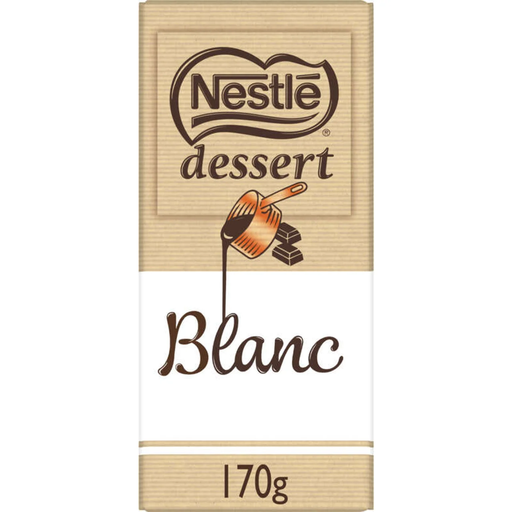 Image unavailable
This 170 g bar is suitable for a baking recipe if the amount you need matches this format. Before making a dessert to share, check the allergens and nutritional information on the packaging. If fair trade sourcing is a priority, also check the label and which ingredients it covers.
Look for a named label or standard, then check which ingredients it covers. For example, Kaoka states that 78% of the ingredients of agricultural origin in its 35% white chocolate in the 1 kg format come from fair trade, checked against the FiABLE standard. This figure does not apply to all white chocolate products.
No, displaying it is voluntary. However, for most prepacked foods, Regulation (EU) No 1169/2011 requires nutritional information, as the European Commission points out. Check the sugars and fat per 100 g in particular, even if there is no Nutri-Score.
No. According to the Ministry of the Economy, the contribution known as the “soda tax” applies to sugary drinks, not solid white chocolate. Sugar content is still worth checking in the nutritional information when comparing bars.
Read the ingredients list and warnings on the exact pack you’re using. The product information for Kaoka 35% white chocolate mentions milk and possible traces of nuts. These details should not be assumed to apply to another product.