Hoteliers looking for proof of a fair-trade commitment
You want to be able to back up what you tell guests with a specific label or claim relating to the spread you order, without confusing fair trade with other commitments around cocoa.


If you want to present the spread served in your café or at breakfast as fair trade, choose a product whose fair-trade scheme and coverage can be verified for the exact item you buy. A general claim about responsibly sourced cocoa isn’t enough. For hotel service, also check the allergens and nutritional information, and make sure the pack size suits your hygiene procedures. In France, Nutri-Score is still optional; a nutrition declaration is compulsory for prepacked foods, subject to the applicable exemptions.
You want to be able to back up what you tell guests with a specific label or claim relating to the spread you order, without confusing fair trade with other commitments around cocoa.
You need to check the ingredients for every product and organise service to minimise cross-contamination, particularly when the recipe contains nuts or milk.
You want to compare nutritional values per 100 g on a like-for-like basis, using Nutri-Score only as an additional guide when it is displayed.
If you’re presenting a product as fair trade, start by checking the evidence for the exact item. Then look at the recipe and how it will be served.
| Criteria | What to check | Who it matters to |
|---|---|---|
| Fair-trade commitment | The label or standard linked to the exact product, and the proportion covered if this is stated. | If the hotel advertises a fair-trade offering, I want to be able to justify that claim for the product served. This evidence would be the top priority for around 36% of consumers. |
| Allergens and recipe | The ingredients list, highlighted allergens and any warnings about possible traces on the packaging. | When serving guests with a range of dietary requirements, I need to be able to tell them what’s in the product being used. For around 27% of consumers, this would be their main need. |
| Service arrangements | A pack size that suits the service area, and utensils that can be cleaned and disinfected regularly. | For the buffet, I look for packaging the team can use without making it harder to clean the containers and utensils. Service arrangements would be the top priority for around 19% of consumers. |
| Nutritional comparison | Nutritional values per 100 g; Nutri-Score only if displayed. | To compare two recipes, I want to check their sugar and fat content on the same basis, without reading anything into the absence of a Nutri-Score. This comparison would be a priority for around 18% of consumers. |
A certification covering cocoa sustainability does not, by itself, prove that a spread meets fair-trade requirements.
Before presenting it as fair trade, check the label or standard linked to the exact product and, if stated, the proportion covered.
France’s Ministry of the Economy says that displaying Nutri-Score is optional in France. Its absence does not mean that the nutrition declaration is missing.
Start by comparing nutritional values per 100 g; use a displayed Nutri-Score as additional information.
Recipes and warnings about possible traces can vary between spreads. The DGCCRF reminds businesses that allergenic ingredients must be highlighted on the label.
Check the packaging of the product being served, and make sure the information is available to staff who deal with guests’ questions.
The size of the jar alone doesn’t determine whether the containers and utensils are suitable for the buffet. The DGCCRF says that equipment which comes into contact with food must be cleaned and disinfected regularly.
Make sure the pack size you choose works with the hotel’s service area and cleaning procedures.
Its hazelnut spread is worth considering if proof of fair trade is your top priority.
The brand offers a large-format spread advertised as palm-oil-free. It’s worth considering if this and the packaging format are important for your service.
A useful product for comparison if your requirements allow a cocoa scheme other than fair trade.
This 340 g jar of spread is worth considering for a hotel café or breakfast service. Before presenting it as fair trade, check the commitment stated for the exact product.
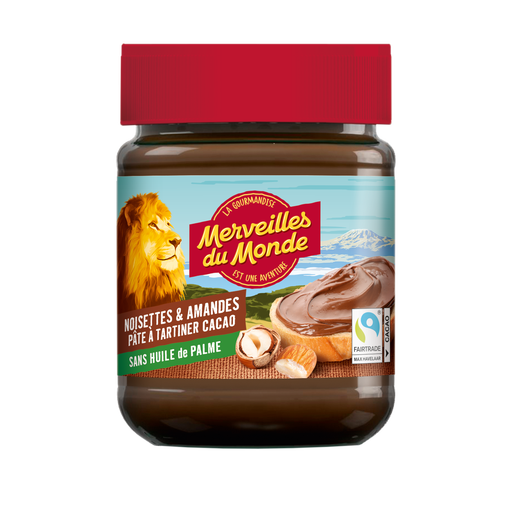 Image unavailable
Consider whether the 340 g format suits the way your hotel serves food. The cocoa is described as fair trade: before repeating this claim to guests, check the standard and the proportion covered for the product you buy.
The recipe is listed as containing hazelnuts, almonds and milk. Check the packaging for any warnings about possible traces, storage instructions and information for guests.
No. France’s Ministry of the Economy says that Nutri-Score is optional. The DGCCRF states that a nutrition declaration has been compulsory for prepacked foods since 13 December 2016, subject to the applicable exemptions. Compare the values per 100 g even when no Nutri-Score is displayed.
Check that the label or standard applies to the exact spread, and find out what it covers. For its hazelnut spread, Ethiquable says that 65% of the total weight comes from fair trade. This figure applies to that product only, not to other recipes.
Make sure staff can access the ingredients and allergen information for the product being served, and provide containers and utensils that are suitable for cleaning. The DGCCRF reminds businesses that allergens must be highlighted on labels and that equipment which comes into contact with food must be cleaned and disinfected regularly.