Shoppers who want clear evidence of fair trade
You want to know which fair-trade standard is used and, for a blend, which ingredients it covers.


If you want to control how much matcha goes into your drink, choose a powder whose ingredients list says ‘100% green tea matcha’. If all you have at work is a mug and hot water, tea bags are more convenient, but may contain very little matcha. Either way, check the fair-trade claim and which ingredients it covers separately: organic certification alone does not mean a product is fair trade.
You want to know which fair-trade standard is used and, for a blend, which ingredients it covers.
You want to make a drink with just a mug and hot water, without needing a whisk or measuring out powder. Tea bags may suit you, even if they don’t contain pure matcha.
You prefer to choose how much powder to use in a drink or latte, and don’t mind mixing it when you prepare your drink.
For a lunch break at work, start by looking at the product’s ingredients, its fair-trade claim and what you need to prepare it. These three things don’t always go hand in hand.
| What to consider | What to check | Who is it for? |
|---|---|---|
| Fair trade | The standard named and, for a blend, which ingredients the claim covers. | I want to be able to see exactly what the fair-trade claim covers on the product. Around 42% of consumers put this evidence at the top of their list. |
| Preparing it at work | The format and preparation instructions, including the infusion time and any equipment needed. | When my break is short and I don’t have a whisk, I prefer a drink that’s easy to make. Around 33% of consumers put convenience ahead of other criteria. |
| Matcha content | The ingredients list and the proportion of matcha: pure powder and a tea blend are suited to different uses. | If I want to measure out matcha for a drink or latte, I look for it to be the main ingredient. This is the top priority for around 25% of consumers. |
The EU organic logo and the Fairtrade/Max Havelaar label relate to different standards. An organic claim alone doesn’t mean that a matcha meets your fair-trade criteria.
Look for the fair-trade standard named on the packaging or product page. If the recipe contains several ingredients, check which ones the claim covers.
Carrefour and Auchan product pages state that Pukka Organic Matcha Green Tea contains 2% matcha, while Jardin Bio Étic Matcha Lemon contains 3%. Don’t mistake their names for a powder made entirely from matcha.
If you want to measure out matcha as the main ingredient, read the ingredients list and look for a product explicitly described as 100% green tea matcha.
According to Anses, caffeine can delay falling asleep and reduce the length or quality of your sleep. So the time of your break is worth bearing in mind when choosing a drink.
If you’re sensitive to caffeine, consider when you drink matcha and what other caffeinated drinks you have during the day.
Tea blends containing matcha, some of which carry a Fair for Life claim.
Matcha Lemon green tea in tea bags, for brewing rather than making a drink from pure powder.
Organic matcha in a tin for shoppers who want to prepare and measure out their own powder.
Organic matcha powders, including a product in individual sticks.
Organic Japanese matcha powder to mix when preparing your drink.
These two Pukka blends combine green tea and matcha with a Fair for Life claim. The first comes in tea bags. Before choosing the second for a quick break, check how it needs to be prepared.
 Image unavailable
The tea-bag format is handy if you make your tea at work with just a mug and hot water.
Carrefour’s product page for Pukka Matcha Mint states that its Fair for Life claim covers 80% of the ingredients. It’s a mint tea blend containing matcha, not pure matcha powder.
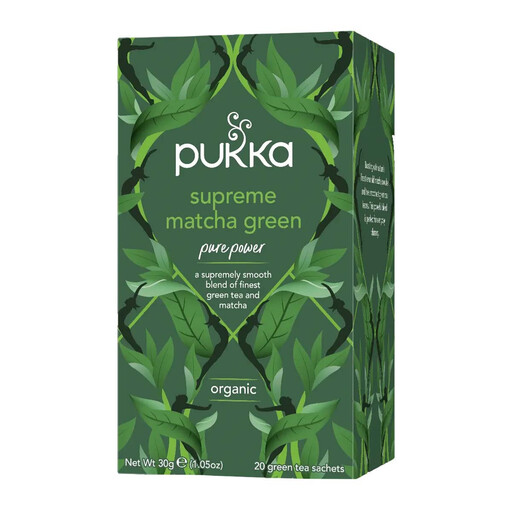 Image unavailable
This blend is for shoppers who prioritise a documented fair-trade claim over pure matcha powder.
For Pukka Organic Matcha Green Tea, Carrefour states that it contains 2% matcha and that its Fair for Life claim covers 98% of the ingredients. If your break is short, check whether it comes in tea bags or as loose-leaf tea, as well as the infusion time.
No. The EU organic logo relates to organic production, while Fairtrade/Max Havelaar is a separate fair-trade standard. For a blend, also check which ingredients the fair-trade claim covers.
No. Carrefour states that Pukka Organic Matcha Green Tea contains 2% matcha, while Auchan states that Jardin Bio Étic Matcha Lemon contains 3%. Check the ingredients list before choosing a product that you plan to measure out as pure matcha.
Tea bags need less equipment than matcha powder that you have to mix. If you prefer powder, read the preparation instructions: Kusmi Tea, for example, recommends using a whisk and water at 80 °C for its Organic Matcha.
It may do if you’re sensitive to caffeine, particularly if you take a late break. Anses says caffeine can delay falling asleep and reduce the length and quality of your sleep. Remember to take into account any other caffeinated drinks you have during the day, too.