Powder buyers looking for a fair trade commitment
You want to whisk matcha, make a latte or use it in a recipe. If a fair trade claim influences your choice, check that it applies to the powder you’re ordering.


To prioritise fair trade when ordering matcha, first choose between powder to prepare yourself and tea bags, then check the certification on the exact product and which ingredients it covers. For example, Carrefour describes a Pukka tea containing 2% matcha, with 98% of its ingredients audited under Fair for Life. It’s suitable for brewing, not for whisking into a matcha drink. A Fairtrade claim shown for a powder should also be checked against the packaging.
You want to whisk matcha, make a latte or use it in a recipe. If a fair trade claim influences your choice, check that it applies to the powder you’re ordering.
You prefer the convenience of tea bags and are happy with a green tea blend containing a small amount of matcha. In that case, the proportion of ingredients covered by a certification matters just as much as the product name.
You’re looking for a powder described as both Japanese in origin and organic. These are separate from a fair trade commitment, so check for that separately if it matters to you.
| What to consider | What to check | Who is it for? |
|---|---|---|
| Fair trade certification | The certification named on the exact product and, for a blend, which ingredients it covers. | If I’m looking for a fair trade commitment, I want to know which product and ingredients the certification applies to; around 36% of consumers would make this their priority. |
| Format and use | Powder to prepare or a blend to brew; check the ingredients list and the proportion of matcha. | If I want to whisk matcha, I don’t want to receive tea bags instead; around 29% of consumers would put a format that suits their intended use first. |
| Origin and organic status | The origin and organic claim for the product you choose, without confusing them with fair trade certification. | If I’m looking for organic Japanese powder, these features guide my choice even though they don’t prove a fair trade commitment; around 21% of consumers would prioritise this. |
| Availability | The product, its format and the delivery or collection options available when you place your order. | I want to receive the product I chose without a substitution that changes its format or certification; around 14% of consumers would make this their priority. |
The Pukka green tea described by Carrefour contains 2% matcha. Its tea bags are intended for brewing, not for whisking.
To whisk matcha or add it to a latte, look for matcha powder and check its ingredients.
These claims describe other product characteristics; they aren’t enough to confirm a fair trade certification’s commitments.
Look for a separate certification claim on the product you choose and, if it’s a blend, check which ingredients it covers.
Amazon France describes Pagoda Tea Matcha Bio Boost as organic and Fairtrade. If this claim determines your purchase, the wording on the listing shouldn’t take the place of what’s shown on the packaging.
Check the packaging photo and the name of the certification before ordering, then check the product you receive.
Carrefour listed its Pukka matcha product as unavailable, while Auchan listed a Pukka matcha tea. Listings from two retailers don’t necessarily refer to interchangeable products.
Before placing your order, check the product, its format and the available delivery or collection options. If a substitute is offered, make sure it still has the certification you’re looking for.
An option if you’re looking for matcha powder with a fair trade claim.
Green tea blends with matcha in tea bags for brewing, rather than pure matcha powders.
Organic Japanese matcha powders, including a product described as ceremonial-grade matcha.
A flavoured option if you’re after strawberry matcha flavour rather than pure matcha powder.
These Pukka products are options if you’re looking for matcha tea to brew. If you want to whisk powder or make a latte with pure matcha, check the format before choosing.
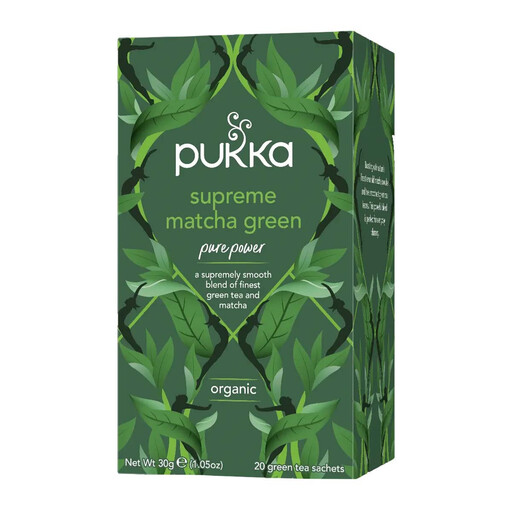 Image unavailable
Choose this if you want green tea with matcha rather than powder to whisk. 30 g pack; check the ingredients and certification wording on the product you order.
 Image unavailable
For a mint and matcha green tea infusion. Box of 20 tea bags; check the ingredients and which ones are covered by any certification claim.
No. Organic status and fair trade are based on different criteria. If a fair trade commitment guides your choice, look for a certification explicitly linked to the product. Fair for Life describes its programme as a fair trade certification.
No, not if you want to whisk matcha or use powder in a latte. The Pukka blend described by Carrefour contains 2% matcha and is made as an infusion. For the other use, choose a product clearly labelled ‘matcha powder’.
Follow the instructions for the product you’ve bought rather than applying one rule to all powders. Kusmi Tea recommends water at 80 °C for its ceremonial-grade matcha; this guidance won’t automatically apply to other products.
Make sure the product you’ve chosen is powder or tea for brewing, depending on how you plan to use it. Then check its ingredients, the certification shown, the product in your basket and the available delivery or collection options. Another matcha product won’t necessarily have the same format or certification coverage.