Students who want clear proof of fair trade
You want to know which label applies to the product and, if it’s a blend, what proportion of the ingredients it covers before choosing your drink.


For a break at uni, tea bags are a simple option if you’re looking for a stated fair-trade percentage. However, according to Carrefour and Auchan product listings, Pukka Matcha Mint and Jardin Bio Étic Lemon are blends containing 2% and 3% matcha respectively. If you’d prefer pure powder or a latte, compare the ingredients and check the fair-trade certification for the specific product separately.
You want to know which label applies to the product and, if it’s a blend, what proportion of the ingredients it covers before choosing your drink.
You’re looking for something you can prepare during a short break. Tea bags need hot water; according to its Carrefour listing, the SIPSTA latte mix can be made with hot or cold water.
You prefer a powder with matcha as its only ingredient rather than a flavoured tea or latte mix. The ingredients and any fair-trade certification are two separate things to check.
For a break at uni, start by considering how much time you have and whether hot water is available. Then check the matcha content and exactly what any fair-trade claim covers.
| What to consider | What to check | Who it matters to |
|---|---|---|
| Fair-trade proof | Look for the label or standard and check which ingredients it covers. Don’t assume the matcha itself is certified. | I want to understand what a fair-trade claim covers before choosing a blend; for around 42% of consumers, this would be the top priority. |
| Preparation | Check whether you’ll need hot water and time to brew it, or whether it can also be made with cold water. | Between lectures, I mainly need a drink I can make with the equipment available; around 33% of consumers would put ease of preparation first. |
| Matcha content | Read the ingredients to tell the difference between pure powder and a tea or latte containing other ingredients. | If I want to measure out my own matcha powder, I prefer to know exactly what’s in it; around 25% of consumers would make matcha content their main consideration. |
Carrefour lists Pukka Matcha Mint tea as containing 2% matcha; Auchan says Jardin Bio Étic Lemon contains 3% matcha powder. These blends aren’t the same as a powder made entirely from matcha.
Before choosing, compare the ingredients with how you plan to use it, rather than relying on the word “matcha” on the front of the pack.
Carrefour Bio describes its product as “100% green tea matcha”, meaning it’s a pure powder. This alone doesn’t prove that the product is fair trade.
Check the ingredients, origin, organic claim and fair-trade certification separately for the specific product you’re considering.
Fair for Life says its certification can apply to a product or to some of its ingredients. For a blend, the proportion covered matters just as much as whether there’s a fair-trade claim.
Check the logo, standard and percentage shown on the packaging, especially if certification is essential to your choice.
Matcha adds to the coffee and other caffeinated drinks you have throughout the day. The European Food Safety Authority considers caffeine from all dietary sources.
When reading product information, take account of the serving you prepare and any other caffeinated drinks you have.
The organic Matcha Mint tea listed by Carrefour combines green tea, mint and matcha in tea bags.
Its lemon tea bags combine green tea, herbs and matcha powder.
A matcha latte mix that can be made with hot or cold water, according to its Carrefour listing.
Carrefour describes its matcha powder as organic.
Kusmi Tea offers organic Japanese matcha powder in 30 g and 100 g packs.
This is a green tea with matcha for a break at uni. Check the ingredients and what any fair-trade claim covers for this specific product, and don’t confuse it with the Pukka Matcha Mint tea described above.
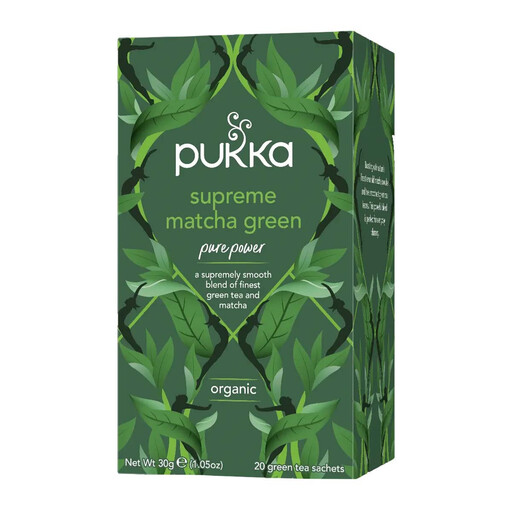 Image unavailable
Worth considering if you have time to make tea during your break. Check the ingredients and fair-trade claim for this specific product before choosing.
No. Carrefour Bio describes its powder as organic and made from 100% green tea matcha, but these claims alone don’t prove that it’s fair trade. Check separately which label or standard applies to the product you buy.
Check which ingredients the certification covers, not just the fair-trade percentage shown for the blend. Fair for Life says its logo can apply to a product or to some of its ingredients. On Carrefour’s Pukka Matcha Mint listing, the stated percentage refers in particular to the green tea and mint, while matcha makes up 2% of the ingredients.
A tea bag is handy if you have access to hot water and time to let it brew. According to Carrefour, a latte mix such as SIPSTA can be made with hot or cold water. If you’re mainly looking for matcha, check the ingredients too: the SIPSTA latte contains 8% matcha, along with oat powder and cane sugar.
Yes. The European Food Safety Authority takes caffeine from all dietary sources into account. To assess how much caffeine you’re having, consider the serving you prepare as well as the coffee and other caffeinated drinks you have throughout the day.