People who want to explain the fair-trade credentials
If you’re displaying the product on a stall, look for a recognisable label or claim, then check the ingredients and, if stated, the proportion covered by the fair-trade commitment.


For a Christmas market, choose an infusion whose packaging makes its fair-trade credentials and the ingredients covered clear. If you want to serve a caffeine-free drink, distinguish rooibos and herbal infusions from tea-based products. For a blend, check the proportion of fair-trade ingredients if this is stated.
If you’re displaying the product on a stall, look for a recognisable label or claim, then check the ingredients and, if stated, the proportion covered by the fair-trade commitment.
If visitors want to avoid tea, consider rooibos and herbal infusions. Check the ingredients of each product before serving it as a caffeine-free option.
An assortment lets you offer a range of flavours, but each variety may have its own ingredients. Check the type of drink and the stated fair-trade commitment for each one.
When choosing a fair-trade infusion to serve or give as a gift at a Christmas market, start by checking what the fair-trade commitment covers, then look at the type of drink and its packaging.
| Criterion | What to check | Who is it for? |
|---|---|---|
| Fair-trade commitment | Look for a fair-trade label or claim, then check which ingredients it covers and their percentage, if stated. Organic certification alone does not demonstrate a fair-trade commitment. | I want to be able to explain exactly what the fair-trade claim covers at the stall, especially for a blend. Evidence of this commitment is the top priority for around 42% of consumers. |
| Type of drink | Check the product name and ingredients to distinguish tea from rooibos and herbal infusions. | For an evening event, I want to offer a drink for visitors who avoid caffeine. This is the main concern for around 33% of consumers. |
| Format and variety | Compare the net weight or number of tea bags with what you plan to serve. If you choose an assortment, check each variety. | I’d like to offer several flavours or organise a tasting without mixing up the products. Format, variety and ease of serving come first for around 25% of consumers. |
A product may meet both sets of standards, but an organic claim alone does not prove a fair-trade commitment.
Check the fair-trade claim or label separately, along with the information on the packaging.
The proportion of ingredients covered can vary from one product to another. For one of its green teas, Clipper states that 64% of the total weight is covered under a mass-balance scheme; this figure does not apply to its other products.
Read the percentage and product-specific traceability details before describing its ingredients.
Tea and herbal infusions do not meet the same needs for visitors who avoid caffeine.
Clearly separate tea-based drinks from rooibos or herbal options, after checking the ingredients.
A gift set may include tea, rooibos and herbal infusions, with different ingredients and fair-trade claims.
Check the details of each variety before giving the set as a gift or serving its contents.
The brand offers fair-trade and organic teas, rooibos and infusions. It’s worth distinguishing between the different types of drink when choosing what to serve or give as a gift.
The range includes herbal infusions and teas, so check the ingredients of each product individually.
This brand is worth considering if you’d also like to offer fair-trade tea, while keeping it distinct from herbal infusions.
This 32 g herbal infusion is worth considering as a drink to offer at a Christmas market. Before describing it as fair trade or caffeine-free, check the relevant claims on its packaging.
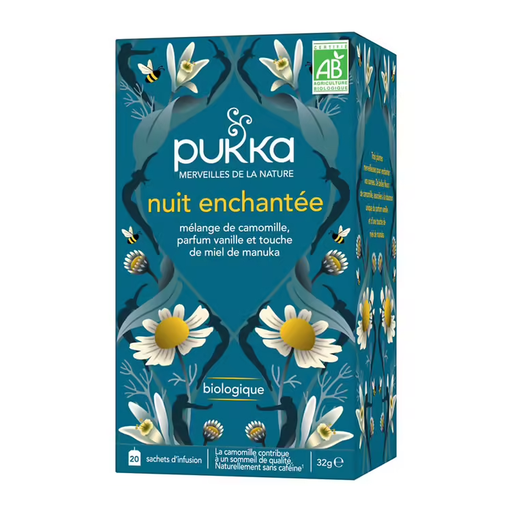 Image unavailable
If you’re planning to serve this at a Christmas market, check the ingredients, what the fair-trade claim covers and the caffeine information before choosing it.
Stated size: 32 g.
No. Organic certification and fair trade are separate commitments. Look for a recognisable fair-trade claim or label, then check which ingredients it covers and their percentage, if stated.
Consider rooibos and herbal infusions, then check the ingredients of the product you choose rather than relying on the word ‘infusion’ alone. Carrefour’s listing for the Ethiquable rooibos mentioned here states that it is caffeine-free; this does not apply to all products.
For a product made from several ingredients, this percentage clarifies what the claim covers. Auchan’s listing for a Jardin BiO étic green tea states that 88.5% of its ingredients of agricultural origin are covered, while Clipper states that 64% of the total weight is covered for a different green tea under a mass-balance scheme. These figures relate to different products and different ways of calculating the percentage.
France’s Directorate-General for Competition, Consumer Affairs and Fraud Control says that food labelling must be legible and written at least in French. For prepacked food, check the product name, ingredients, any allergens highlighted, the net quantity and the date marking relevant to the product.