Teams that want clear proof of fair trade
You’re buying herbal tea for the office and want to be able to identify the label or sourcing scheme behind your chosen product, rather than relying on how the packaging looks.


When choosing herbal teas to share at work, first check the fair-trade certification or scheme stated for each product: Fairtrade/Max Havelaar and Bio Équitable en France are separate initiatives. Then compare the formats and blends to suit your colleagues’ tastes, and don’t overlook the ingredient list, particularly whether it contains liquorice.
You’re buying herbal tea for the office and want to be able to identify the label or sourcing scheme behind your chosen product, rather than relying on how the packaging looks.
You’re looking for boxes that are easy to store, with a choice of blends for colleagues. For example, English Tea Shop France offers an assortment of 20 tea bags featuring four blends.
You want a drink for your break without assuming its name promises therapeutic benefits. It’s particularly worth checking for liquorice if the same blend may be consumed regularly.
For an office tea cupboard, first decide what proof of fair trade you expect. Then choose a shareable format and blends with clear ingredient lists.
| Criteria | What to check | Who it matters to |
|---|---|---|
| Proof of fair trade | The Fairtrade/Max Havelaar label or named fair-trade scheme for the product, and which ingredients the claim applies to. | I want to be able to explain why the herbal teas offered at work are described as fair trade, rather than relying on the word “natural” alone; around 46% of consumers put this proof first. |
| Format and variety | The number of tea bags and blends, or the equipment and storage needed if the tea is loose-leaf. | If several colleagues share the same supply, I want to give them a choice without making preparation more complicated; convenience and variety come first for around 36% of consumers. |
| Ingredients | The list of plants, particularly liquorice, and what claims such as “detox” or “digestion” mean. | For a drink that’s available regularly, I want to know which plants each blend contains instead of relying on a wellbeing promise; this is the priority for around 18% of consumers. |
An organic claim alone doesn’t prove that a herbal tea is Fairtrade-certified or comes from a specific fair-trade scheme.
If proof of fair trade is important to you, check the label or scheme named for the product you’ve chosen.
A box containing several blends makes it easier for colleagues to choose, but the format doesn’t tell you whether they’re certified.
Read the fair-trade claim on the assortment and check which blends or ingredients it applies to.
A blend’s name doesn’t prove that it works. The DGCCRF notes that health claims on food products are regulated.
Choose herbal tea for its ingredients and flavour, rather than presenting a break-time drink as a treatment.
Anses warns of the risks associated with consuming large amounts of liquorice repeatedly, particularly in relation to blood pressure.
Clearly identify the blends that contain liquorice and offer a choice of blends without it, too.
You can’t assume that every blend in a range carries the same label, so always check the specific product you’re considering.
Ethiquable offers herbal infusions made with plants from fair trade and organic farming, including products linked to a French sourcing scheme.
English Tea Shop France offers organic herbal infusions, including rooibos, fruit blends and assortments.
Twinings France offers a range of tea and herbal infusion blends.
This is a ready-to-drink rooibos option for an office break, not a box of tea bags for making hot herbal tea for the team.
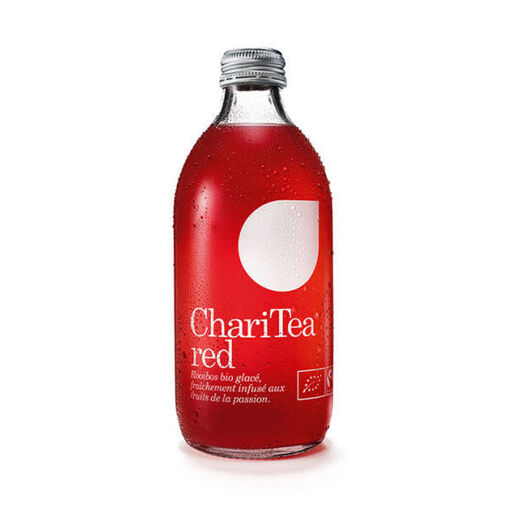 Image unavailable
For a break with a ready-to-drink rooibos, rather than making hot tea from tea bags.
Format: 33 cl bottle.
If Fairtrade certification is important to you, check the wording on the packaging and which ingredients it applies to.
Look for the Fairtrade/Max Havelaar label on the box and check which ingredients it applies to. Fairtrade International says its standards govern certification and that independent organisations check compliance.
No, the terms are not interchangeable. Ethiquable describes some of its herbal infusions as coming from a Bio Équitable en France scheme, while Fairtrade International outlines its own standards and certification framework. Check the claim on the product you’re buying.
No, these terms don’t guarantee that the product will work. The DGCCRF notes that health claims on food products are regulated; check the ingredients rather than treating the blend’s name as a therapeutic promise.
Clearly label blends containing liquorice and offer other herbal blends as well. Anses warns of the risks of consuming large amounts of liquorice repeatedly, particularly in relation to blood pressure.