For someone who wants clear proof of fair trade credentials
Choose a product with clear information about its label, standards and the proportion of ingredients covered. This is particularly important for herbal blends.


To give fair trade herbal tea for Mother’s Day, check the label and, if it’s a blend, the proportion of ingredients covered: organic certification alone doesn’t establish that it’s fair trade. Fair trade rooibos is a good option if the recipient wants to avoid caffeine. A gift set offers more variety, but check each blend separately if fair trade credentials are your priority.
Choose a product with clear information about its label, standards and the proportion of ingredients covered. This is particularly important for herbal blends.
Rooibos may suit their preference: the product listing for ETHIQUABLE rooibos on Auchan’s website says it is caffeine-free. Check the ingredients if you’d rather give them a blend.
A gift set offers variety and attractive presentation. If you also want it to be fair trade, check the information for each blend: an organic label alone doesn’t meet this criterion.
When choosing a gift, start with the recipient’s priorities: proof of fair trade, ingredients that suit their habits, or a choice of flavours and attractive presentation.
| Criterion | What to check | Who is it for? |
|---|---|---|
| Fair trade credentials | The label or standards, and, for a blend, the proportion of ingredients covered. For example, Carrefour says that 75% of the agricultural ingredients in its Jardin BiO étic rooibos meet fair trade standards. | I want to know exactly what makes the gift fair trade, rather than relying on its organic credentials; around 42% of consumers are said to prioritise this proof. |
| Ingredients and caffeine | The ingredients list, whether it’s labelled caffeine-free if that matters, and whether it contains liquorice. Anses advises caution about consuming large amounts of liquorice repeatedly. | If the recipient avoids caffeine or pays close attention to the herbs they consume, I’d choose a blend that suits them first; around 33% of consumers are said to prioritise this. |
| Presentation and flavours | The blends and gift format; if a gift set is presented as fair trade, check the information for each herbal tea. | I’d like to give several flavours in an attractive gift set rather than just one blend; around 25% of consumers are said to prioritise this. |
These labels describe different commitments. In a blend, the fair trade claim may not cover every ingredient.
Check the label, standards and stated proportion for the exact product, rather than relying solely on the brand or the packaging design.
A blend’s name doesn’t prove that it has a health benefit. The European Union regulates health claims made about food.
For a gift, compare the flavours and ingredients instead, without presenting the herbal tea as a treatment.
The Pukka Trois Gingembres and Digestion Délicieuse blends listed by Auchan contain liquorice. According to Anses, consuming large amounts repeatedly may pose risks, particularly for some people who are more sensitive to it.
Read the ingredients before giving someone a blend, especially if you don’t know their usual consumption habits.
An organic selection can offer variety without confirming that every herbal tea has fair trade credentials. Kusmi Tea describes its Les Infusions gift set as organic, with a range of flavour profiles.
If fair trade is important to you, check the information for every blend in the set or choose a herbal tea with clearly stated credentials.
A single-ingredient organic rooibos, making it easy to check what’s in the gift.
The brand describes its teas, rooibos and herbal teas as fair trade and organic.
Herbal blends to consider if the recipient prefers a spicy or aniseed flavour to plain rooibos.
An organic herbal tea gift set offering several flavours in one pack.
A retailer whose product listings make it possible to compare the claims for different products.
This selection features a herbal tea to consider as a gift. If fair trade certification is your top priority, check the information on the packaging of the product you choose.
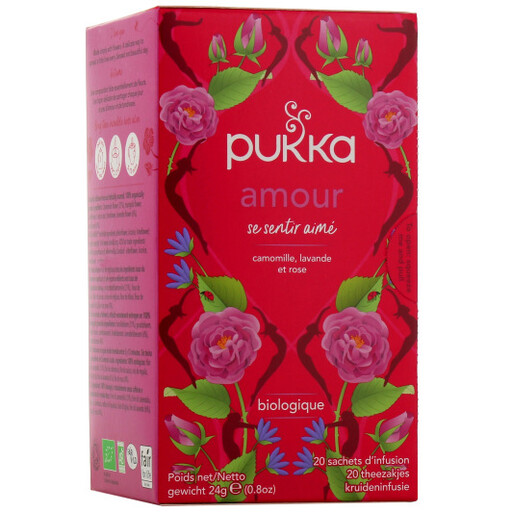 Image unavailable
Worth considering if the recipient enjoys floral herbal teas. Before giving it as a gift, check the ingredients, particularly for liquorice; according to Anses, consuming large amounts of liquorice repeatedly may pose risks. If fair trade credentials are your priority, also check the label and the proportion of ingredients covered on the packaging.
No. Organic certification alone doesn’t prove a fair trade commitment. For herbal tea carrying a Fairtrade/Max Havelaar claim, check the label and information about the ingredients covered, particularly if it’s a blend.
Rooibos labelled as caffeine-free is one option. The ETHIQUABLE product listed by Auchan carries this claim; for another blend, read the ingredients and check the information for that specific product before giving it as a gift.
Yes, provided the blends you choose also meet your fair trade criteria: the gift set’s organic claim doesn’t establish this. Check the label and the ingredients covered for each herbal tea you plan to give.
Liquorice is worth checking for, particularly if the herbal tea is likely to be consumed regularly. According to Anses, consuming large amounts of products containing liquorice repeatedly may pose risks, especially for some people who are more sensitive to it. So read the ingredients before choosing a blend as a gift.
No. The name alone doesn’t establish a specific health benefit. The European Union regulates health claims about food, so when choosing a gift, focus on the flavours, ingredients and stated precautions, rather than treating the herbal tea as a remedy.