Procurement manager with a fair trade requirement
You need to be able to show a client or event organiser which standard applies to the herbal tea supplied, without assuming that a brand name alone proves its certification.


For a conference break, choose a herbal tea with a clearly identifiable fair trade standard on the specific product you’re ordering. Then check that its packaging and product information are suitable for the service you have in mind. If your specifications require Fairtrade/Max Havelaar, Fair for Life certification cannot be used as a substitute without changing that requirement. In either case, the label on the recipe being served matters more than a brand’s general commitment.
You need to be able to show a client or event organiser which standard applies to the herbal tea supplied, without assuming that a brand name alone proves its certification.
You’re looking for recipes that are easy to tell apart and portions that are easy to count, while keeping ingredients and brewing instructions accessible to attendees.
You need to establish whether the service falls within the scope of EGAlim for collective catering, then keep the supporting documents needed to track purchases.
If Fairtrade/Max Havelaar is required, check for that label on the specific product first. If the requirement is for fair trade more broadly, look at the standard offered, then consider the practical needs of your service.
| Criterion | What to check | Who this matters to |
|---|---|---|
| Proof of fair trade | Check the exact label and full product reference. For a blend, note which ingredients are certified if this information appears on the packaging or product page. | If my specifications name Fairtrade/Max Havelaar, I need to be able to prove that the herbal tea being served meets this requirement. This is the top priority for around 31% of consumers. |
| Choice of recipes | Compare the ingredient lists and check any caffeine information for the products on offer. | When attendees have different preferences, I want to offer a choice of recipes without assuming they all have the same ingredients. Around 25% of consumers put variety ahead of other criteria. |
| Service arrangements | Check the number of tea bags, brewing instructions, and how to access ingredient and allergen information. | For a self-service break, I need to plan portions and make it easy to find the information for each recipe. Ease of service is the top priority for around 31% of consumers. |
| EGAlim purchase tracking | Confirm that the establishment falls within the relevant scope, and keep the product reference and proof of its label for purchase tracking. | If I manage a collective catering service covered by EGAlim, I need to document the products declared. This is the main priority for around 13% of consumers. |
These refer to different standards. Vague wording may also fail to meet specifications that require a particular label.
Specify the required standard and full product reference on your order, then use the exact label name in the materials for your conference.
In a blend, certification may apply to only some of the ingredients. For example, Auchan states that 80% of the dry weight of the ingredients in one particular Pukka infusion is Fair for Life certified. This figure does not apply to other recipes.
Keep the product information for the recipe you order, and check the standard and the ingredients covered before the event.
Attendees and the service team need to be able to match each recipe to its ingredients and allergen information. The French decree of 17 April 2015 sets out requirements for allergen information on non-prepacked foods.
Keep a box or manufacturer’s information sheet accessible at the drinks station, clearly marked with the corresponding recipe.
The French Ministry of Agriculture states that the relevant sourcing targets have also applied to private collective catering establishments since 1 January 2024. Holding a conference does not, on its own, mean that the service falls within this scope.
Ask the catering or procurement manager to confirm the service’s status before presenting these herbal teas as meeting an EGAlim requirement.
Pukka says its teas are Fair for Life certified. Auchan lists a 20-bag Pukka infusion whose ingredients are stated to be 80% Fair for Life certified by dry weight.
Clipper lists its organic Marchand de Sable infusion in a box of 25 tea bags, with an ingredient list and a brewing time of 3 to 5 minutes.
In a 2021 publication, Max Havelaar France describes La Route des Comptoirs as a company selling fair trade and organic teas and infusions, working with Fairtrade/Max Havelaar-certified tea cooperatives.
These Pukka herbal teas are worth considering for conference catering. Their descriptions mention Fairtrade ingredients, but check the label on each product supplied before confirming that it meets a Fairtrade/Max Havelaar requirement.
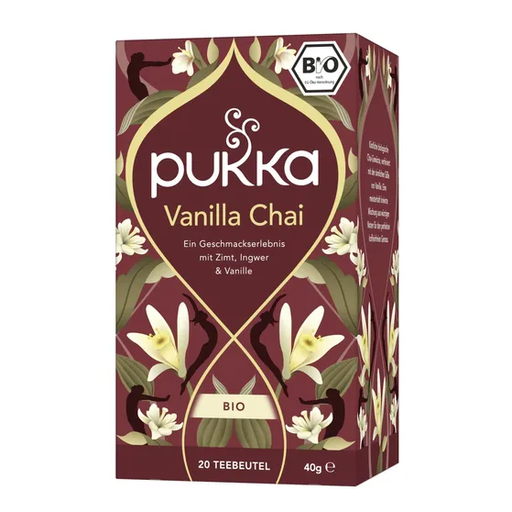 Image unavailable
The tea bag format makes it easy to count the portions you’ll need for the break. The box contains 20 tea bags. Check the label on the product supplied and its allergen information before serving.
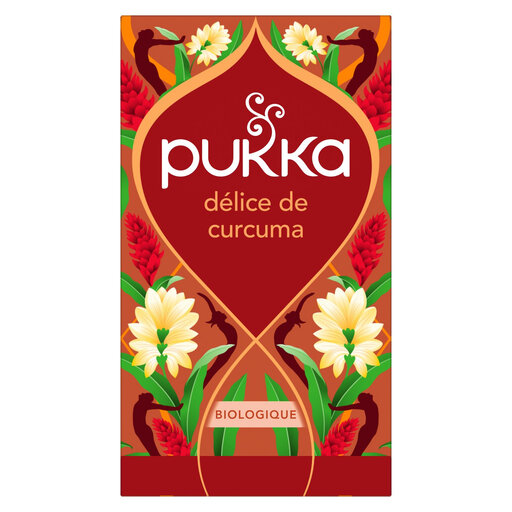 Image unavailable
If you’re serving one tea bag per cup, check how many tea bags are in the box before calculating your order. This product is listed in a 36 g format. Also check its exact label if Fairtrade/Max Havelaar certification is required.
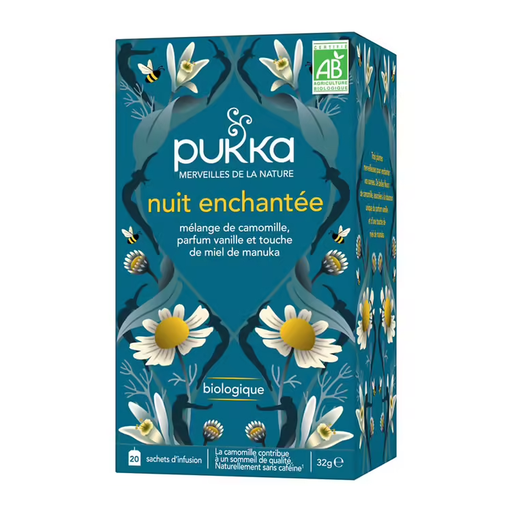 Image unavailable
If you’re offering attendees a choice of recipes, keep the information for this one accessible at the drinks station. The product is listed in a 32 g format. Confirm the number of tea bags, allergen information and label before including it in your service.
No. Organic certification and fair trade are different approaches. Check the standard for the recipe you buy; for example, Fair for Life should not be described as Fairtrade/Max Havelaar.
A product bearing a fair trade label may be included in the tracking of sustainable, quality products described by ma cantine for collective catering covered by EGAlim. Confirm that your service falls within this scope and check which supporting documents you need to keep before declaring it.
Keep the manufacturer’s information and clearly link it to each recipe served, particularly if the boxes won’t be kept at the drinks station. For non-prepacked foods, the French decree of 17 April 2015 sets out the allergen information that must be provided.
Start with the number of attendees, the breaks planned and the recipes on offer, then use the number of tea bags listed for each box. The total weight of a box alone doesn’t tell you how many portions it contains.