Shoppers looking for fair trade credentials
You want to know whether the claim applies to the product you’ve chosen and which ingredients it covers. The label on the product and details of its supply chain matter more than a general brand promise.


For a fair trade herbal tea to enjoy mid-morning, first choose a product with a label or supply chain clearly identified. Ethiquable’s peppermint, for example, comes from a Bio Équitable en France-certified supply chain, while its Rooibos Mint details ingredients sourced through fair trade. Then narrow down your options according to the flavour you’re after and the ingredients, particularly if you want to avoid caffeine or regularly drink blends containing liquorice.
You want to know whether the claim applies to the product you’ve chosen and which ingredients it covers. The label on the product and details of its supply chain matter more than a general brand promise.
You’re looking for a hot drink that isn’t tea. Ethiquable’s Rooibos Mint is worth considering: the brand says its rooibos contains no caffeine.
You read the list of plants before buying, particularly to spot tea or guarana if you’re concerned about caffeine, and liquorice if you often drink the same infusion. ANSES highlights precautions around caffeine and high, repeated consumption of liquorice.
For a mid-morning break, first check what the fair trade claim covers for the specific product. Then choose a recipe you’ll enjoy and check for any ingredients that could affect your decision.
| What to consider | What to check | Who is this for? |
|---|---|---|
| What the fair trade claim covers | The label or supply chain stated on the product, followed by the ingredients covered. Bio Équitable en France and Fairtrade / Max Havelaar refer to different schemes. | If fair trade credentials guide my purchase, I want to know what they cover in the herbal tea I choose; around 31% of shoppers prioritise this proof. |
| Flavour | The exact recipe: peppermint on its own, mint rooibos or a ginger and lemon blend, for example. | Between breakfast and lunch, I’m mainly looking for a flavour I’ll enjoy coming back to; around 31% of shoppers put taste first. |
| Caffeine | Check the ingredients for tea or guarana. According to ANSES, these plants naturally contain caffeine. | If I’m sensitive to caffeine, I don’t want to mistake a herbal infusion for tea; around 23% of shoppers prioritise this check. |
| Liquorice and other ingredients | The full ingredients list, especially if you often drink the same blend. ANSES advises caution with high, repeated consumption of liquorice. | If an infusion is a regular part of my break, I want to spot any plants that call for caution; around 15% of shoppers put ingredients first. |
These terms refer to different schemes. Max Havelaar France explains the guarantees behind the Fairtrade / Max Havelaar label, while Bio Équitable en France has its own standards for the supply chains it certifies.
Check the label or supply chain stated for the product you’ve chosen, and find out which ingredients it applies to.
Jardin BiO étic says that ingredients meeting fair trade standards make up 56% of the agricultural ingredients in its Ginger and Lemon infusion. This figure alone doesn’t tell you about the rest of the blend.
If the scope of the claim matters to you, compare which ingredients are covered across the products you’re considering.
According to ANSES, tea and guarana naturally contain caffeine. Some blends also contain liquorice, which the agency says may pose risks if consumed in large amounts repeatedly.
Read the ingredients before choosing, especially if you want to limit caffeine or drink this beverage often.
A name that suggests digestive or detox benefits isn’t enough to establish a medical benefit.
Choose according to the recipe and the scope of the fair trade claim. If you have a health concern or are taking medication, ask a healthcare professional for advice.
Ethiquable offers herbal infusions from French fair trade supply chains, as well as fair trade recipes sourced internationally, including a mint rooibos.
Alter Eco describes its Natural Rooibos as Fairtrade and organic, sourced from South Africa.
Jardin BiO étic offers a Ginger and Lemon infusion whose product information states the proportion of agricultural ingredients that meet fair trade standards.
These two products suit different mid-morning routines: a herbal tea to brew for a hot drink, and a ready-to-drink rooibos beverage served cold. For each product, check the scope of its fair trade claim and the ingredients that matter to you.
 Image unavailable
Worth considering if you’d like to brew a hot herbal tea during your break. If you expect the fair trade scheme to cover every ingredient, check what Fair for Life covers for this product. Also check whether it contains liquorice before drinking it regularly.
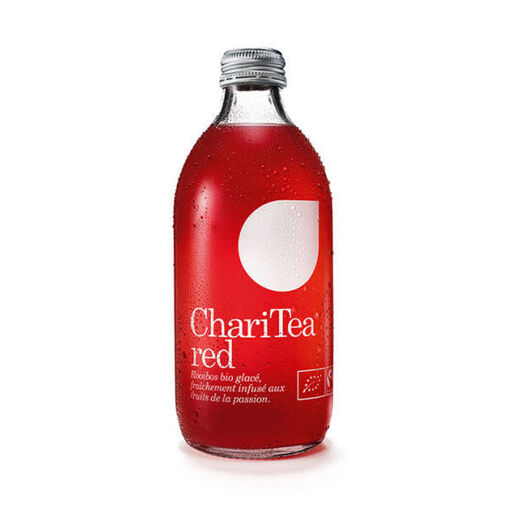 Image unavailable
Worth considering if you’d prefer a ready-to-drink rooibos beverage served cold rather than a herbal tea to brew. If you want to avoid caffeine, check the ingredients for this product. Also check how the Fairtrade claim applies to its ingredients.
No. Fairtrade / Max Havelaar is a specific label, while Bio Équitable en France refers to a different scheme. Check the label and what it covers for the herbal tea you’ve chosen, rather than assuming it is certified based on the word ‘fair trade’ alone.
No. ANSES reminds consumers that tea and guarana naturally contain caffeine. Read the ingredients list: Ethiquable says that the rooibos in its Rooibos Mint recipe contains no caffeine, but this doesn’t apply to every drink sold as an infusion.
Not necessarily; it depends on the individual. However, ANSES recommends consuming liquorice in moderation and only occasionally, and advises particular caution during pregnancy or breastfeeding, for children and for people with certain cardiovascular, kidney or liver conditions. If you’re taking medication or have any concerns, ask a healthcare professional for advice.
Check which scheme is stated and which ingredients it applies to. For fair trade supply chains, the ministry responsible for the ecological transition highlights the importance of traceability information. For a blend, the proportion of ingredients covered helps distinguish a partial scheme from a claim that applies to the entire recipe.