If your priority is a fair-trade supply chain, a chocolate bar with a clear commitment stated for the specific product you choose could be a good option, provided your child is happy to have it instead of gummy sweets. However, this commitment says nothing about sugar or allergens, so check the label separately and keep confectionery as an occasional treat.
Who is this choice for?
Parents who prioritise a fair-trade cocoa supply chain
You’re happy to swap gummy sweets for chocolate and want to identify the fair-trade commitment behind the product you buy. Kaoka, Alter Eco and Ethiquable offer ranges of fair-trade chocolate; check the specific bar before choosing it.
Parents who keep an eye on sugar and snacking
You want to give your child a treat without confusing fair trade with nutritional content. The French health insurance service highlights how often children eat sugary snacks as a factor in their risk of tooth decay.
Shoppers with ingredient restrictions to consider
You need to take an allergen, gelatine or another restriction into account. Check the ingredients list and allergen information for each variant: the brand or texture alone won’t tell you what it contains.
What should you check?
Start with the reason for your purchase, then check the ingredients and nutritional information for the confectionery you choose. A fair-trade claim doesn’t replace nutritional information or an ingredients list.
| Criteria | What to check | Who is it for? |
|---|
| Fair-trade commitment |
Look for a fair-trade label or commitment on the specific product, rather than relying on the brand’s reputation alone. |
If the origin of the cocoa is important to my purchase, I want to be able to identify the commitment on the product I choose. Around 40% of consumers prioritise this evidence. |
| Sugar and frequency |
Compare the sugar and other nutritional values per 100 g, and consider how often treats are eaten. |
For an occasional treat, I check its nutritional content without assuming that ‘fair trade’ means less sugar. Around 40% of consumers put managing sugar and snacking ahead of other criteria. |
| Ingredients and format |
Read the ingredients list, allergen information and any ‘may contain’ statements for the variant in question. |
If an ingredient is a problem or my child wants a particular texture, I check the recipe before choosing. This suitability is the main concern for around 20% of consumers. |
Common mix-ups to avoid
-
Assuming Nutri-Score is compulsory
In France, the Ministry for the Economy states that displaying Nutri-Score is voluntary. The DGCCRF says that nutrition declarations are generally required for pre-packed foods, subject to certain exemptions.
If the logo isn’t shown, check the nutritional information per 100 g and the ingredients list rather than ruling out the product for that reason alone.
-
Confusing a fair-trade supply chain with nutritional content
A fair-trade commitment doesn’t prove that a confectionery product contains less sugar. The French health insurance service also stresses the importance of limiting frequent sugary snacks for children.
Check the fair-trade commitment and nutritional values separately, and consider the occasion on which the treat will be given.
-
Guessing the recipe from the brand or texture
Ingredients vary from one product to another. Haribo, for example, states that Chamallows Mania contains gelatine and may contain traces of milk and soya; this doesn’t describe all its confectionery.
Check the packaging of the variant you’re buying whenever an ingredient or allergen matters to your choice.
Brands to consider
Kaoka
Kaoka offers a range of organic, fair-trade milk chocolate, worth considering if a chocolate bar could take the place of gummy sweets.
- The brand describes several milk chocolate recipes and formats.
- The range description alone doesn’t tell you about sugar content, allergens or whether a product is right for every child. Check the specific product you choose.
Alter Eco
Alter Eco offers organic chocolate bars as part of its fair-trade approach, including milk and hazelnut recipes.
- The different recipes give you a choice of chocolate formats to suit the ingredients you’re looking for.
- Check the stated commitment, sugar and allergens on each bar; these features aren’t the same across the whole range.
Ethiquable
Ethiquable describes its chocolate bar range as fair trade and organic.
- A chocolate bar is an option for families who are happy to choose chocolate instead of a bag of sweets.
- Being part of the range doesn’t mean you can skip checking the fair-trade commitment, ingredients and nutritional values for the specific product.
A chocolate bar on Joybuy
This selection is for anyone choosing a milk chocolate bar instead of gummy sweets. If a fair-trade commitment is your top priority, check that it’s stated on the packaging of the specific product.
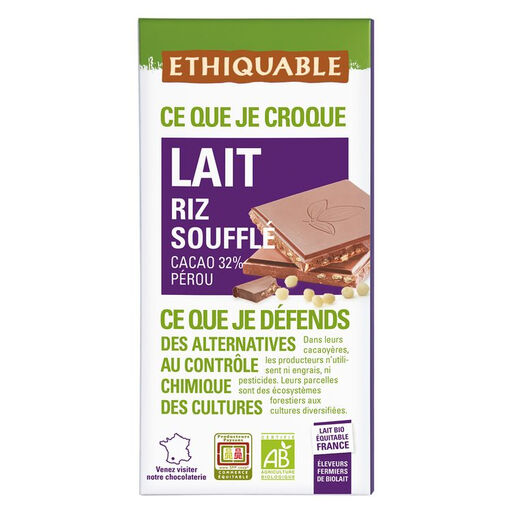 Image unavailable
Ethiquable organic milk chocolate with puffed rice, 100 g
This bar is a good match if you fancy chocolate rather than gummy sweets. Before choosing it for a child, check the packaging for the fair-trade commitment for this specific product, allergen information and nutritional values per 100 g.
View on Joybuy
Frequently asked questions
Is Nutri-Score compulsory on sweets and chocolate in France?
No. The Ministry for the Economy says that displaying Nutri-Score is voluntary. A nutrition declaration is generally required for pre-packed foods, subject to certain exemptions, so check it even if the logo isn’t there.
Does fair-trade chocolate necessarily contain less sugar?
No. A fair-trade commitment relates to the supply chain, not to a specific sugar content. Compare the nutritional values per 100 g for the products you’re considering and take frequency of consumption into account.
Where can you find chocolate carrying the Fairtrade/Max Havelaar label?
Max Havelaar France says that labelled products are available from local shops, organic retailers, fair-trade shops and supermarkets, among other places. Check the label on the bar actually on offer.
What should you read before giving confectionery to a child with an ingredient restriction?
Read the ingredients list, declared allergens and any ‘may contain’ statements on the packaging of the exact variant. The fact that it’s chocolate or a marshmallow doesn’t, by itself, tell you whether an ingredient is present or absent.


