
Livraison le jour même ou le lendemain

Qualité garantie

Débloquez vos offres de bienvenue: Livraison GRATUITE | Jusqu'à -80 % | 30 jours d'essai gratuits à JoyPlus
Téléchargez l'application
A grease stain on clothing, limescale in the bathroom, or a stubborn odour on a carpet – these don't necessarily need the same product to treat them. Yet the shelves of fabric stain removers and household cleaners are packed with promises: instant action, universal formula, low-temperature effectiveness, or compatibility with all surfaces.
To avoid buying the wrong product or something you don't need, always check the intended use, the format, the compatible materials, and the precautions listed on the label. Here are the key criteria to consider before choosing a laundry stain remover, a multi-surface cleaner, or a product designed for carpets and other fabrics.
A product marketed as versatile may work on several hard surfaces, but not necessarily on leather, treated wood, wool, silk, or upholstery fabrics. A carpet and rug stain remover must, in particular, limit excessive moisture and preserve the appearance of the fibres.
Always read the list of approved and prohibited surfaces. A formula intended for the bathroom, for example, isn't automatically suitable for clothing.
Claims such as "up to 100%" or "five times more cleaning power" are part of the manufacturer's marketing. They don't guarantee the same result on every stain, every fabric, or every surface. The action time, temperature, age of the soiling, and rinsing also play a crucial role.
It's better to choose a product suited to the situation: a pre-wash stain remover for a fresh mark, a stain removal powder for regular laundry loads, or a targeted formula for grease stains.
A product containing oxygen-based bleaching agents, chlorine, solvents, or concentrated surfactants can cause skin or eye irritation. The pictograms and hazard statements comply with the European CLP regulation. Wear gloves when the label recommends it, ventilate the room, and keep products out of reach of children.
Never mix a degreaser or a cleaner containing bleach with an acidic descaler or another household product. Dangerous gases could form.
A stain remover spray lets you treat a stain locally and easily control the amount applied. A gel is suitable for precise application, while a stain removal powder can be used in the machine, for soaking, or, in some cases, as a pre-treatment.
For a household that does frequent laundry, a large format can reduce the cost per use. Conversely, a small, specialised bottle takes up less space and avoids storing a formula you rarely use.
Before any application, check the garment's care label and test the product on an inconspicuous area. Do not use a formula containing bleaching agents on wool, silk, leather, or items that require dry cleaning, unless the manufacturer explicitly states it's safe.
Even a stain remover without bleach may contain irritants or fragranced allergens. The phrase "chlorine-free" does not, therefore, mean the product is suitable for all materials.
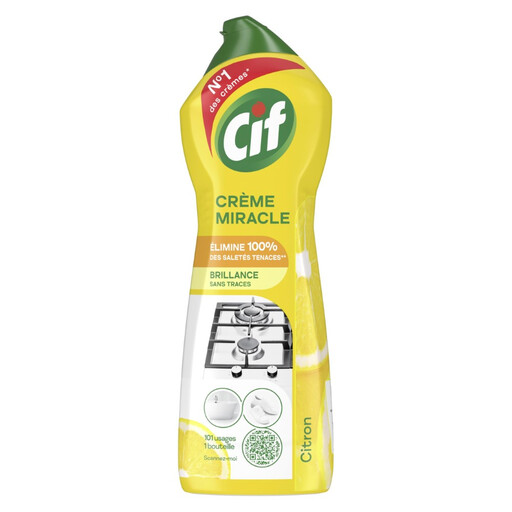
Why this choice suits this profile: Its 750 ml format and creamy texture are ideal for everyday kitchen and bathroom cleaning, without needing multiple products.
It is intended for hard surfaces, not laundry: this distinction reduces the risk of applying it to an incompatible fabric. Testing on an inconspicuous area is still recommended.
Creamy texture, lemon fragrance, and use on multiple kitchen and bathroom surfaces.
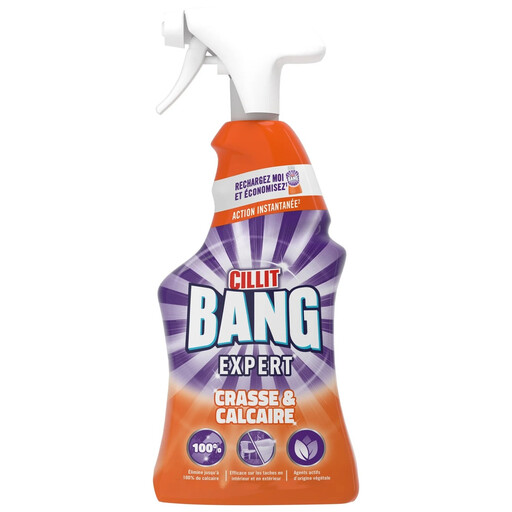
Why this choice suits this profile: This spray targets limescale deposits, soap residue, and bathroom soiling. Its refillable bottle is compatible with certain refills from the range.
Its use is clearly aimed at the bathroom and certain indoor or outdoor surfaces: it does not, therefore, replace a laundry stain remover.
750 ml spray format, foam, formula claimed to limit redeposition, and refillable bottle.
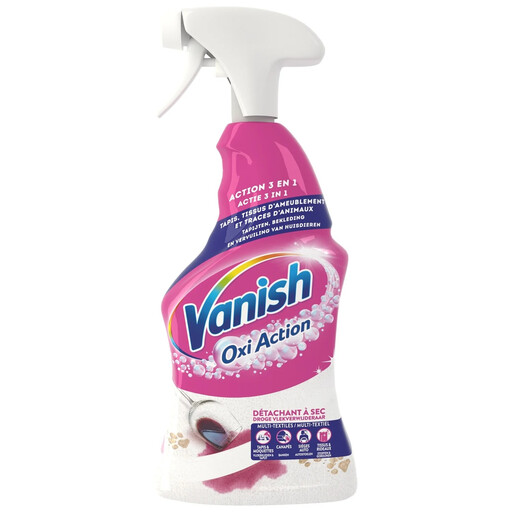
Why this choice suits this profile: This format is designed to treat stains locally on carpets, fabrics, and rugs, particularly in homes with children or pets.
The instructions recommend testing on an inconspicuous area first and exclude wool, silk, and leather: these limitations must be respected.
500 ml spray, local application, claimed use without pre-treatment, and suitability for carpets, fabrics, and rugs according to the instructions.
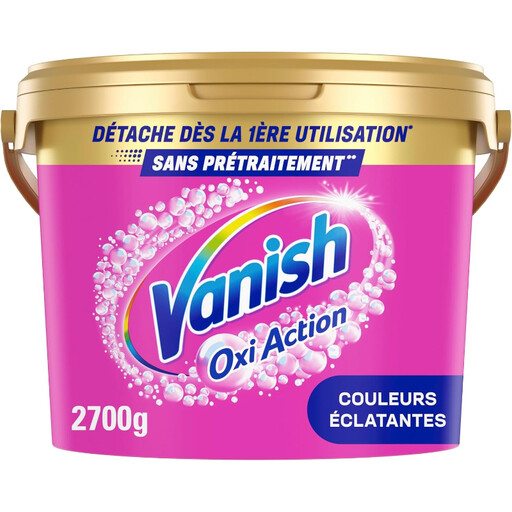
Why this choice suits this profile: The 2.7 kg pack is ideal for households that regularly use a stain removal powder in the machine or as a pre-treatment.
The instructions specify dosages, temperature limits, and excluded materials, including wool, silk, and leather. Do not mix products randomly and do not exceed the stated time.
Large format, formula claimed to be chlorine-bleach-free, use in washing, and pre-treatment option according to the manufacturer's instructions.
We've compiled a comprehensive, real-time updated list of products that fully meet these strict selection criteria and European safety regulations.
Choose it based on the origin of the stain. A spray or gel is suitable for local application before washing, while a powder can be added to the laundry or used for soaking. Always check compatibility with colours and fibres.
The shelf life depends on the labelling and storage conditions. Keep the product in its original packaging, tightly closed, away from heat and sunlight. If its texture, smell, or colour changes, consult the instructions before use.
No, unless the instructions explicitly allow it. A multi-surface cleaner or descaler is formulated for hard surfaces, whereas a laundry stain remover must comply with washing instructions and the fabric's composition.