
Livraison le jour même ou le lendemain

Qualité garantie

Débloquez vos offres de bienvenue: Livraison GRATUITE | Jusqu'à -80 % | 30 jours d'essai gratuits à JoyPlus
Téléchargez l'application
A coffee stain on a car seat, a muddy mark on a carpet or a small pet accident on a sofa cannot always be cleaned in the same way. Choosing between a fabric stain remover, a cleaning spray and a spray-extraction machine depends on the textile, the surface to be treated and how often it will be used.
Before you reach the checkout, it is worth knowing the main pitfalls to avoid an unnecessary expense.
A gel or spray works directly on the fibres. It is suitable for pre-treating a garment or cleaning a small stain on a carpet. A portable spot cleaner, on the other hand, sprays a solution and then vacuums up the dirty water. It is better suited to carpets, sofas, stairs and car seats.
Buying a bulky machine to treat only a few garments would therefore be excessive. Conversely, a simple carpet stain remover may struggle with regular soiling or liquid spilled over a large area.
Electrical power alone is not enough to assess a machine’s performance. You should also look at suction capacity, spray efficiency, hose length and tank capacity. A powerful spray-extraction cleaner with small tanks may force you to stop frequently to refill it.
At home, concrete specifications such as 330 W, 750 W, 1.9 litres or 2.8 litres are generally more meaningful than a vague promise of deep cleaning.
Wool, silk, leather, suede and certain treated fabrics may react badly to moisture, heat or bleaching agents. A product described as versatile is not necessarily compatible with every surface.
Check the garment label or the sofa manufacturer’s recommendations. Always test the product on an inconspicuous area and avoid mixing different cleaning products.
On a spray-extraction machine, two separate tanks are particularly practical: one holds clean water, while the other collects dirty water. After each use, empty, rinse and leave them to dry.
A hose-rinsing tool can also help prevent residue from building up. This step is important for avoiding unpleasant smells and maintaining the fabric cleaner’s performance.
Weight, cord length and hose length have a direct impact on ease of use. A 5.9 kg machine with a 7.5 m cord does not offer the same freedom of movement as a rechargeable 1.5 kg model. Noise levels, sometimes above 70 dB, also deserve attention if you live in a flat.
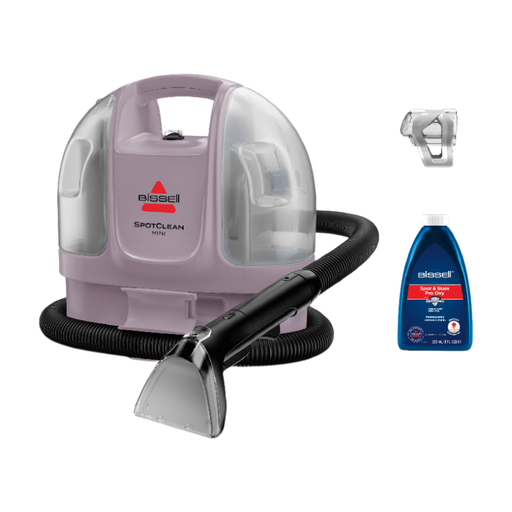
Why this choice suits this profile : Weighing 3.4 kg, it is suitable for small cleaning jobs on carpets, upholstery and car seats, without the bulk of a full-size machine.
It avoids overbuying for a few occasional stains. Its 0.5 l and 0.43 l tanks are best suited to spot cleaning.
330 W motor, stated suction of 12 kPa, 3.6 m cable, 10 cm brush and HydroRinse tool.
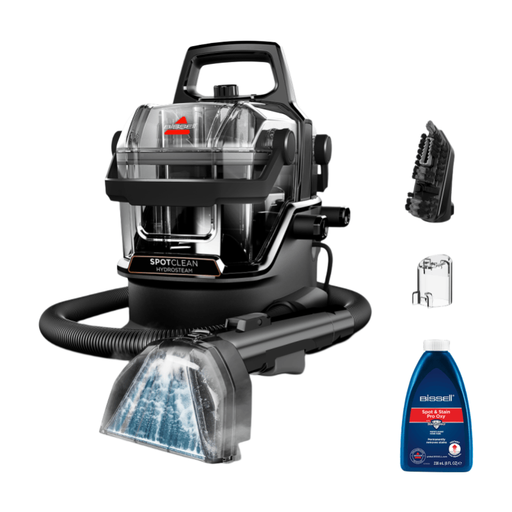
Why this choice suits this profile : Its three modes and steam function tackle sticky or greasy dirt on different surfaces around the home.
It does not rely solely on motor power: spraying, brushing and suction work together in a single pass.
1,000 W power, 1.9 l and 1.5 l tanks, hose-rinsing tool and accessories for fabrics, seals and car interiors.
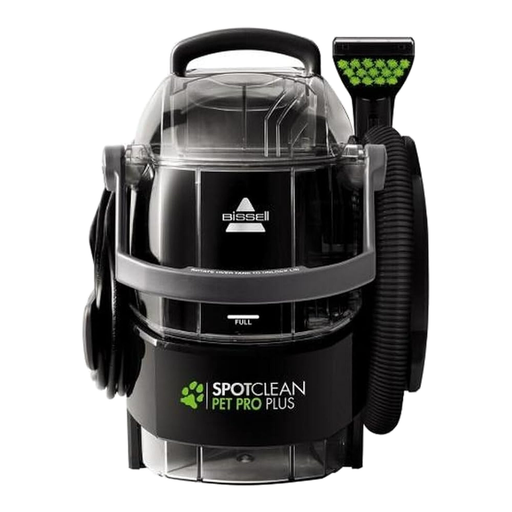
Why this choice suits this profile : Households with pets and motorists who clean frequently benefit from larger tanks and accessories designed for stubborn dirt.
Its separate 2.8 l and 2.2 l tanks reduce interruptions. The Stain Trapper helps contain dirt and recovered water directly in the accessory.
750 W power, 7.5 m cord, 1.52 m hose, Stain Trapper tool and HydroRinse system.
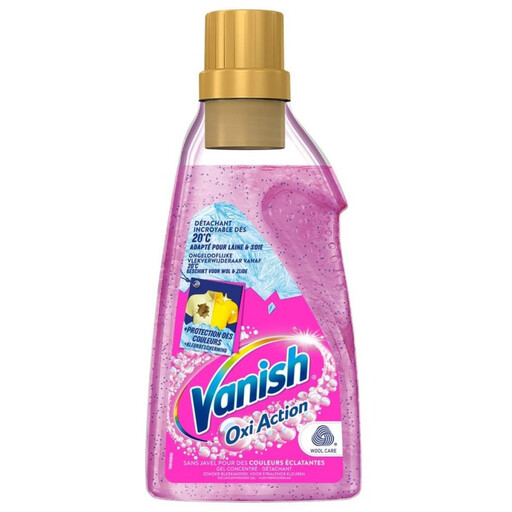
Why this choice suits this profile : With its 1.5 l gel format, it fits easily into the washing routine of households that regularly remove stains from their laundry.
It is designed for laundry, not surfaces such as wood or metal. Its cap with a built-in scrubbing tip makes it easier to apply to a specific area.
Formula containing oxygen-based bleaching agents, large format and stated suitability for wool and silk according to the product information.
We have brought together a complete, real-time updated selection of products that meet these demanding criteria while complying with European safety regulations.
Take particular care with products containing oxygen-based agents, flammable sprays and solutions that may irritate the eyes. Never mix different cleaning products.
Choose a product specifically intended for fabric upholstery or a spray-extraction machine designed for sofas. Check the fabric’s care code and always test the product on a hidden area. Effective suction helps reduce residual moisture.
It depends on the machine’s power, how long it is used and the number of passes. Smaller models generally have smaller tanks and are suitable for touch-ups. Larger machines use more water per session but need refilling less often when cleaning a larger surface.
Follow the expiry date and storage conditions shown on the packaging. For a machine, empty and rinse the tanks after each use, clean the filter and allow the accessories to dry before storing them. This maintenance helps preserve the fabric cleaner’s performance and reduce odours in the hose.